

Tamil Nadu’s link to the first amendment to the Constitution is better known in this part of the country, as the amendment, among others, helped to create a system of reservation in education and public employment for the Backward Classes. But what does not figure much in public discourse is another link of the State with the amendment that deals with the concept of freedom of expression in general and freedom of the press in particular. The Constitution had to be amended in the light of the Supreme Court’s landmark judgment in the Romesh Thappar [sic] vs State of Madras, also known as the Cross Roads case. Moreover, The Hindu, on the day (May 27, 1950) it carried the judgment as a news item, said, “This was the first case in which violation of Article 19(1) (a) of the Indian Constitution conferring the right to freedom of speech and expression was alleged.”
Though the case directly dealt with the State government imposing a ban on the entry and circulation of Cross Roads, an English journal published from Mumbai, the trouble for the journal began with the decision of the government of Maharashtra (which was then called Bombay) in July 1949, prohibiting the editor, Romesh Thapar, from publishing the magazine for three months under the Public Security Measures Act. Section 9 of the Act, under which the ban order was passed, “empowers the Government to prohibit the publication of a newspaper or a periodical if they are satisfied that its activities are prejudicial to the public safety, maintenance of public order or tranquillity of the province,” reported this newspaper on August 19, 1949.
Challenged in High Court of Bombay
The order was challenged in the High Court of Bombay. But Justice N.H.C. Coyajee of the High Court dismissed the petition in mid-August, saying, “The only test in the circumstances of the case” was the opinion of the government and nothing else in as much as it was the subjective process that was referred to in the relevant Section of the Act: “the satisfaction of the Government”, this newspaper reported. A few months later, when the Madras Legislative Assembly and Council debated on the Madras Maintenance of Public Order Bill, 1949, some of the members expressed apprehension over the possible misuse of the legislation, as the government had referred to “violent acts” of Communists as a justification for the Bill. A. Lakshmanaswami Mudaliar, who was in the Opposition, advised the government to bring forward pieces of legislation backed up by public opinion.
On March 1, 1950 came the Madras government’s ban on Cross Roads, regarded widely as a Left-leaning journal. On April 21, the matter came up before a full Bench of the Supreme Court. C.R. Pattabhi Raman, arguing for the petitioner, submitted that the ban on the journal was illegal, as it had violated the right to freedom of speech and expression under Article 19 of the Constitution. “K. Raja Aiyar, Advocate General of Madras, conceded that there was no doubt a restriction on the petitioner’s right of expression. But the State of Madras had only prohibited the petitioner’s expression from reaching Madras. To prove the validity of the Madras ban on the weekly, Mr. K. Raja Aiyar contended that the three expressions — security of State, public safety, and public order — were equivalent in their meaning, which the court declined to accept,” according to The Hindu on April 22, 1950. When the court reserved judgment on April 24, Chief Minister P.S. Kumaraswami Raja was present in the court hall, a rare occurrence.
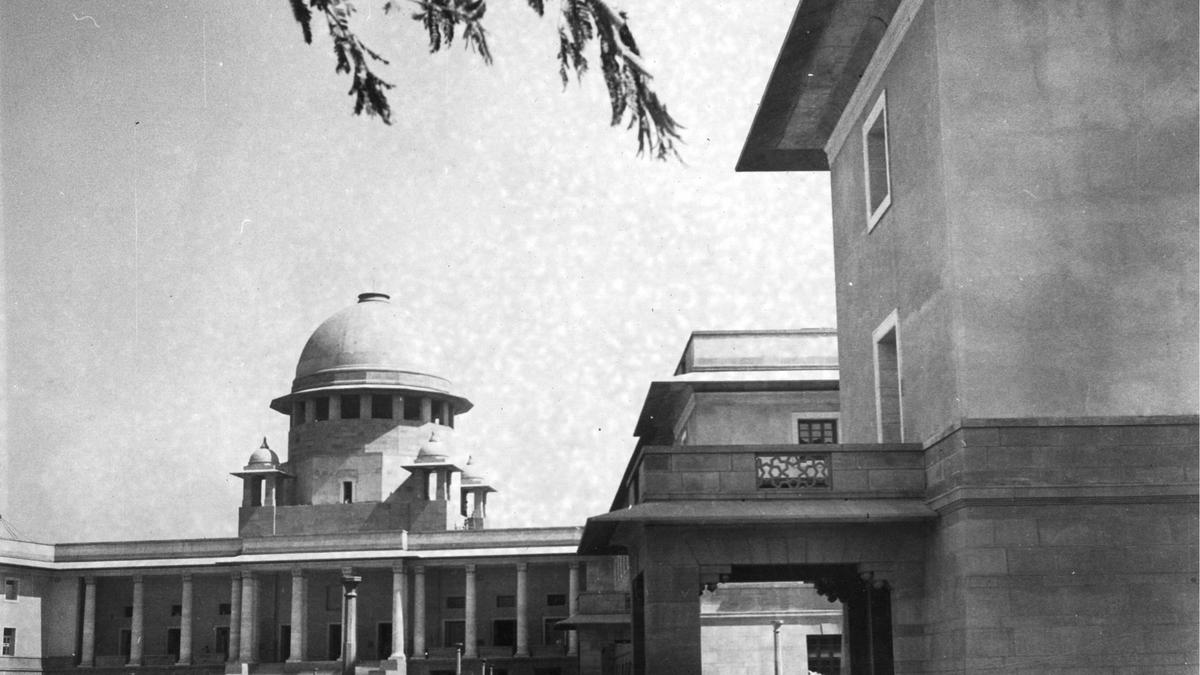
A month later, the Supreme Court’s full Bench, by five to one, quashed the State government’s ban. The contentious provision — Section 9 of the Madras Maintenance of Public Order Act — was declared ultra vires the Constitution. The judgment allowing the petition was delivered by Justice M. Patanjali Sastri with whom Chief Justice of India Hiralal J. Kania, Justice Sudhi Ranjan Das, Justice B.K. Mukherjea, and Justice Mehr Chand Mahajan concurred, while the dissenting judge was Justice Saiyid Fazal Ali.
Deletion of ‘sedition’
Referring to the deletion of the word, ‘sedition’, which occurred in Article 13 (2) of the draft version of the Constitution, from the final version, Justice Sastri observed that this showed that the “criticism of Government exciting disaffection or bad feelings towards it is not to be regarded as a justifying ground for restricting the freedom of expression and of the press, unless it is such as to undermine the security of or tend to overthrow the state.” He said, “Unless a law restricting freedom of speech and expression is directed solely against the undermining of the security of the state or the overthrow of it, such law cannot fall within the reservation under Article 19 (2) of the Constitution, although the restrictions which it seeks to impose may have been conceived generally in the interests of public order.” He concluded that Section 9 of the State’s law fell outside the ambit of Article 19 (2). But Justice Fazal Ali held that the restrictions, authorised by this Section, were within the Article concerned.
“There is a limit to the licence that one can allow at any time, more so at times of great peril and danger to the state,” Prime Minister Jawaharlal Nehru said in Parliament on May 16, 1951, while introducing a motion to refer the Constitution Amendment Bill to a Select Committee.
| Photo Credit:
The Hindu Archives
A year later, Prime Minister Jawaharlal Nehru, who introduced a motion in Parliament on May 16, 1951 to refer the Constitution Amendment Bill to a Select Committee, spoke for 75 minutes. He said, “Anything dealing with Fundamental Rights [referring to Article 19 (2)] incorporated in the Constitution is of even greater importance.” His government had brought forward the Bill “in no spirit of light-heartedness, in no haste, but after the most careful thought and scrutiny given to this problem”.
On the criticism against his government for putting a curb on the freedom of citizens or the press, Nehru clarified, “This Bill only perhaps clears up what the authority of Parliament is. We are not putting down any kind of curb or restraint. We are removing certain doubts so as to enable Parliament to function if it so chooses and when it chooses (https://nehruarchive.in /documents/the-constitution-first-amendment- bill-16-may-1951-v9q861).”
He touched upon the role of the press in a democratic society and felt, “One has to face the modern world with its good and bad, and it is better, on the whole, I think, that we give even licence than suppress the normal flow of opinion.” At the same time, he added, “There is a limit to the licence that one can allow at any time, more so at times of great peril and danger to the state.” Ten days later, the Select Committee’s report on the proposed amendment was ready. It prefixed the term “restrictions” with “reasonable”.
Rajaji’s take
Before the Bill was adopted, Deshbandhu Gupta, veteran journalist and MP, urged Nehru not to go ahead with the amendment. Home Minister C. Rajagopalachari (CR or Rajaji) argued that the freedom of expression and speech was “a natural right which should be subject to natural restrictions”, this newspaper reported on June 1, 1951. With an “unprecedented majority”, Parliament adopted the Bill, with 246 members voting in favour and 14 against. J.B. Kriplani, Sucheta Kriplani, Shyama Prasad Mookerjee, and K.T. Shah were among those who voted against the Bill.
While scholars of contemporary history continue to be critical of Nehru for having amended the Constitution over the issue of freedom of expression, the Supreme Court’s judgment still receives commendation from different quarters worldwide, which think that the verdict is “still authoritative” in so far as it draws a distinction on the basis of whether such restrictions would be viewed as “reasonable”.
Published – January 02, 2026 05:30 am IST

