

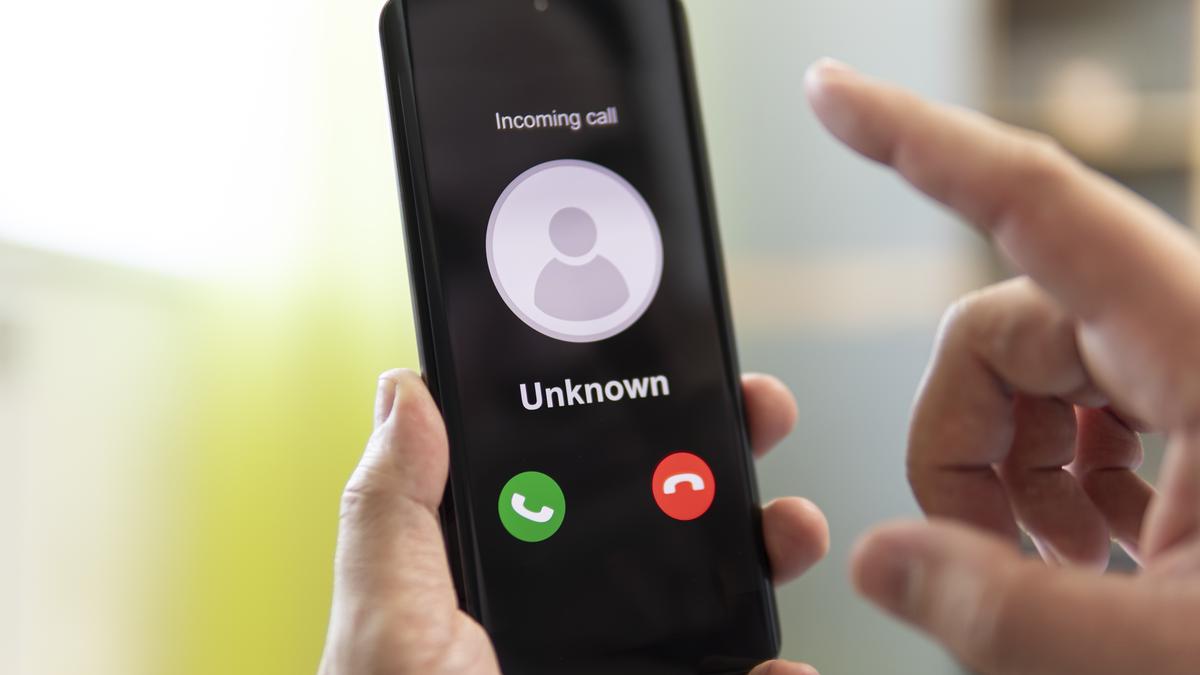
Representational image only. File
| Photo Credit: Getty Images/iStockPhoto
In the next few months, the Department of Telecommunications (DoT) will mandate telecom operators to show the KYC-registered name of all incoming callers using Indian phone numbers. Currently, a trial for this is ongoing in Haryana alone.
The feature, known as Caller Name Presentation (CNAP), will use the same technology that telecom operators such as Reliance Jio and Bharti Airtel use to flag certain calls as “Suspected” or “Suspicious,” but instead of those words, the caller ID will display the name a number was registered with.

The move has been proposed since 2022 as a key step in fighting fraud and spam calls, by allowing users to screen calls before they answer them. The move is aggressive — countries that have mandated CNAP, like Qatar, have only done so for corporates placing calls. The feature will be enabled by default, and users might have the choice to disable seeing the KYC name of people from whom they receive calls, with the corollary — concealing one’s name from call recipients — being available only to restricted line facility users, like Ministers and top government officials.
Anti-spam move
With the move, the DoT and the Telecom Regulatory Authority of India (TRAI), which released recommendations earlier this year on the facility at the former’s request, said that scammers and spam callers would find it harder to have their calls answered, especially now that all call recipients would be able to screen to whom a certain incoming call’s number corresponds.

The Cellular Operators Association of India (COAI), which supported the move, expressed reservations during a 2022 consultation by the Telecom Regulatory Authority of India. “Under CNAP, there may be genuine cases wherein some users are not keen to share their name,” the industry body said in a filing. COAI represents Airtel, Jio, and Vi.
Other industry groups and one civil society organisation, the Internet Freedom Foundation, raised privacy concerns, particularly for women.
However, the DoT pushed ahead, as this would only disclose the identities of people placing a call, and not expose the identities of people being called; Truecaller, a popular service that provides crowdsourced identity information for incoming calls, allows users to look up a number’s registered owner without receiving a call from them. The DoT did not respond to a questionnaire on the progress of the Haryana pilot, where operators are testing their systems to ensure that the KYC-registered names can be retrieved from their databases and displayed to call recipients in time.
On by default
In 2024, TRAI dismissed these privacy concerns, and pointed out in its recommendations that a facility called Caller Line Identification Restriction (CLIR) permitted users to withhold their identity if needed. This facility is available to top government officials, Ministers, the President, and intelligence agencies. CLIR masks the number from which an individual’s phone call is coming.
“The DoT, which had sought TRAI’s recommendations on this issue, and is overseeing the pilot in Haryana, sought a key modification to TRAI’s recommendations: while the telecom regulator recommended an opt-in approach, where users would sign up for CNAP, DoT said it should be enabled by default. TRAI received this feedback as a so-called “back-reference,” a formal request to amend its recommendations, and “noted” the input, clearing the way for CNAP’s rollout on most smartphones, with feature handsets as an issue that DoT said would be looked into by the Ministry of Electronics and Information Technology (MeitY).
Published – December 03, 2025 12:27 pm IST

