

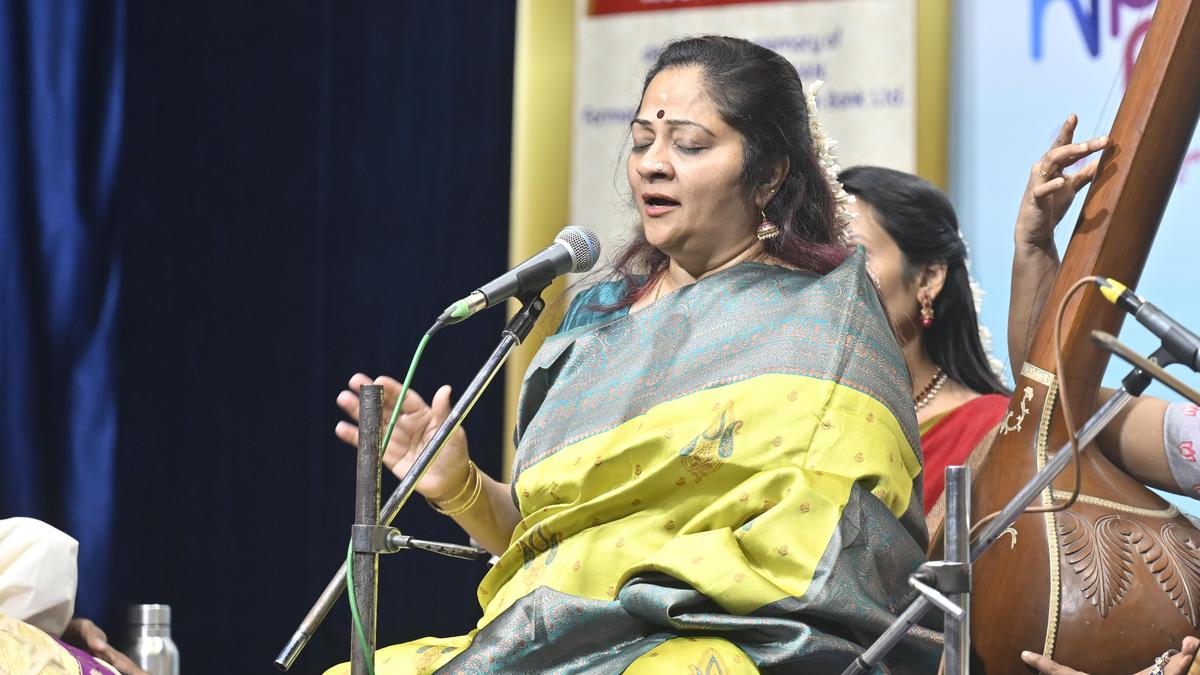
S. Sowmya performing at The Mylapore Fine Arts Club.
| Photo Credit: AKHILA EASWARAN
A musician of rare calibre, S. Sowmya possesses a sensibility attuned to the finer aspects of her art. Unwavering in her commitment to classicism, she offers listeners profound insights in her concerts.
Her repertoire often foregrounds lesser-known kritis, and the recital at the Mylapore Fine Arts Club was firmly in that mould. Indeed, the first five songs she presented belonged entirely to this category. Sowmya was accompanied by her regular collaborators Embar S. Kannan (violin), Neyveli R. Narayanan (mridangam) and G. Chandrasekara Sharma (ghatam).
Sowmya began with a vivadi touch in the form of Walajapet Venkataramana Bhagavatar’s ‘Anandamaya manave’ in Jyotiswarupini. She topped it with a lively swarakalpana, with Kannan relishing the early exchanges.
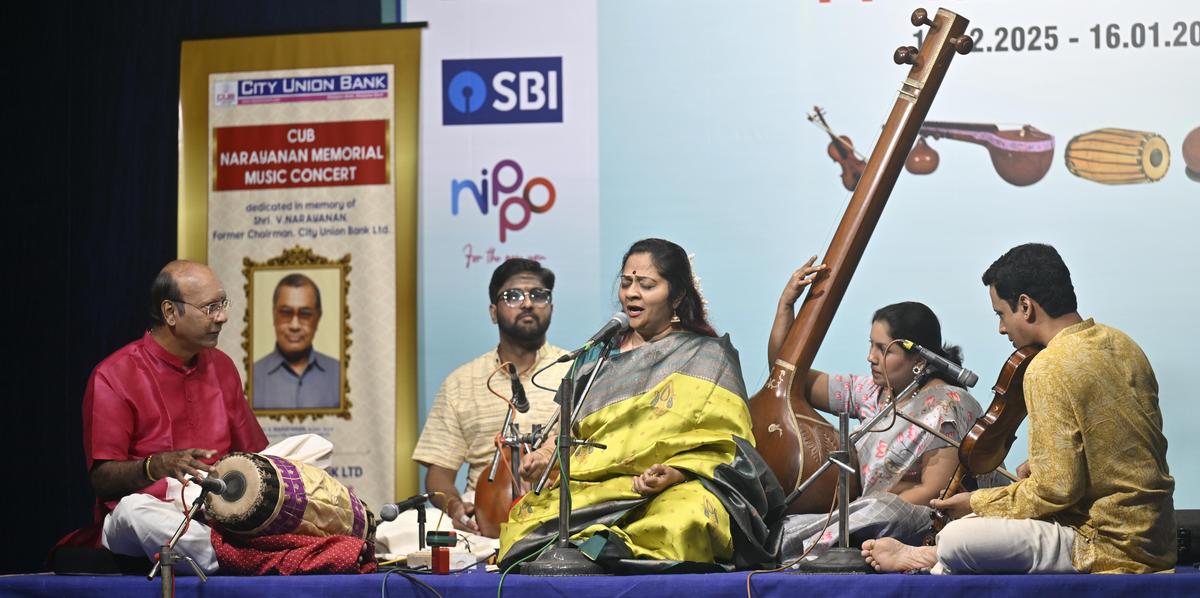
Sowmya accomapnied by Embar Kannan (violin), Neyveli R. Narayanan (mridangam) and G. Chandrasekara Sharma (ghatam).
| Photo Credit:
AKHILA EASWARAN
If the first piece hinted at the concert’s course, the second was an intriguing statement in itself. Sowmya presented a Husseni alapana that stood apart from contemporary practice. The vakra sampurna-sampurna raga, as commonly heard today, employs chatusruti dhaivatam in the ascent and its suddha variant in the descent. Her interpretation, she said, dispensed with the suddha dhaivatam altogether, using only the higher note throughout. She later explained that this was the raga’s original formulation, the lower note having crept into usage over time. While the alapana and the rendition of Vallalar’s Tiruvarutpa ‘Enna punniyam seydeno amma’ naturally sounded a shade different, they retained the raga’s innate elegance.
Muthuswami Dikshitar’s ‘Sri guruna palitosmi’ in Paadi, a raga derived from Mayamalavagowla, followed. The speciality of the kriti, which extols the guru embodied as Shiva, lies in its consistent use of antya prasa (ending-syllable alliteration) on ‘na’ for poetic effect. The lyrical import and the musical structure vest the composition with solemnity, a quality emphasised in the rendition and extended through the swara sequence with the violinist.
A bhava-laden Gowrimanohari alapana preceded Papanasam Sivan’s ‘Gowrimanohara karunakara’, which was echoed by Kannan. The niraval and swara segments at the charanam line ‘Taratalam pugazh’ were absorbing, especially in the second speed. Sowmya then rendered Gopalakrishna Bharati’s ‘Vandalum varattum’ in Balahamsa with a measured gait, deftly articulating its characteristic, zigzag ma-ga-ma-ri-sa phrase. The ensemble displayed compelling synergy in Tyagaraja’s Pantuvarali kriti ‘Vadera deivamu’, delivered in a gripping kalapramanam, and in the niraval and swarakalpana at the charanam line ‘Dhatru vinutudaina’.
The main raga of the evening was Bilahari. Sowmya developed it methodically, deploying compact phrases to telling effect, before easing into longer, more expressive arcs. The vocalist’s exposition was well complemented by Kannan’s violin essay. It had to be a Dikshitar kriti for topicality’s sake — the 250th birth anniversary — and ‘Kamakshi sri varalakshmi’ it was. After a serene rendition, the vocalist and violinist offered engaging swara passages, particularly in the second speed, underscoring panchama nyasam. In the ensuing tani avartanam, Narayanan and Chandrasekara Sharma engaged in a spirited rhythmic dialogue in two-kalai Adi tala, culminating in a crisp korvai.
The post-tani section comprised ‘Parulanna mata’, a Kapi javali by Dharmapuri Subbarayar, a Kavadi-chindhu, Poochi Srinivasa Iyengar’s Purnachandrika thillana and the Tiruppugazh ‘Thullumadha velkai kanaiyale’ in Hamsanandi. The recital presented a rich compositional canvas, sourcing from 10 composers for its 11 songs, with Dikshitar featuring twice.
Published – December 31, 2025 04:34 pm IST

