

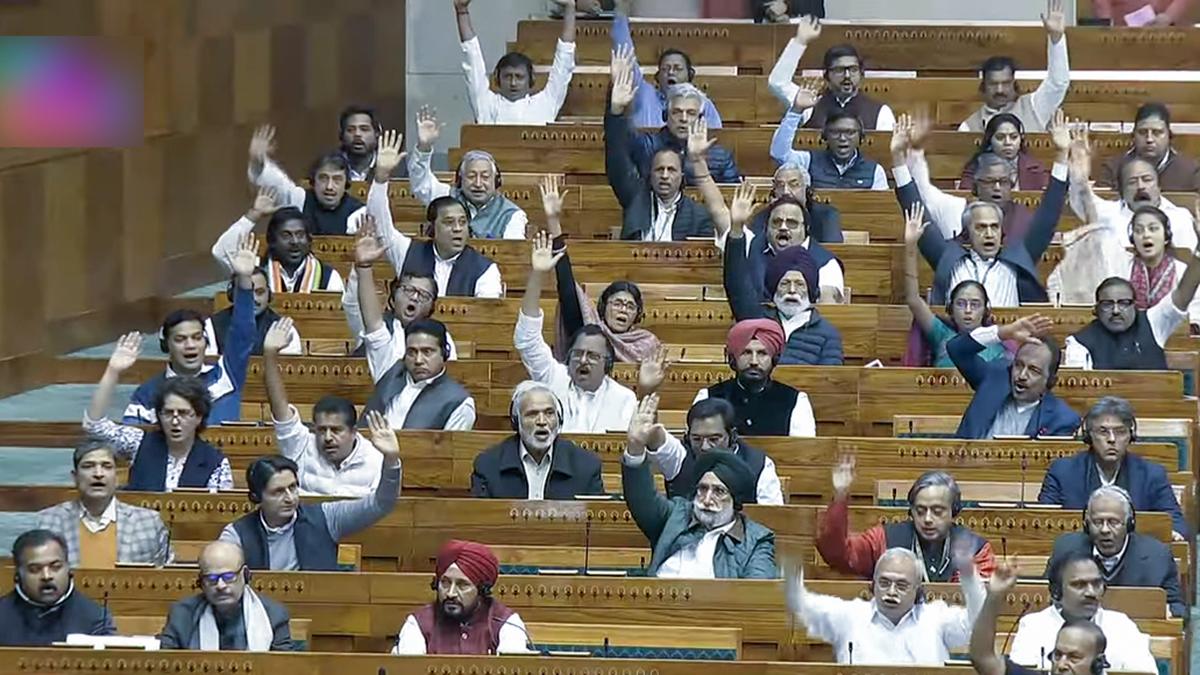
The Constitution (One Hundred and Twenty-Ninth Amendment) Bill, 2024, introduced in the Lok Sabha on December 17, 2024, mandates a fixed five-year term for the Lok Sabha, with State Legislature elections aligned to this cycle. If the Lok Sabha or any State Assembly is dissolved before completing its full term, mid-term elections will be held only for the remainder of the five-year term. Should legislatures in India have fixed tenures? P.D.T. Achary and M.R. Madhavan discuss the question in a conversation moderated by Aaratrika Bhaumik. Edited excerpts:
Do fixed legislative tenures promote better governance by reducing the disruptions of frequent elections?
 P.D.T. Achary: It is worth questioning whether this Bill and the proposal for simultaneous polls are necessary at all. The claim that such a system will reduce electoral expenditure lacks credibility. A portion of the expenditure is allocated by the Election Commission and State governments through budgetary provisions from the Centre and the States. However, the majority of election spending is incurred by political parties. Even if some costs are saved, it is improbable that political parties would redirect these funds toward development or infrastructure projects. More importantly, frequent elections enhance political accountability, compelling representatives to regularly engage with the electorate.
M.R. Madhavan: This Constitution Amendment Bill does not propose a fixed term for legislatures, as it allows for mid-term elections. It ensures accountability to the legislature, in line with the core tenet of the parliamentary system. By permitting mid-term elections, the Bill is also in conformity with the basic structure of the Constitution. The key change, however, is that in the event of a mid-term election, the term of the newly elected legislature will be shorter than five years. Whether this improves governance is uncertain. However, it does not provide the same stability as the U.S. presidential system for instance, where the incumbent President can only be removed through impeachment.

Does aligning the tenure of State Assemblies with that of the Lok Sabha compromise federalism and pose a threat to political plurality?
M.R. Madhavan: I find the Bill symmetrical since it also aligns the tenure of Parliament with that of State Assemblies. For instance, if the central government collapses after three years, fresh elections will be conducted for the Lok Sabha, and the newly elected legislative body will serve only a reduced term of two years. Therefore, I don’t think State Assemblies are being aligned with Parliament. Rather, the Bill standardises the timing of all elections to a common date. I do not see any threat to federalism in this approach.
Also read | BJP’s P.P. Chaudhary to lead panel on simultaneous polls
The argument that simultaneous polls would drive voters to select the same party for both the Centre and the State Assembly is flawed, as it underestimates the electorate’s intelligence. Historical examples, such as the 2014 elections in Delhi, demonstrate that voters can and do make distinct choices. Despite the BJP’s overwhelming victory at the Centre, voters elected the AAP in the State Assembly — despite both polls being held within six months of each other.
P.D.T. Achary: For the first time, this Bill seeks to make the tenure of State Assemblies contingent upon that of Parliament. For instance, if Parliament completes its full term while a State Assembly is only in its second year, the Assembly would be prematurely dissolved, with elections held concurrently with Parliament. This approach undermines the principles of federalism. Under the existing constitutional framework, State Assemblies function as autonomous legislative bodies. This Bill seeks to alter their independent tenure, a crucial attribute of the federal structure.
Could such a system discourage attempts to destabilise governments and curb practices like horse-trading?
P.D.T. Achary: This is a novel proposal, and it is difficult to predict whether such a system can effectively deter these practices at this stage. However, a greater concern lies in the potential erosion of India’s identity as a federal republic, which is rooted in the autonomy of its legislative bodies.
Also read | Why simultaneous elections are impractical and complicated
M.R. Madhavan: My understanding of the Bill is that it aligns the tenure of State Assemblies with Parliament for the first time. However, after a few electoral cycles, if a mid-term election occurs for Parliament, State Assemblies will continue and will not be dissolved.
Recent large-scale defections in Madhya Pradesh and Karnataka, where MLAs resigned or were disqualified, triggered by-elections. However, I doubt the Bill will curb such practices. A more significant concern is the dissolution of the House. If a government falls after three and a half years, mid-term elections will be necessary, taking an additional 4-6 months. This would result in a Lok Sabha with a tenure of one year or less, which I believe is undesirable.
Does the Bill adequately account for political exigencies? For instance, if the ruling party splits but the breakaway faction refuses to side with the Opposition.
M.R. Madhavan: I believe the Bill effectively addresses such contingencies. For instance, the 2013 Delhi and 2005 Bihar legislative assembly elections resulted in hung assemblies. The Bill resolves such deadlocks by allowing fresh elections to take place. The only difference is that the newly elected legislature will serve a reduced tenure rather than the full five years.
Also read | ‘One Nation, One Election’ Bill threatens to alter India’s polity forever, says T.N. CM Stalin
P.D.T. Achary: The Constitution prescribes a five-year term for State Assemblies and the Lok Sabha but allows for their dissolution to address political exigencies. This flexibility reflects a pragmatic approach to governance. While fixed legislative tenures provide stability, the option to dissolve legislatures is crucial for addressing political instability. For instance, State governments have often dissolved Assemblies to seek a fresh and decisive mandate through mid-term elections—a contingency the Bill fails to adequately address.
Could the German model of a constructive vote of no-confidence help resolve political stalemates?
P.D.T. Achary: Such a proposal was rejected by the high-level committee led by former President Ram Nath Kovind. It has also been deliberated upon previously, but I doubt its adoption is feasible in India.
Also read | The misplaced move of ‘one nation one election’
M.R. Madhavan: I don’t think it is a viable option given our system. In most instances, when a ruling government loses a no-confidence motion, no alternative government commands a majority in the House. This could lead to a situation where the incumbent government remains in power but lacks the majority needed to pass essential bills or the budget.
The U.K.’s Fixed-term Parliaments Act of 2011, repealed in 2022, was criticised for triggering constitutional crises and policy paralysis. What lessons could this hold for India?
M.R. Madhavan: The Bill is being misunderstood as proposing fixed legislative tenures when it only introduces a “maximum term”. This is different from the system that existed in the U.K., where a newly elected legislature would complete its full five-year term, even if mid-term elections were to be held. In contrast, under the system proposed by the Bill, if the government loses the confidence of the legislative majority, mid-term elections will be called, and the newly elected legislature will then serve a truncated tenure.
Also read | Simultaneous polls — but only in a presidential system
P.D.T. Achary: In a country like ours, political instability is a real possibility, especially at the State level. While Parliament will continue to have its five-year tenure, States may encounter situations that necessitate mid-term elections, resulting in shorter tenures for state legislatures. I firmly believe that, despite its flaws, the current system should be preserved. The proposal for simultaneous elections risks creating unnecessary turmoil, and there is no compelling reason to pursue it at this juncture. The government should instead focus on tackling more pressing challenges that affect the people.
P.D.T. Achary, Former Secretary General of the Lok Sabha; M.R. Madhavan, Co-founder and president of the PRS Legislative Research

