

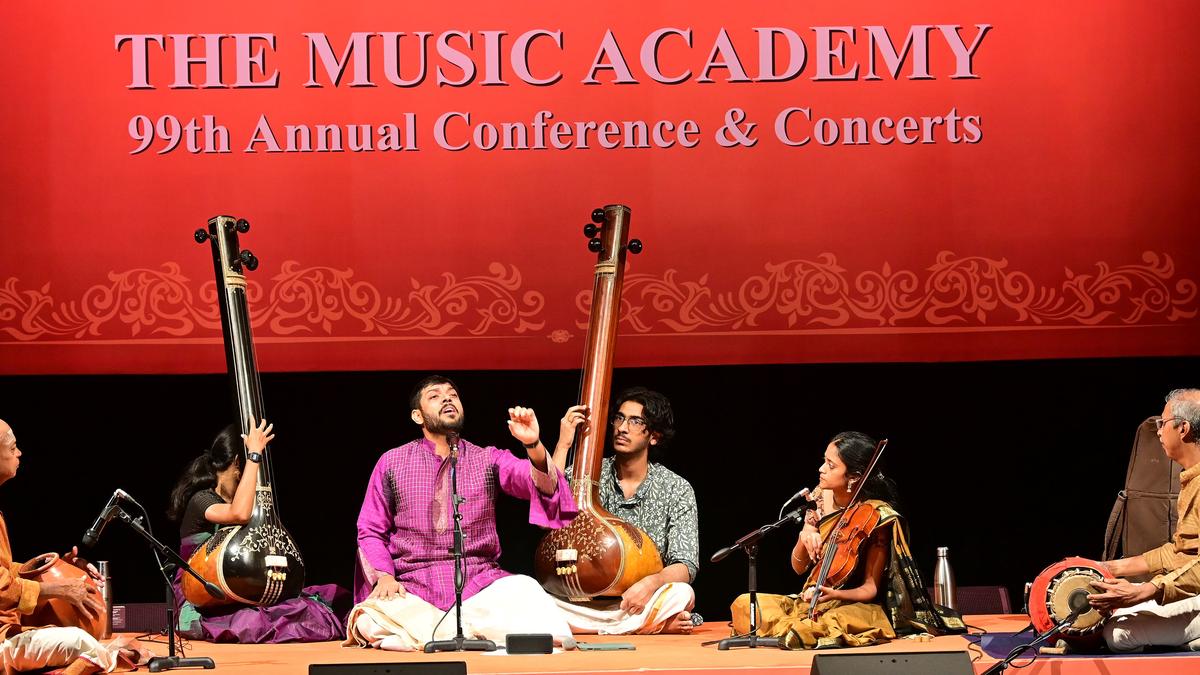
Rithvik Raja accompanied by Sruthi Sarathy on the violin, K. Arun Prakash on the mridangam and Madipakkam A. Murali on the ghatam.
| Photo Credit: K. Pichumani
Rithvik Raja is known for approaching his art with sensitivity and awareness, consistently shaping his concerts with a distinct outlook. This year at The Music Academy, his presentation featured three Dikshitar kritis, among other compositions. He was accompanied by Sruthi Sarathy on the violin, K. Arun Prakash on the mridangam and Madipakkam A. Murali on the ghatam.
Early in the kutcheri, niraval was presented for ‘‘Shri nathadi’ (Mayamalavagowla) and ‘Sarasa samadana’ (Kapi Narayani). Sruthi effectively magnified Rithvik’s ideas in these sections, while Arun’s steady tempo and use of contrast at appropriate moments helped build the concert in a thoughtful manner. Murali mirrored Arun’s approach and blended with the ensemble.
A ragamalika alapana with quick raga shifts created a sense of unpredictability about what raga would emerge next. Sruthi deserves appreciation for her responsiveness and ability to quickly perceive and follow Rithvik. This novel attempt connected well with the audience, as Rithvik clearly seemed to enjoy what he was doing. The rendition of this long kriti eschewed loudness and was presented at a sedate pace. While the alapana was engaging, it was doubtful whether the audience could decipher that it comprised the ragas of Dikshitar’s ‘Chaturdasha Ragamalika’, especially since the order was reversed.
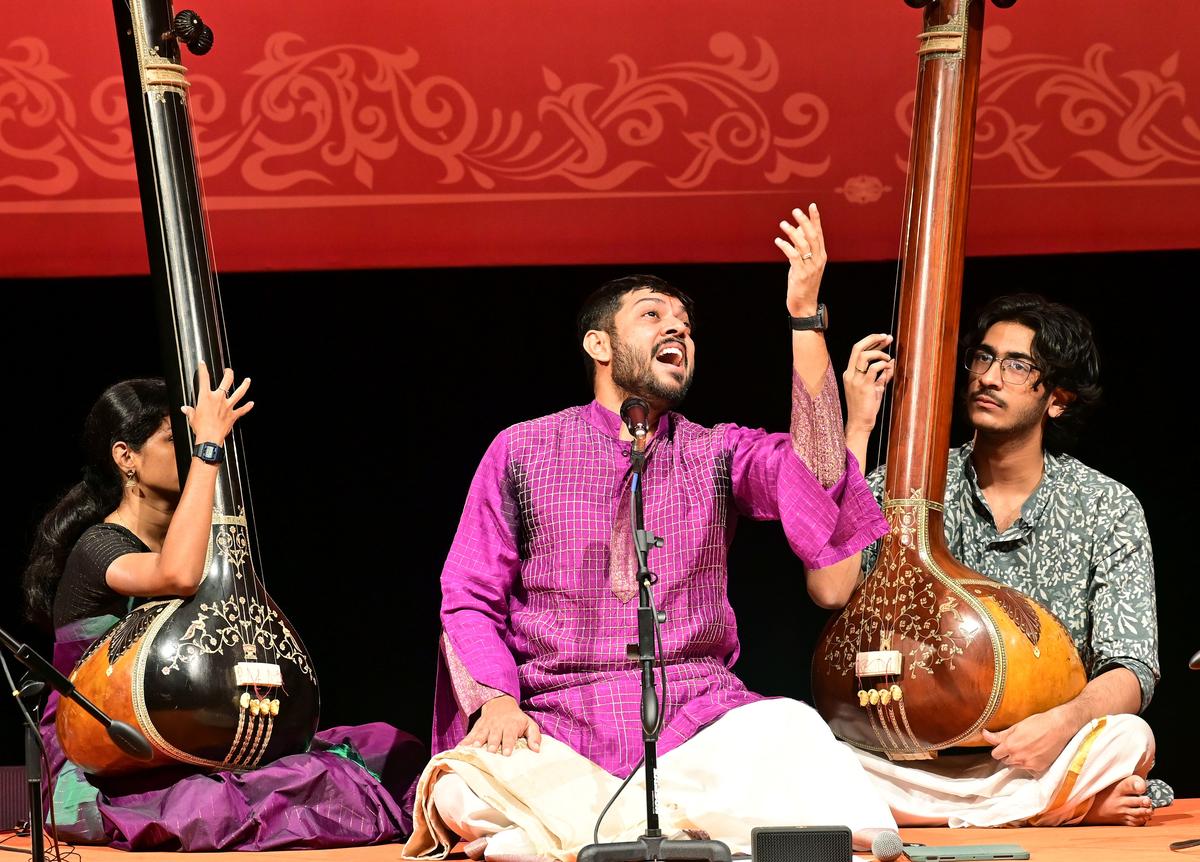
Rithvik’s presentation of ‘Balagopala’ stood out for its adherence to the Muthuswami Dikshitar sampradaya
| Photo Credit:
K. Pichumani
Rithvik’s presentation of the magnum opus ‘Balagopala’ stood out for its adherence to the Muthuswami Dikshitar sampradaya, with the shuddha daivatam (D1) featuring prominently. The manodharma sections comprised several relevant prayogas that highlighted this distinctive usage. From an academic perspective, presenting compositions in this manner is important to showcase Dikshitar’s unique approach. Rithvik excelled in this respect by demonstrating, in multiple ways, how the shuddha daivatam combines with the nishadam, with sparing use of the chatushruti daivatam (D2) in his alapana, lending a different shade to the raga. His niraval and kalpanaswara in ‘Vainika Gayaka’ were also centred on the D–N relationship and made for delightful listening. Some distinctive phrases in the nishadam to upper rishabham region stood out. Sruthi’s Bhairavi alapana sparkled with clarity.
More efficient time management could have allowed for a longer, more unhurried RTP; however, the vocalist and violinist presented a well-structured Purvikalyani RTP in Khanda Triputa.
Published – December 24, 2025 05:14 pm IST

