

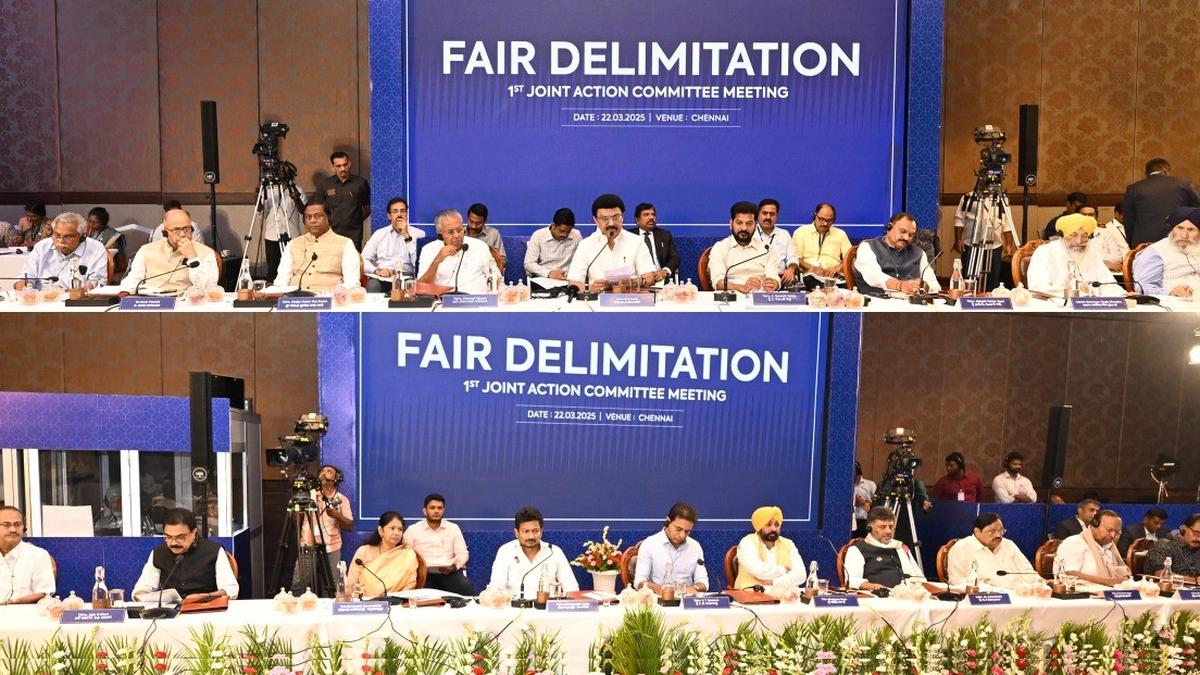
Leaders at the first meeting of the Joint Action Committee on Fair Delimitation, in Chennai. File photo: Special Arrangement
The southern States have found that reducing population growth and improving health and education have led to serious disadvantages. The immediate fallout is that the Finance Commission (FC) has reduced allocations to the south as population size carries 50% weight in the redistribution of Union tax revenue among States. The longer-term implication is more serious: according to the current proposals, the proportion of seats will remain the same but the gap in the absolute number of seats will widen in the run up to the 2029 elections, impacting southern States. Delimitation will be decided by a Delimitation Commission (DC) before 2029.
Should the southern States be punished for having invested better in health and education that helped reduce population growth, by having their Lok Sabha seats reduced and thereby losing relative political and fiscal power? Most of the population increase since 1991 has happened in the northern States, such as Bihar, Uttar Pradesh, Jharkhand, Madhya Pradesh, Rajasthan, and Chhattisgarh.
The possible solutions
The 84th Constitutional Amendment (2001) on delimitation has implications for representation, and the south needs to make its case urgently. The 84th Amendment Act extended the freeze on the number of seats from 2000 to 2026. It stated, “Keeping in view the progress of family planning programmes in different parts of the country, the government… decided…, as a motivational measure to enable State governments to pursue the agenda for population stabilisation,” that Lok Sabha seats shall “remain unaltered till the first census to be taken after… 2026.”
That is why the Census was delayed from 2021. The results are now expected by October 2028, after which the DC will be constituted and its recommendations announced, ahead of the 2029 Lok Sabha elections. Clearly, New Delhi always had this strategy of ensuring permanent power, by controlling the northern, more populous, States.
What are the solutions to prevent the unfair outcomes of delimitation to the south? Four alternative methods are conceivable. The first is to increase the total number of Lok Sabha seats, while retaining the current proportional distribution among States, using the 2011 Census as the basis. A redistribution based on the 2011 population, with no State losing seats, would result in a Lok Sabha of about 866 members. This might cause the least disruption. But it still does not solve the problem of States with higher population growth gaining more MPs.
The second is to raise the total number of Lok Sabha seats and also introduce equality among States in the Rajya Sabha (as is the case in the U.S. Senate), with each State having the same number of seats — for example, 10 seats per State — raising the total number of Rajya Sabha seats from 245 to 290. But the ruling party will oppose this as it would interfere with its goal of dominating the Lok Sabha.
The third is to raise the number of seats in Vidhan Sabhas to equalise representatives per 1,000 population for each State, leaving the Lok Sabha intact. In a large, federal country, this would improve representation in more populous States, particularly at the State level. But the ruling party will oppose this as well, since its eyes are on the Lok Sabha.
The last is to raise the total number of Lok Sabha seats, but change current ratios so that 60% of seats are allocated according to population size and 40% depend on efforts to reduce population growth. This would benefit States that have reduced their population growth (using a downward sliding scale). This could be a united negotiating position for the south.
Editorial | Counting matters: On delimitation, federalism, the Census
This is comparable to the principle for representation of 27 member States to the European Parliament (called the Degressive Proportionality principle). It ensures fair representation in legislative bodies such as the EU Parliament by giving larger countries more seats but fewer per person and giving smaller countries fewer seats but more representation per person. It balances population size with state equality to prevent total domination by large nations. It is a compromise between pure population proportionality (one person, one vote) and equal representation for all states. It means a vote in a small country has more weight than in a large one.
What’s going to happen in south India if delimitation takes place? | In Focus podcast
The principle to be used
This will also rely on a principle used in India by the FCs. The FCs have had to deal with complaints of unfairness: the legitimate complaint by the southern States is that they contribute the most, but receive less over time from each FC. To address this, FCs use multiple criteria to allocate funds. The first is income distance (equity) (with 50% weight). This means that States with lower incomes receive higher transfers. The second is population size, which reflects the expenditure needs of the States. Here, the FCs have used either the 2011 Census population to reflect current needs or the 1971 population to reward population control efforts. So, if the FC, a constitutional body, uses a method to reward population control, why can’t the DC? The third is demographic performance. This rewards States that have successfully reduced fertility rates. The fourth is tax effort. The FC rewards States that mobilise their own tax revenues effectively and thus encourages responsible financial management. The southern States have no choice but to join hands around the Degressive Proportionality principle, and build consensus before the Centre constitutes the DC.
Santosh Mehrotra, Former Professor of Economics, JNU, and currently Visiting Professor, Higher School of Economics, Moscow
Published – January 12, 2026 01:02 am IST

