

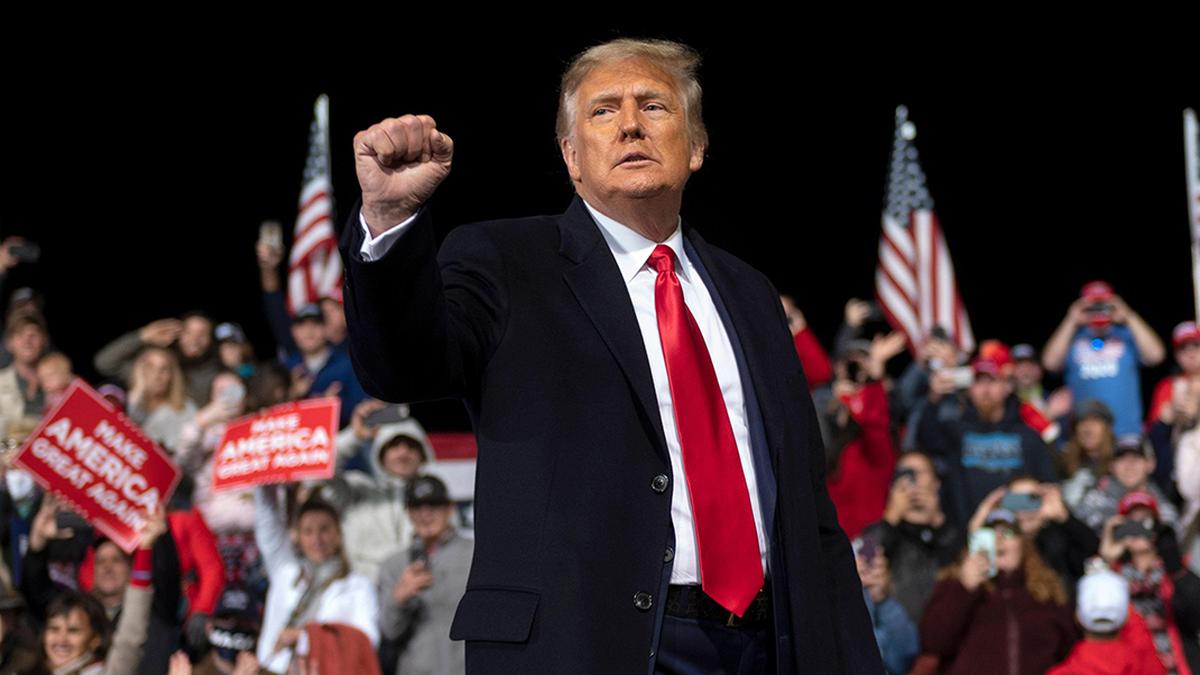
“‘Polarization’ refers to beyond America also”
| Photo Credit: AFP
Donald Trump’s victory in the 2016 U.S. presidential election prompted contemplation of a “divided” United States in terms of politics and society, bolstered by waves of fake news amid a post-truth era. In his book Polarization: What Everyone Needs to Know (2019), academic Nolan McCarty explores the social, economic, and geographic factors that contribute to polarisation in America, walking readers through both what is known and unknown about the causes, evolution, and ramifications of the nation’s growing political conflicts.
America has recently appeared to be defined by profound political, cultural, and societal divides as Mr. Trump won a second term in 2024. And along with nine other words, “polarization” was chosen as the 2024 word of the year by Merriam-Webster, the U.S.’s premier dictionary.
The term “polarization” — defined as “division into two sharply distinct opposites; especially, a state in which the opinions, beliefs, or interests of a group or society no longer range along a continuum but become concentrated at opposing extremes” — has become widely used in the media and in public discourse, and has become a significant aspect of modern life. While MSNBC perceived the 2024 presidential election as having left America “more polarized than ever”, and Fox News reports that “[Vice-President-elect J.D.] Vance’s debate answer on immigration crisis shows voter polarization”, Forbes has cautioned that “cultural polarization is becoming a pressing challenge” in workplaces. Indeed, in October, Merriam-Webster stated that new terms such as “far left” and “far right,” as well as “MAGA” — the abbreviation for Mr. Trump’s divisive “Make America Great Again” movement — would be included in its dictionary in 2024. Vice-President Kamala Harris warned of fascism under Mr. Trump during the heated election, while Mr. Trump used derogatory language and said his opponent was running on “destruction”. The election was so divisive that many Americans believed that the other candidate posed an existential threat to the U.S. when they cast their ballots.
About eight out of 10 Harris supporters were very or somewhat concerned that Mr. Trump’s beliefs, but not Harris’, were too radical, while roughly seven out of 10 Trump supporters felt the same way about Ms. Harris, but not Mr. Trump, according to AP VoteCast, a poll of over 1,20,000 people.
The usage of the word is one aspect that is not polarised. According to Peter Sokolowski, editor at large for Merriam-Webster, “it’s something that actually everyone agrees on,” to put it in a slightly sardonic way. However, “polarization” has more than only political meanings. The controversy over Taylor Swift’s use of a private jet and the Drake-Kendrick Lamar feud (they are rappers) are perceived to be polarising.
“Polarization” refers to beyond America also. Globally, centrist policies are being destroyed. Maybe Emmanuel Macron, the centrist French leader, or Olaf Scholz, the centre-left German leader, can better attest as to what it means if society is increasingly polarised. The insanity of the “other side” — in our politics, at work, or at home — confounds us. Even the “us vs. them” rift may frequently be trembling a political society such as ours.
A germination that began much earlier
However, to believe that polarisation is as recent as Mr. Trump’s presidency or that Trump or Trump-like individuals are to blame for today’s polarised world would be a grave mistake. The seeds were sown a long time ago. Although it is evident from the current political environment that extreme viewpoints are growing in popularity, McCarty contended that these divisions have been developing for several decades and are firmly anchored in the way politics and society are structured.
For instance, American culture has seen significant transformation in recent decades, from changing social group relationships and language and behavioural standards to the rising importance of a college degree. In fact, the 1950s-60s civil rights struggles influenced the partisan culture conflicts of today. And decades before the parties’ split on these issues, opinions regarding civil rights were already associated with a variety of other culture war beliefs — much earlier than previous scholarship realised. However, since the 1970s, income and wealth disparities have increased dramatically, which has exacerbated existing polarisation.
In the modern context
In recent years, there has been a notable technological revolution. Thus, “polarization” in the modern world can also be viewed through the prism of the shifting global order brought about by social media, the Internet, and artificial intelligence. Yes, Professor Chris Bail critically investigated the underlying causes of political tribalism on social media in his book, Breaking the Social Media Prism (2021). It raises an interesting question: do our social media networks impact people’s political views? Or do people’s political views shape our networks?
Prof. Bail’s research highlights how today’s political polarisation is exacerbated by the widening gap between social media and in-person encounters. His analogy of social media as a prism refracting, rather than mirroring, perfectly captures how it can skew how people see themselves and other people.
And the AI genie also continues to transform social media and our way of life. The “us vs. them” drift grows as society, politics, and culture descend further into the rabbit hole, rendering the world more and more polarised.
Atanu Biswas is Professor of Statistics, Indian Statistical Institute, Kolkata
Published – January 03, 2025 12:08 am IST

