

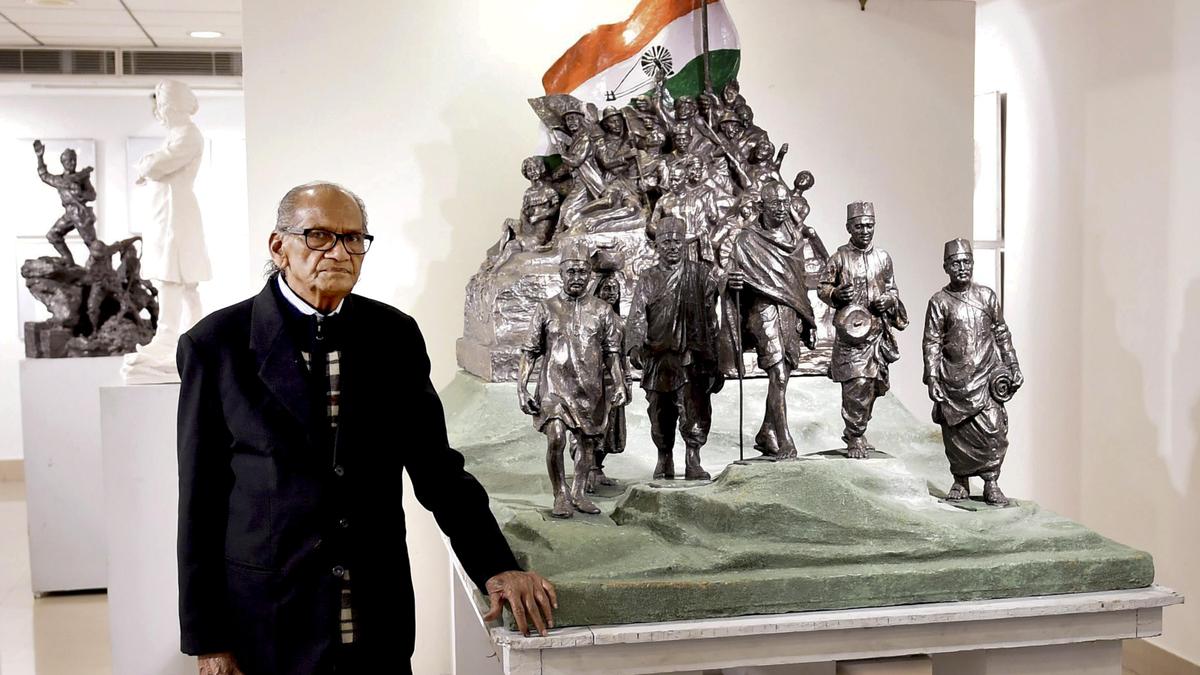
In this picture from February 12, 2017, sculptor Ram Sutar stands near sculptures of Jawaharlal Nehru Mahatma Gandhi, Sardar Vallabhbhai Patel and Indira Gandhi created by him, during an exhibition at the All India Fine Arts and Crafts Society (AIFACS) Gallery, in New Delhi.
| Photo Credit: PTI
Ram Vanji Sutar, one of India’s most prolific sculptors, passed away on Thursday (December 18, 2025) at the age of 100 in Noida. Popularly called the ‘Statue Man’, he designed over 50 large-scale public works projects over a career spanning seven decades, including the world’s tallest statue, the Statue of Unity. Laced with dynamism and technical precision, his works were defined by hyper-realistic bronze and stone portraits of national icons, and his death marks the end of an era in Indian monumental sculpture.
Born in Gondur village in Dhule district of Maharashtra, into a modest Vishwakarma family, Sutar showed early promise. He trained at Sir J.J. School of Art in Mumbai, earning a gold medal. His initial inspiration was the caves of Ajanta and Ellora, and he began his career restoring temple sculptures before shifting to independent monumental works in the late 1950s. Italian sculptors influenced the style of drapes in his work, but as far as expression is concerned, he would say he learnt it from his trips to Ajanta and Ellora.

Gandhi statues
Sutar excelled in lifelike portraiture and scale. He mastered the delicate process of getting to the face through the person. The 182-metre, bronze-clad statue of Sardar Vallabhbhai Patel, an engineering marvel visible from kilometres away, is an enlarged and enhanced version of his earlier realistic sculpture at the Ahmedabad airport. Sutar’s art aligned with the grand project’s nationalist goals, favouring an Indian artist with a track record of chiselling national figures, particularly Mahatma Gandhi, for posterity. He was known for creating nearly 400 Gandhi statues and busts, including the meditative seated figure at the Parliament House.
As a teenager, he saw Gandhi at public meetings and found his most fascinating features to be his forehead, moustache, and pursed lips. Once he told this critic, “When he laughed, it was hearty and full. How much he is loved by people all over the world is what is always so touching.” Be it Gandhi with a thin moustache and Buddha-like aura at the Parliament House or the 72-feet-tall Gandhi with two children at Patna’s Gandhi Maidan, Sutar’s every expression of Gandhi has its own spirit and personality. A bronze statue in Berlin, a marble one in Madrid, and a cement figure in Sri Lanka, Sutar helped spread Gandhi’s message in different media in different countries. “I wanted my works on the Mahatma to portray his strength of purpose, while through the ‘Statue of Unity’ I wanted to depict the face of the Iron Man,” he said in an interview with The Hindu.
If Gandhi was an emotion for him, he created Patel’s statue out of deep respect for a man who united India after Independence. He would say that getting Patel’s traditional shawl, dhoti-clad legs, and sandalled feet right were crucial to him because that was how people always saw him.
From Chhatrapati Shivaji to B.R. Ambedkar and Jawaharlal Nehru, from Govind Ballabh Pant to Ram Manohar Lohia and Dalit Prerna Sthal, Sutar’s art transcended the political and ideological divide.
Sutar’s realism and scale won him popularity, but in avant-garde circles, he was not fully embraced, as they saw a lack of innovation in his conservative approach. Sutar would say he was unable to create a set of contemporary sculptures because the requests from governments and embassies were always reverential and ones of great admiration for the subjects.
The Padma Bhushan’s personality was a blend of unyielding ambition and quiet humility. Even in his 90s, Sutar maintained a rigorous daily routine, working eight hours on clay models, demonstrating physical and mental stamina that belied his age.
In the 1990s, he established his main studio in Noida and later collaborated with his gifted son, Anil Ram Sutar, who helped him align his craft with technical advancements. Humble and approachable, Sutar’s studio reflects this unpretentiousness. By fostering a collaborative environment, he mentored young sculptors, many of whom went on to build successful careers under his guidance.
(The writer is a seasoned art curator and critic)
Published – December 18, 2025 10:59 pm IST

