

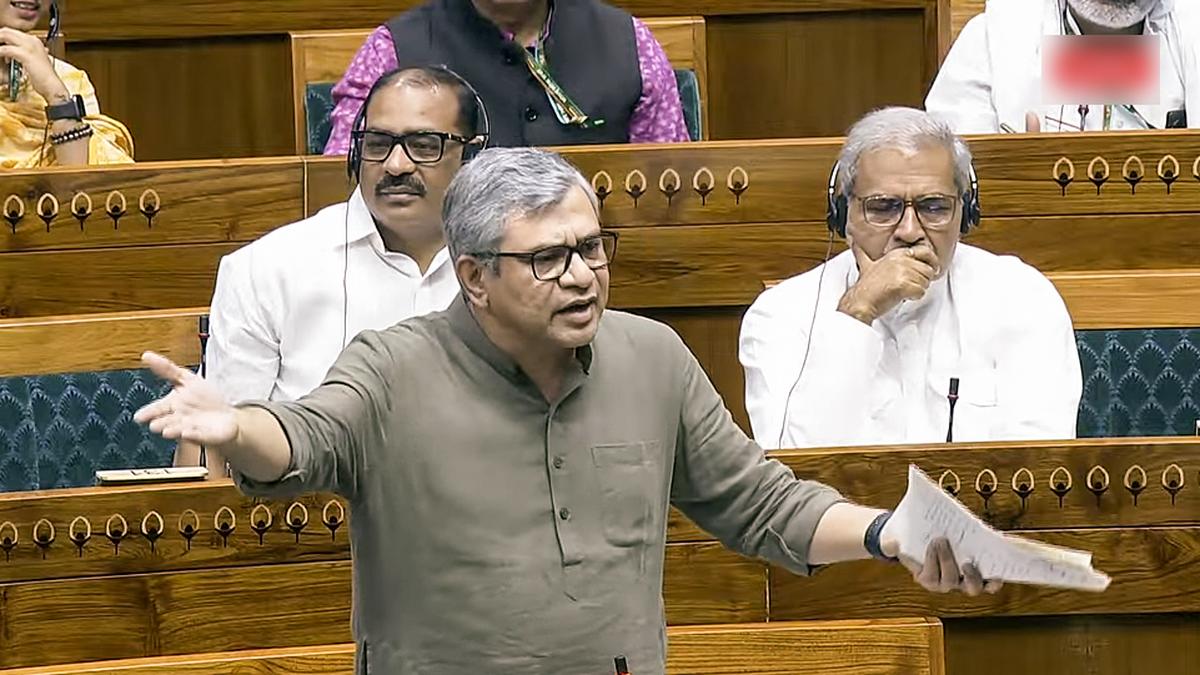
Union Minister Ashwini Vaishnaw speaks in the Lok Sabha in New Delhi on August 1, 2024.
| Photo Credit: ANI
The Railways will add nearly 2,500 coaches in general compartments in the upcoming months, Union Railways Minister Ashwini Vaishnaw said on August 1.
Taking part in a discussion in the Lok Sabha on the demands for grants under the Railway Budget, he said the ratio of general coaches, including sleeper and non-AC coaches, to AC coaches was almost 2:1. Approximately 2,500 additional general coaches would be manufactured in the upcoming months. Apart from this, nearly 10,000 additional general coaches would be produced in the foreseeable future, ensuring their smooth availability.
During the discussion, he emphasised that the Railways is the lifeline of the country and a crucial organisation upon which the nation’s economy depends. He urged Parliament to depoliticise the Railways and focus on its improvement for the benefit of the country.
Also Read | Parliament Session updates on August 1
Flaw detection tests
Mr. Vaishnaw stated that track failure, a prime reason for rail accidents, had been addressed. Over the last 10 years, 26,52,000 ultrasonic flaw detection tests had been conducted, and new technologies incorporated. In 2013-14, there were around 2,500 rail fractures, but by 2024, these had decreased to only 324, indicating an 85% reduction, he said.
On the automatic train protection (ATP) mechanism, he said Prime Minister Modi decided to develop ATP in 2014, with KAVACH undergoing its first trials in 2016 and receiving the SIL-4 certification in 2019. He added that in 2022, a 3,000-km-long project was initiated for the implementation of this system, and in 2024, version 4.0 of KAVACH was approved. He noted that there are currently three manufacturers of KAVACH, with two additional ones being added. Additionally, 8,000 engineers had been trained. “We now have the necessary human resources and capabilities to roll out KAVACH on a large scale,” he said.
Land acquisition
Replying to regional issues, Mr. Vaishnaw said Kerala’s allocation had increased to ₹3,011 crore from an average of ₹372 crore during the UPA government, while Tamil Nadu’s allocation rose to ₹6,362 crore from an average of ₹879 crore. He said the Railways was expecting support from the Kerala and Tamil Nadu governments for acquiring land to complete railway projects. While 2,749 hectare was required in Tamil Nadu for projects, only 807 hectare had been acquired.
Mr. Vaishnaw also said 50 Amrit Bharat trains would be added to the production line. A Vande Metro train, designed for a range of 150-200 km, is being tested.
He addressed the issue of unmanned railway crossings, noting that in 2019 there were 9,000 such crossings. This problem had now been resolved through the construction of rail overbridges, gates, and underpasses.
He highlighted that stations now had control through electronic interlocking. While only 837 stations had this technology between 2004 and 2014, a significant increase was seen in the next decade, with 2,964 stations covered from 2014 to 2024.

