

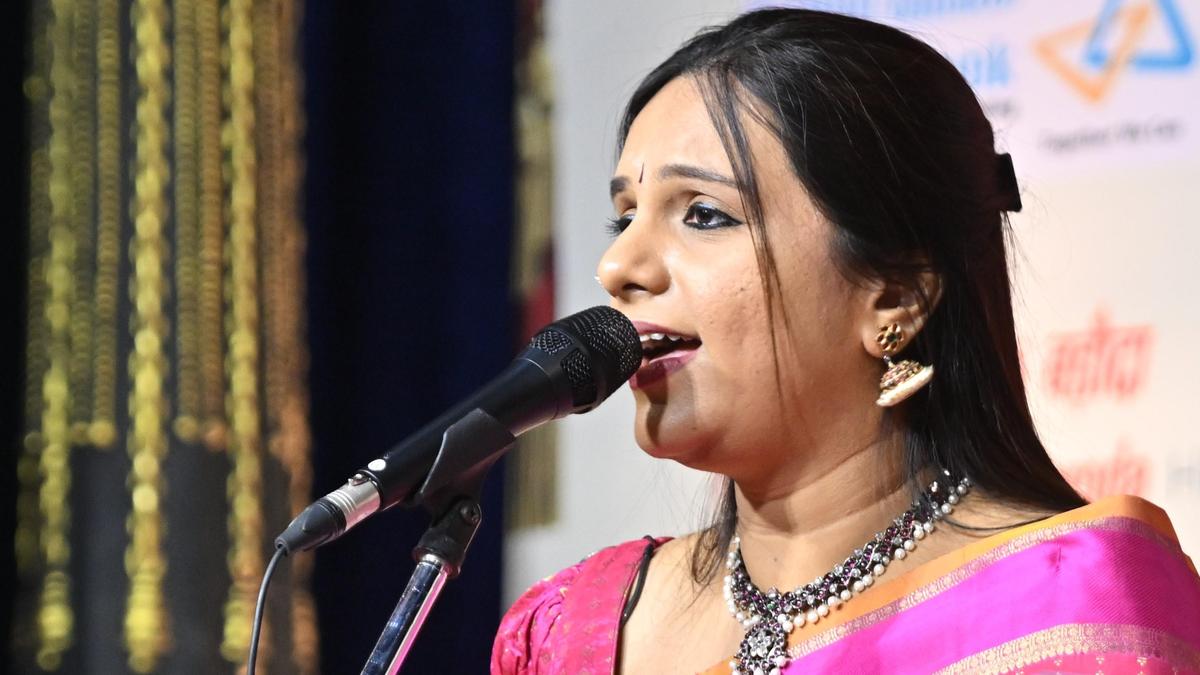
The inaugural concert at the Thyaga Brahma Gana Sabha’s annual Isai, Iyal, Nataka Vizha, featured Sriranjani Tapasya Santhanagopalan, who emphasised clarity and balance, allowing compositions to breathe. The accompanying musicians — Vittal Rangan (violin), Vijay Natesan (mridangam) and Chandrashekara Sharma (ghatam) — contributed with discernment.
Veenai Kuppaiyar’s ‘Intha chala’, a short Begada alapana, was taken up in two kalams. The rendition was largely steady, though mild breath control issues surfaced during the chittaswaras. These moments, however, did not detract from the overall flow of the opening piece.
Swati Tirunal’s ‘Deva deva kalayamithe’, set in Mayamalavagowla, followed as the second piece. The niraval at ‘Jatarupa nibhacela janmarcita mamakhila’ allowed room for open-throated movement in the upper sthayi. The decision to explore the tara sthayi early in the concert came across as refreshing. Vittal Rangan mirrored these ideas with finesse on the violin, leading into kalpanaswaras. Chandrasekara Sharma’s ghatam stood out for its clarity and effective use of bass tones.
Sriranjani Santhanagopalan accompanied by Vittal Rangan (violin), Vijay Natesan (mridangam) and Chandrashekara Sharma (ghatam).
| Photo Credit:
SRINATH M
The concert then shifted to Yamuna Kalyani with Muthuswami Dikshitar’s ‘Nanda Gopala’, bringing a distinctly melodic turn. During the higher-octave sanchara at ‘Muralidhara’, the voice acquired a sharper edge. However, the well-placed brigas added definition, enhancing the kriti’s overall impact. Mridangam’s extensive use of ghumkis enriched the rhythmic texture.
Tyagaraja’s ‘Sarasa Samadana’ in Kapi Narayani followed, underscoring Rama’s command over saama, daana, bheda and danda, the four principles of righteous governance. The mridangam accompanied the anupallavi, with the ghatam joining in for the charanam, lending tonal contrast. Playful podi sangatis interspersed the kriti, while the kalpanaswaras at the ‘Hitavu maata’ phrase, moved fluidly across all octaves.
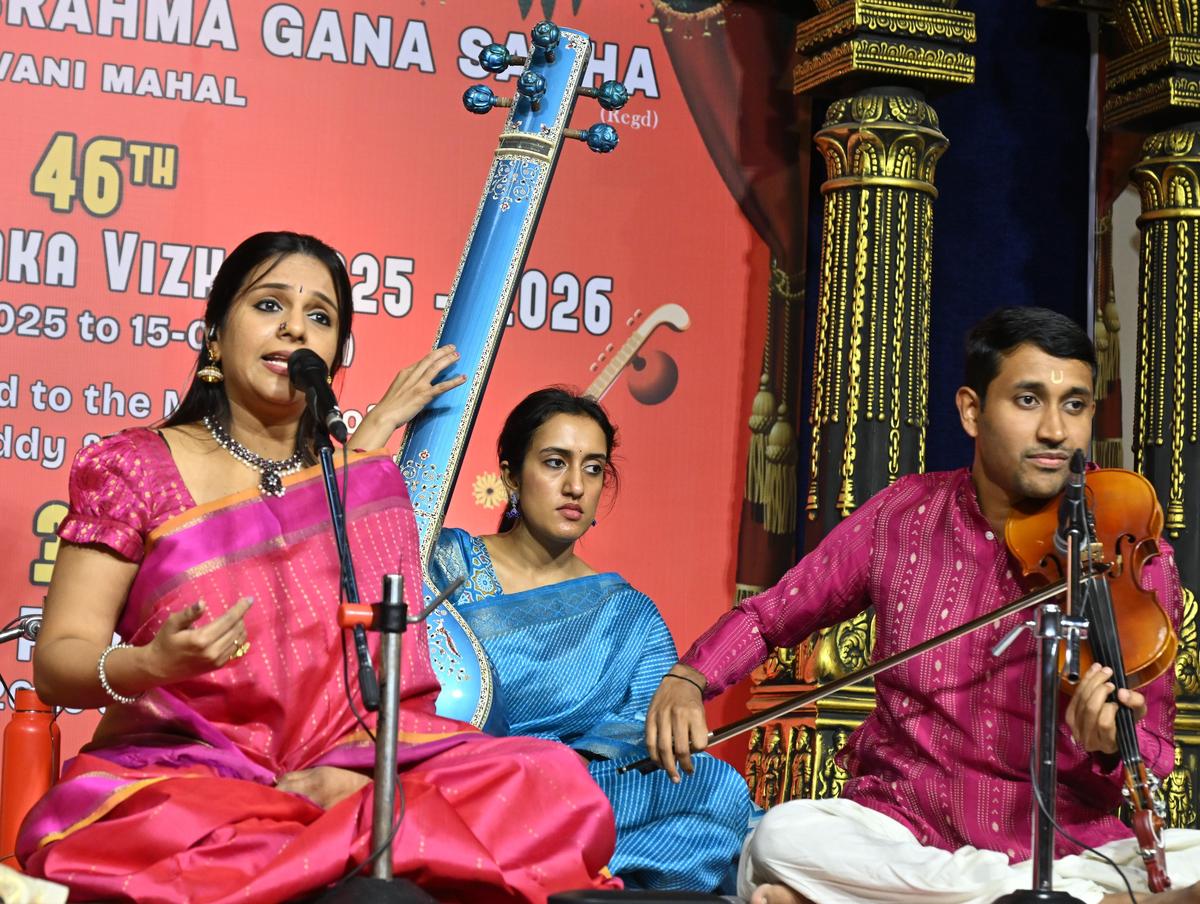
Sriranjani Santhanagopalan with Vittal Rangan on the violin at her concert for Sri Thyaga Brahma Gana Sabha’s 80th annual festival 2025.
| Photo Credit:
SRINATH M
The repertoire for the evening leaned largely towards well-known compositions, a choice that proved effective. The sequencing was thoughtful and consistent, resulting in a concert that remained accessible while sustaining the audience’s engagement throughout.
The Kamboji alapana, which prefaced the main piece of the evening, bore a discernible stylistic imprint reminiscent of Neyveli Santhanagopalan. Marked by briga-laden passages, sustained long notes and an open-throated approach, the exposition traversed all three octaves with confidence, privileging amplitude and sweep over repose. This led to Tyagaraja’s ‘O Rangasayi’, with niraval taken at ‘Bhooloka Vaikuntam’.
The ensuing exchange between voice and violin was notably playful. Vittal Rangan’s responses carried a lyrical ease that blended seamlessly with the vocal line. Kalpanaswaras in two kalams followed, while the mridangam accompaniment stood out for a sudden and effective shift from sarvalaghu to thaka dhina thom patterns, which added a rhythmic contrast without disturbing the kriti’s emotive core. The rhythmic support remained measured and sensitive, complementing the raga’s gravitas.
The tani avartanam began with a crisp, almost assertive opening, as though releasing restrained energy. The mridangist launched into brisk korvais, presenting a mini mohra-korvai within the first round itself, followed by neatly articulated patterns across three speeds. The ghatam, in contrast, adopted a slower opening trajectory, gradually building towards well-shaped korvais. While the second round of mridangam leaned heavily on solkattu-driven passages, the third and fourth rounds regained balance, marked by effective thoppi rolls, engaging one-handed playing, and a simple yet distinctive one-handed stroke korvai to conclude. The finish was aesthetically satisfying and well-measured, though the transition back to the pallavi might have benefited from a gentler rhythmic dovetailing.
Following the main item, the concert turned towards the lighter devotional segment with ‘Gopi gopala lala’, a Surdas bhajan set in Gamanasrama. The rendition featured minor variations in the sequencing of lyrical phrases, handled unobtrusively. This was followed by a namavali, ‘Vanamali radha ramana’.
The penultimate segment comprised a set of three viruthams, drawing from the Tiruppadhigam, Tiruvachagam and the Periya Puranam, each aligned to the respective ragas – Sahana, Amritavarshini and Khamas. This led to Papanasam Sivan’s ‘Idadu padham’ (Khamas), where the raga’s emotive contours were explored with restraint. The concert concluded with M.D. Ramanathan’s Kapi thillana, bringing the evening to a measured, rounded close.
Published – December 16, 2025 06:06 pm IST

