

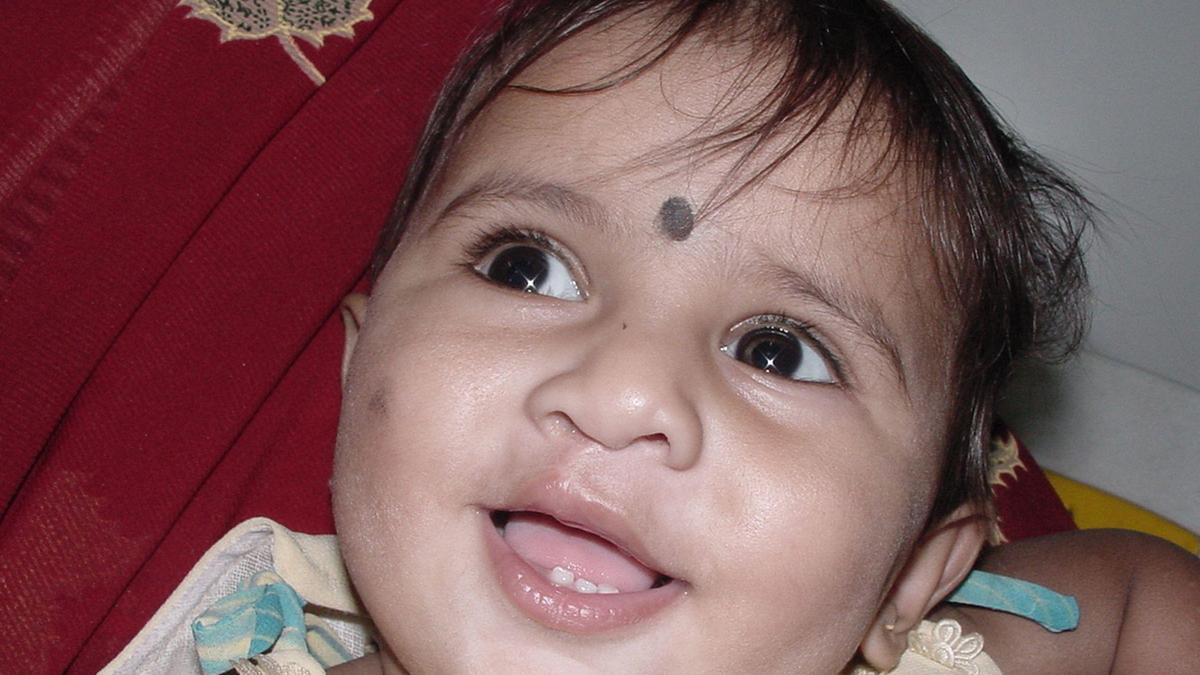
A child after cleft lip treatment. File photo: Special Arrangement
More than 7,50,000 cleft surgeries were performed in India in the last 25 years by the international NGO Smile Train. This amounts to 30,000 surgeries annually. It is the highest by any organisation in the private or public sector. But the figures don’t shine in India where one in 700 children are born with lip and/or palate deformity every year and there is a backlog of 7,000 corrective surgeries annually.
Smile Train India is among the NGOs that support and partner with skilled surgeons to provide free cleft surgeries and related care. While its contribution has benefited 7.5 lakh children so far, others, including Mission Smile, Operation Smile, Transforming Cleft and Healing Smile Foundation, have collectively benefited another 15 lakh children in the last 20 years. Their efforts deserve appreciation. However, they still fall short in India, which, despite recording the highest number of cleft births globally, has no national epidemiological data on cleft lip/palate.
Cleft lip/palate is a facial birth defect that occurs when certain tissues and structures do not fuse during pregnancy due to genetic factor or maternal nutrition deficiencies. It leaves newborns with a gap in the upper lip and the roof of the mouth. Independent surveys estimate that 36,000 babies are born with cleft abnormalities in India every year. About 68% of them rely on government hospitals for initial diagnosis, yet there are 17.5 lakh children with unrepaired clefts.
The situation in India
The situation is complex: there is lack of documentation of birth anomalies, and parental counseling on care and treatment is woefully inadequate. Also, the high cost of surgery deters families from seeking help. A decade ago, the Lancet Surgery Commission estimated a burden of 18.7% untreated Orofacial Clefts (OFC) in India. A 2022 report of the Institute for Health Metrics and Evaluation, University of Washington’s School of Medicine, stated that children with OFCs in India were 1.5 times more vulnerable to severe malnutrition compared to other children under five. It also says one-third of the cleft lip and palate-related malnutrition deaths can be prevented with timely surgical treatment and proper nutrition.
Free or subsidised surgery and follow-up treatment are provided by NGOs in collaboration with mostly city-based private hospitals because government hospitals lack specialised infrastructure and trained personnel. The fragmented cleft care offered by government hospitals are not aggregated in public databases, maybe because India is yet to nationally recognise craniofacial anomalies as a notifiable disease.
The World Health Organization has formally recognised craniofacial anomaly in the Global Burden of Disease initiative. This is what perhaps led the NITI Aayog to initiate conversations around birth defects. The National Birth Defect Awareness Month launched in August 2024 on the theme ‘Breaking Barriers: inclusive support for children with birth defects including clefts’ helped discuss prevention, early identification, and timely management of common congenital malformations.
Surgeons play a key role in minimising birth defects. While people think of cleft lip and/or palate as a cosmetic deformity, it impacts a child’s ability to speak, swallow, hear, and breathe. If not surgically corrected, babies with a cleft lip have difficulty nursing and require special feeding techniques. Children with a cleft lip get bullied and struggle with school and with communication. Employment and marriage become challenging. All this leads to psychological trauma and affects confidence. Ignorance and superstitions strengthen the stigma surrounding the disfigurement, and treatment is marked by a rural-urban divide.
Every health challenge requires collaboration. Smile Train India and others address the gaps in cleft services with a sustainable and scalable global health model. This empowers local doctors as equal partners by providing support in training and covering surgical costs. As per the 2011 Census, 68.8% of the population in rural areas need to be covered aggressively. Collaborating with the Rashtriya Bal Swasthya Karyakram and ASHA for clear communication on early screening of birth defects and deficiencies is a way forward. In the absence of hospital partners in interior areas, timely medical intervention, with incentives that cover travel cost, surgery and hospital stay, and post-operative support including speech therapy, is imperative.
The way forward
UNICEF estimates that about 2.5 crore children are born in India annually. The 2022 National Family Health Survey states that 1.35 crore children are born in government hospitals, where cleft care in detected cases can ideally start at birth and life-transforming surgery can be done after three months of birth. It is time for policymakers to recognise cleft deformity as a health issue and opt for better management at the grassroots level, where there is limited awareness and access. The government can devise a multi-level approach to address under served communities. NGOs are trying to expand the footprint but government hospitals, where almost 50% of India’s children are born, need to upgrade.
Health experts say cleft missions help strengthen government healthcare systems by improving surgical infrastructure, increasing access to affordable care, training the local workforce, and breaking social taboos. The success of cleft surgeries is measured by improved functionality, which depends on the age at which the child is brought for treatment.
Published – December 31, 2025 12:36 am IST

