

On July 6, 2025, Maharashtra Navnirman Sena chief Raj Thackeray got front page space in Saamana, the Shiv Sena (UBT) mouthpiece. Showing the two cousins Uddhav and Raj arm-in-arm, the strap above the masthead of the broadsheet blared, “Historic! Joy in entire Maharashtra!”
The front page was dedicated to stories of the show of unity by the cousins, their appeal to Marathi people, and how the reunification is slated to impact the State. “We have come together to stay together!”, “Thackerays have stood for mother Marathi!” said the headlines. At the time, they had not formally announced their coming together.
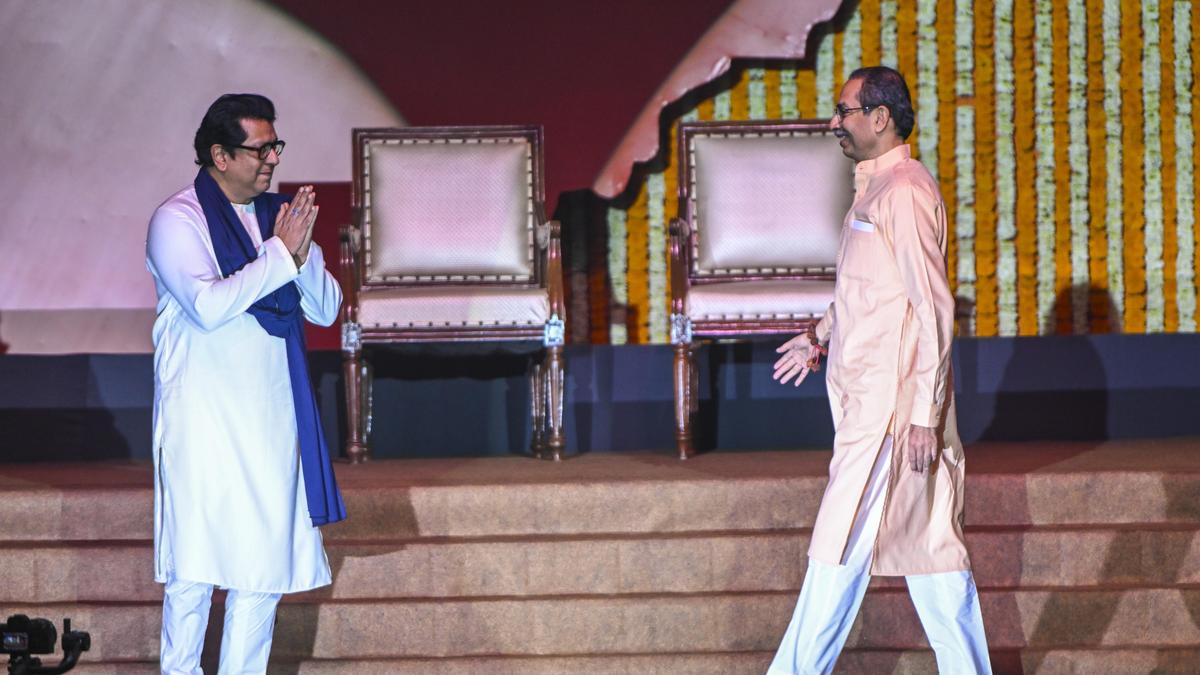
The previous day, the duo had met at the Worli Dome, a theatre-in-the-round, when they decided to mark the day as Marathi Vijay Diwas, to commemorate the Maharashtra government’s withdrawal of the three-language policy in primary education, which would have forced children to learn Hindi.
Sanjay Raut, a Shiv Sena (UBT) leader, and common friend of the Thackerays, who played a significant role in bringing them back together, says, “It was a moment the Marathi manoos (people) had been waiting for. ‘The Thackerays should unite for Marathi, for Mumbai, for Maharashtra,’ is the sentiment among several Marathi households. That dream has been fulfilled.” He called it an emotional moment in a break-up from two decades ago.
On Christmas Eve 2025, the cousins announced an electoral alliance between the Shiv Sena (UBT) and the Maharashtra Navnirman Sena (MNS) for the January 15 municipal corporation elections. While these are to be fought in 29 cities, the cousins have primarily joined hands for Mumbai, Mumbai Metropolitan Region, and Nashik, in what is being seen as a battle for survival.
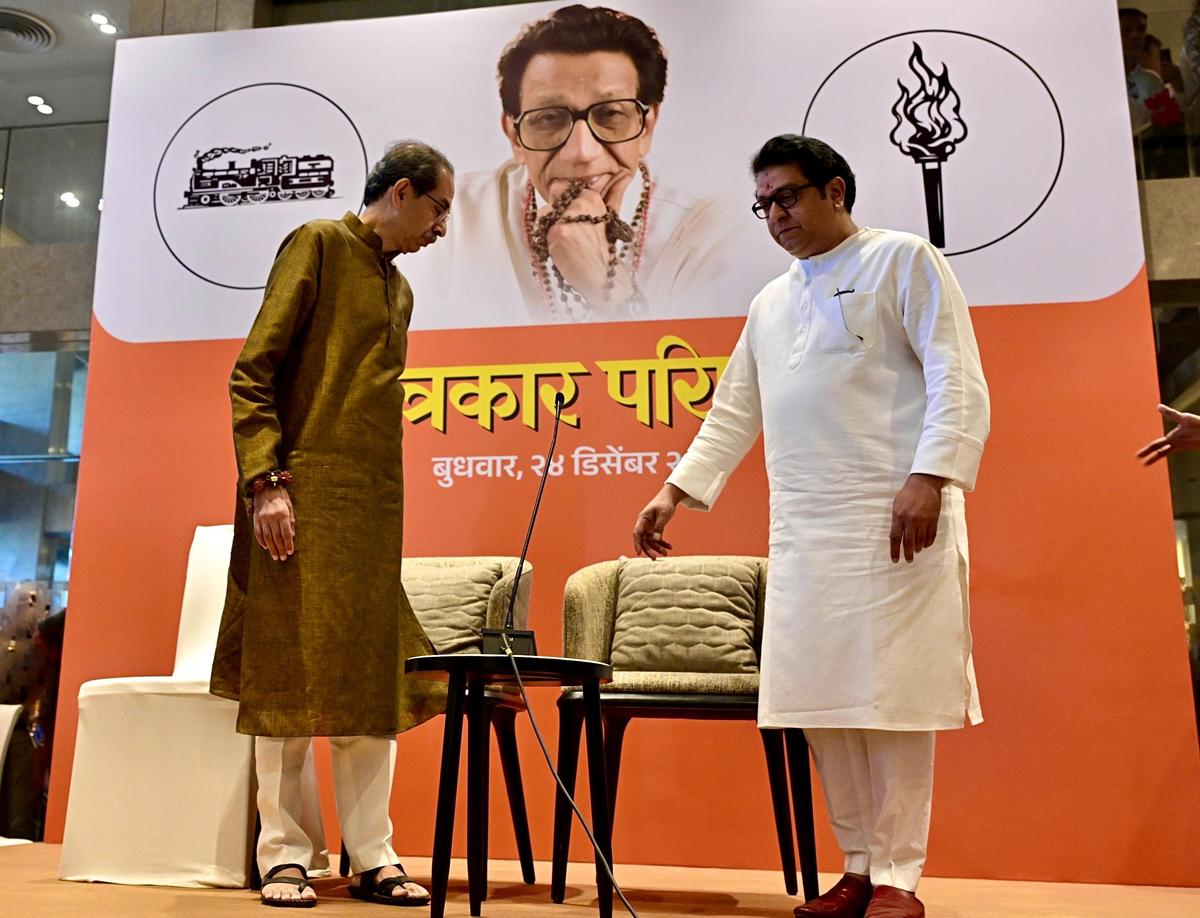
Cousins Uddhav Thackeray, Shiv Sena (UBT) chief, and Raj Thackeray, Maharashtra Navnirman Sena chief, during a press conference in Mumbai, after announcing their alliance for the upcoming municipal corporation elections.
| Photo Credit:
The Hindu
At the press briefing to announce their political alliance, the family turned up. Rashmi Uddhav Thackeray and Sharmila Raj Thackeray sat next to each other, on chairs next to the stage.
Raut stood between Uddhav and a slightly stiff Raj, before the duo posed for photographs together. At the venue was an enlarged photo of the two cousins with Balasaheb sitting in the centre and holding them as adults. Soon, party leaders jumped on to stage to hand over bouquets and felicitate them.
The family saga spanning three generations has all the masala of a Bollywood blockbuster: family drama, high emotion, suspense, distrust, and action. Based in Mumbai, the plot starts in erstwhile Bombay 60 years ago with the formation of a political party and a larger-than-life ideologue. The charismatic Balasaheb Thackeray, who built the Shiv Sena in 1966, on a ‘sons of the soil’ plank, had Bombay renamed to Mumbai, after the goddess Mumbadevi.

Sharing and compromise
On December 24, the duo invoked the Samyukta Maharashtra movement, setting the stage for their joint political agenda of regional linguistic identity and the alleged threat to this identity by ‘outsiders’. They talked of how these powers wanted to break Mumbai away from Maharashtra. The script was similar to Balasaheb’s appeal during the formation of Shiv Sena amid what he pushed as the growing threat of livelihood and cultural identity loss for Maharashtrians. The Marathi manoos plank unites people on linguistics rather than religion.
However, where Balasaheb had targeted people from south India and Gujaratis, Mumbai’s changing demographics, with several migrants from north India are the current ‘outsiders’. Rough estimates by political parties have put Mumbai’s Marathi-speaking population at over 30%, in tandem with the 2011 Census.
“The original ideology for the formation of the Shiv Sena itself was the Marathi manoos. Yes, thereafter Balasaheb took the stance of Hindutva, other things happened. But the Thackerays always had the Marathi manoos at heart,” says Raut. Uddhav’s and Raj’s grandfather ‘Prabodhankar’ Thackeray, was prominent in the Samyukta Maharashtra movement, which eventually led to Mumbai going to Maharashtra in 1960.
The cousins did not field many questions about the alliance for the January 15 local body elections. “Who will fight on how many seats, we will not tell you,” Raj said, to a packed hall of journalists at a hotel on the Worli promenade. The crowd cracked up.
Of particular importance to the Shiv Sena (UBT) is the Brihanmumbai Municipal Corporation (BMC) election. Traditionally, the Thackerays have controlled the BMC, the country’s richest civic body. Things changed in 2017, when the BJP got just two seats less than the Shiv Sena. The polls to BMC have been pending since 2022.
Sources say that in the BMC elections, Uddhav’s party would contest 163 seats, Raj’s on 53, of the 227 seats. Sharad Pawar’s NCP, that has been with Uddhav, is also in on the seat-sharing, with 11. “They had wanted a respectable seat share. Our position is also challenging as we have sitting corporators at several of these places. But Uddhavji has decided that he will adjust,” says a leader from the Shiv Sena (UBT).
“Raj saheb has told the party cadres, they should not stretch things. We are willing to compromise,” an MNS leader says. A total of 2,869 corporators will be elected in these polls, the results of which will be declared on January 16.
The break-up years
Raj was seen to have inherited the aura and the oratory appeal of Balasaheb, his uncle. Uddhav, Balasaheb’s son, was known as the quiet organisation man who built discipline in the party. In 2003, Raj had supported Uddhav’s name as the party’s working president in Mahabaleshwar, despite growing tension between the cousins. This was a year after Balasaheb had named Uddhav as the executive president.
In 2005, Raj left the Shiv Sena after an acrimonious public fallout, when he called a press conference to announce his resignation, saying in an emotionally wrought voice, “All I asked for was respect…. All I got was insult and humiliation.”
He added, “I don’t have complaints against my Vitthal. I have problems with the coterie which wants to control everything,” with a reference to Balasaheb, who was called Vithhal by those close to him. Violence followed, as cadres felt torn between the two cousins. Famously, when now-peace-broker Raut had tried to convince Raj against exiting the Shiv Sena, angry supporters of Raj had vandalised and toppled Raut’s car.
Most of the old leaders had stayed with Balasaheb and Uddhav, and a handful went with Raj. The sentiment among the supporters of Raj was that he was being wronged and denied his due, and that he was Balasaheb’s rightful political heir. Uddhav’s supporters said he was building organisational strength. At that time, several top BJP leaders too tried to intervene to stop the cousins from parting ways. It did not work.
The following year, Raj founded the Navnirman Sena. In 2014, after a fallout between the Shiv Sena and the BJP, there were murmurs again, but Raj had then blamed Uddhav for failing to respond.
In 2022, Eknath Shinde, a grassroots organiser, split from Uddhav, taking 40 MLAs to form the government with the BJP.
Uddhav and Raj have often traded barbs over the style of functioning, leadership qualities, and ideological strength. Uddhav believed that Raj had helped the BJP by cutting the votes of the Shiv Sena. “First, they stole the photo of Bal Thackeray…. Today they are trying to steal another Thackeray. Take it, I and my people are enough,” he had said, in 2024. Raj called Uddhav an “accidental Chief Minister”.
Blood, and water under the bridge
From the first quarter of 2025 though, something changed. They said in separate public appearances that they were willing to put their problems aside ‘in the interest of Maharashtra’. With a BJP coalition now in power in Maharashtra, the statement came amid dwindling political fortunes for both.
In the State Legislative Assembly elections held in 2024, the Shiv Sena (UBT), which fielded candidates in over 90 seats, won 20, less than 10% per cent of 288, the strength of the lower house. In the Lok Sabha elections held the same year however, the Shiv Sena (UBT) won nine of the 21 seats it had fielded its candidates on. There are 48 seats for Maharashtra in Parliament.
The MNS has had consistent legislative losses, barring the 2009 Maharashtra Assembly elections, which were the first State elections for the party since its formation. From 13 MLAs then, the party has no representation in the Assembly. It had just one MLA in the 2014 and 2019 elections. The MNS has no representation in Parliament either.
“When there is an external threat, the family unites. This is the tradition of Maharashtra. Here, the family has united politically as well,” Shiv Sena (UBT) leader Anil Parab says. “The cousins have different qualities. Raj’s oratory is charismatic. For a political party to flourish, it has to be disciplined, its organisational strength has to be increased. Uddhav does that well,” adds Parab.
“Blood is thicker than water. Ultimately, it is the family which stands with each other. We have no qualms against Raj saheb anymore,” a Shiv Sena (UBT) party worker from Sion, says. He recounts how he had participated in the violence outside Shiv Sena Bhavan in 2006, between the supporters of the two leaders.
Another leader highlights the hold of the family on the conservative, regional, and dynastic political landscape of Maharashtra. Both parties have so far fought for the same vote bank, confronting each other in the same Marathi-strong pockets.
Gen next
In the first two phases of city local body elections last month, the Shiv Sena UBT got presidents elected on nine of the 288 municipal councils and Nagar panchayats. “We don’t give importance to the elections fought with such money power. We had left these polls to our local cadres, who could not withstand the misuse of money and might. Over ₹100 crore was spent by the ruling parties here. Where were we supposed to get this money from?” says Raut.
On the last day for the withdrawal of candidature for the civic polls, January 2, Shiv Sena (UBT) MLA Aaditya Thackeray, Uddhav’s son; and the MNS’ Amit Thackeray, Raj’s son, held a joint workshop for potential corporators. Their main campaign pitch is to be ₹1,500 monthly assistance for registered women domestic workers. They also announced support for the women of the Koli fishing community and relief on property tax.
The following day, 68 candidates in the Maharashtra civic polls from the Mahayuti alliance — the BJP, Shiv Sena (Shinde faction), NCP (Ajit Pawar faction) — are unopposed. This has united the opposition, including the cousins. Now, both Shiv Sena factions and the MNS are fighting for the same pie.
vinaya.deshpande@thehindu.co.in
Edited by Sunalini Mathew

