

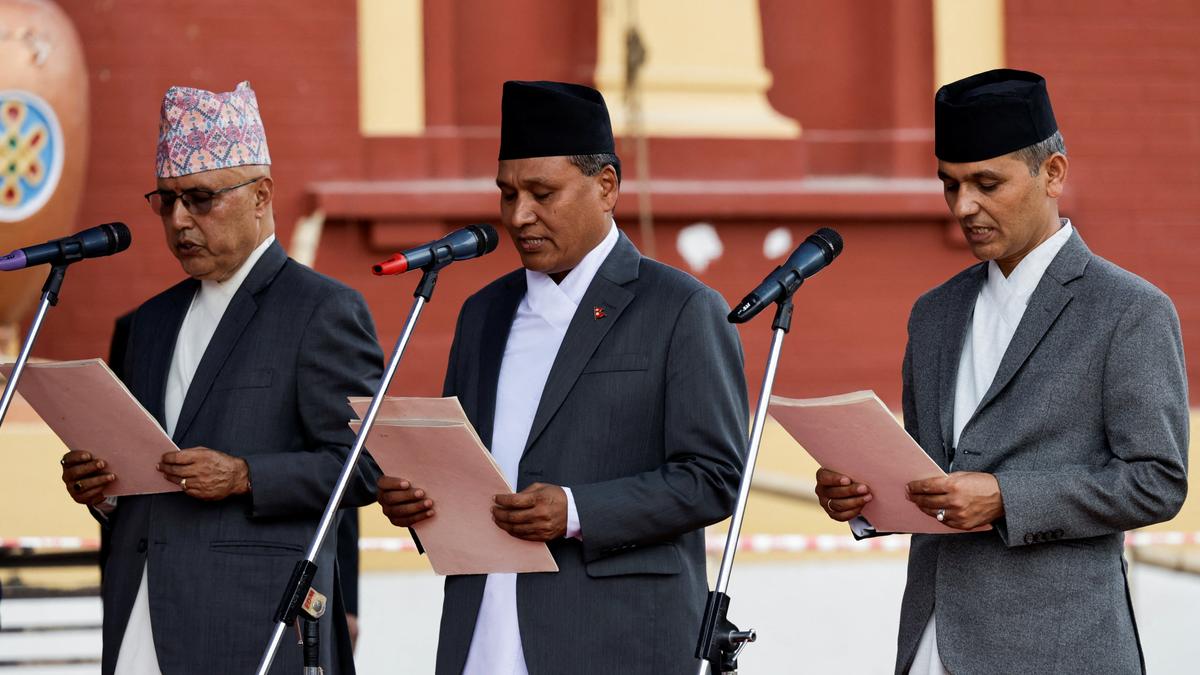
Nepal President Ram Chandra Poudel administered the oath of office to three newly inducted Ministers in the interim Cabinet led by Prime Minister Sushila Karki on Monday (September 15, 2025).
Two days after her appointment, Ms. Karki on Sunday (September 14) formed the Cabinet with Rameshore Khanal, Kulman Ghising, and Om Prakash Aryal as Finance Minister, Energy Minister, and Home Minister, respectively.
Rameshore Khanal — from Finance Secretary to Finance Minister
Mr. Khanal, 55, is a former Finance Secretary who recently submitted a recommendation of over 400 pages to the erstwhile K.P. Sharma Oli Government, outlining economic reforms.
Known for his long-standing advocacy of reform in Nepal’s economic sector, Mr. Khanal has served on the boards of major public institutions, including Nepal Rastra Bank, Nepal Electricity Authority, Agricultural Development Bank, Nepal Telecom Company, and Nepal Airlines Corporation.
He made national headlines in 2011 when he abruptly resigned as Finance Secretary, citing political pressure from business groups resisting investigations into the fake VAT bill scam.
At the time, Jhala Nath Khanal was Prime Minister and Bharat Mohan Adhikari the Finance Minister, both from Mr. Oli’s Communist Party of Nepal (Unified Marxist-Leninist).
Mr. Khanal later said his resignation stemmed from being excluded from the preparation of the supplementary budget, a move that, he argued, showed a lack of confidence in him, which did not allow him to continue in the post.
In a bureaucracy often viewed as compromised, Mr. Khanal’s decision bolstered his reputation for honesty and independence.

Kulman Ghising — Nepal’s ‘power saviour’
Mr. Ghising, 54, is the former Executive Director of the Nepal Electricity Authority, and is widely credited with ending Nepal’s chronic power outages.
Until 2016, Nepal suffered up to 18 hours of load-shedding per day. After Mr. Ghising took charge, the country saw 24-hour electricity for the first time in years, an achievement many dubbed “a miracle.”
Mr. Ghising, however, said in an interview at the time that it was “simply better management of demand and supply.” Among the public, who had suffered years of blackouts, he became a national hero.
What led to Nepal’s Gen Z protests?
His dramatic removal by the Oli Government earlier in March this year sparked widespread criticism. Many saw it as part of a broader scheme by Mr. Oli and his Energy Minister Dipak Khadka, a Nepali Congress leader, at the behest of unscrupulous interest groups to reverse reforms and reinstate corruption.
Since his ouster, Mr. Ghising has spent time meeting ordinary Nepalis, including migrant workers in the Gulf, listening to their grievances, a move that had fuelled speculation about his political ambitions.
Some critics argued that improved rainfall and smooth electricity imports from India played a greater role in ending load-shedding than Mr. Ghising’s management, but most Nepalis credited him directly.
He is widely seen as an efficient and trusted public figure.
Om Prakash Aryal — an anti-corruption crusader
Mr. Aryal, 49, is a Supreme Court advocate known for challenging corruption and filing high-profile public interest litigation.
A close confidant of PM Karki, Mr. Aryal played a key role in her behind-the-scenes negotiations with President Ram Chandra Poudel to resolve the standoff over House dissolution.
In 2022, he was appointed legal adviser to Kathmandu Mayor Balendra Shah, who publicly backed the youth-led protests and argued that House dissolution should be a pre-condition for dialogue with the Nepal Army. Mr. Shah later emerged as a key force behind the movement that led to the collapse of the Oli administration.
He filed the petition in 2013 against Khil Raj Regmi’s dual role as Chief Justice and head of the interim council. A Bench led by Ms. Karki and then officiating Chief Justice Kalyan Shrestha had observed that Mr. Regmi’s dual role was against the spirit of the Interim Constitution.
He was also one of the early petitioners challenging the appointment of Lokman Singh Karki as the chief of Nepal’s top anti-corruption body. Ms. Karki’s decision to open the petition subsequently led to Lokman’s disqualification in 2017.
In February this year, Mr. Aryal filed a petition in the Supreme Court, seeking action against then PM Oli for failing to implement the court verdict in a tea estate scam. When Mr. Oli, during his earlier stint, dissolved Parliament in 2021, Mr. Aryal was one of the petitioners who challenged the move, calling it unconstitutional.
Mr. Aryal has a track record of taking on powerful figures.
Parliamentary elections on March 5
Following the youth-led protests last week that killed 72 people, Nepal got Ms. Karki, a former Chief Justice, as its first female Prime Minister.

Her government has been mandated to hold elections to the House of Representatives on March 5. She said on Sunday (September 14) that the youths of Nepal are demanding an end to corruption, good governance, and economic equality.
Stating that she did not intend to become Prime Minister and was given the responsibility from the streets, Ms. Karki said, “We will not stay here more than six months in any situation. We will complete our responsibilities and pledge to hand them over to the next Parliament and Ministers.”
Published – September 15, 2025 02:02 pm IST

