

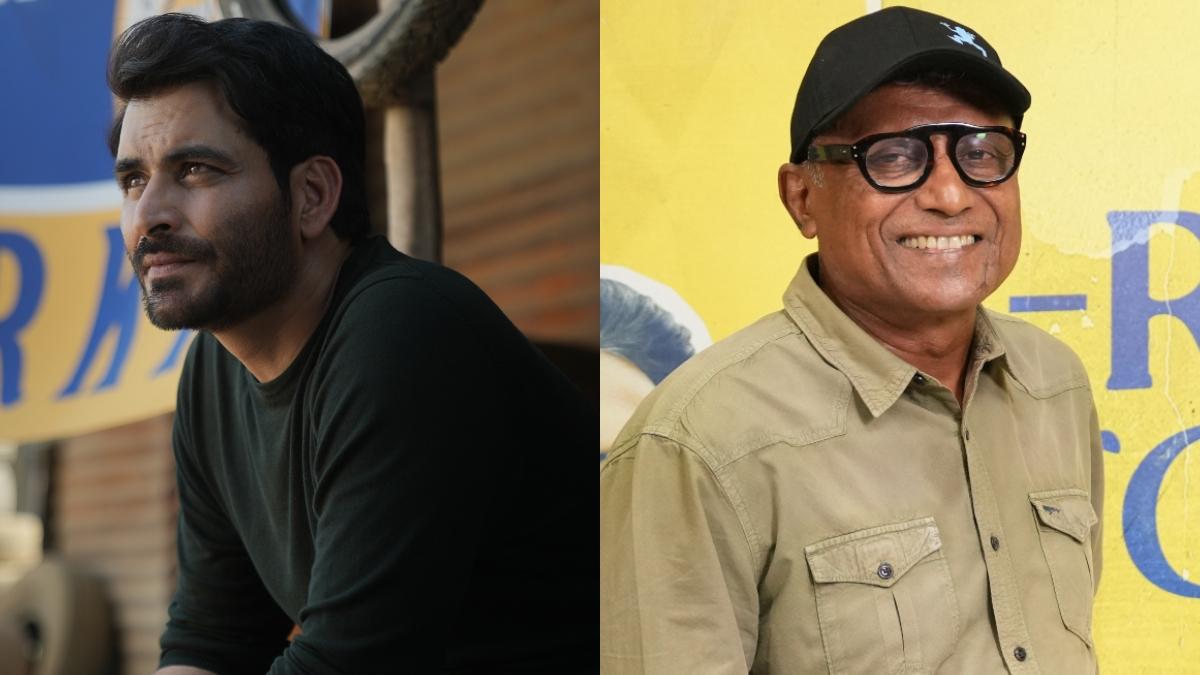
Manav Kaul and Mahesh Mathai
| Photo Credit: Special Arrangement
It seldom happens that an actor’s own life is projected through the characters they portray on-screen. With Manav Kaul, that has happened twice recently. In Baramulla, which was released on Netflix last month, the actor played a cop investigating a series of kidnappings in the quaint town of Kashmir, which also happens to be Manav’s birth place. He returns to the valley with Real Kashmir Football Club,set to be released on Sony LIV on December 9. Playing a Kashmiri Pandit businessman, who helps in building a soccer team, the show bears even closer resemblance to Manav’s own life. Especially how in the first episode of the show, his character says with heartfelt honesty that he has left Kashmir once and won’t do it again. Perhaps the resolute charm in his voice comes from his lived reality of leaving the valley during the rise of insurgency in the 1990s — an experience he has sumptuously captured in his deeply personal travelogue, Rooh. Manav lets out a big smile at the comparison.
Interestingly, it was during his second meeting with the series’ director, Mahesh Mathai, and producer, Kilian Kerwin, that Manav learned both of them had read Rooh. “That was a different meeting altogether. It is like they had consumed my work and then they were talking to me. I just felt heard when I met them. It was a big thing for me. I realised during that meeting how sensitively they were making the show by understanding every aspect of Kashmir,” Manav says.

A still from the show
| Photo Credit:
Special Arrangement
Apart from a singe-eyed focus on recounting the real story about the formation of the football club, the series also strives to touch upon the socio-political complexity of the valley. It features a conservative leader of a youth group, who shares his divisive idea of ‘Kashmiriyat’ while pressing on the importance of preserving identity and culture. A simple counterpoint is realised in the change-driven mindset of Manav’s character, for whom, living in peace is a right and maintaining unity, a responsibility. Mahesh says that they extensively discussed on correctly using the word ‘Kashmiriyat’ while making the show.
“Sometimes even the idea of Kashmiriyat can get hijacked. So, we were careful not to over-politicise it as we wanted to focus on our main story about the club,” says the director, known for making films like Bhopal Express (1999) and Broken Thread (2007). Mahesh admits that it was a challenge to rightfully represent the voice of people in Kashmir through the show.

“When I met the local people in Kashmir during the recce and research, some of them asked if the show is about Pandits. I told them no. But I realised that it is important to give the whole picture otherwise it can be misleading. I understood that I need to give a balance to the story. So, I can say now that the show represents the community of Kashmir at large, especially that of Srinagar. Anybody from Srinagar who watches it will feel that it is their show,” Mahesh says.

The show also stars Mohammed Zeeshan Ayyub in a pivotal role
| Photo Credit:
Special Arrangement
Manav too feels that the show has covered a “spectrum of life” from Kashmir. “At the end of the day, if the show is not entertaining and engaging, it is not going to work whatever your intentions are,” he adds. Manav is also a filmmaker apart from his extensive work in writing plays and books. He has directed two independent films, Hansa (2012) and Tathagat (2021), both set in the mountains and shot in Uttarakhand. Even his third directorial, Jolly Joker, was shot in the same region. Does he ever plan to shoot a film in Kashmir? “I don’t know. I am a very instinctive person. I will do it if I feel like. But whatever I am doing now is enough I feel,” he smiles.
His instincts also guide him when he is performing before the camera or on stage, rendering an effortless charm to his presence. Manav maintains that everything he knows about acting is through his experience as a director and writer. “I was a terrible actor. When I started out, I wanted to prove myself. But when I left acting for 12-13 years in between, that’s when I understood acting because I was directing some great actors on stage,” he says, adding that he learnt a lot about the craft by observing child actors while shooting Hansa and Tathagat. “They don’t act, they are really living their part and camera only captures what you live then and there. So, I usually don’t prepare. I just want to live between ‘action’ and ‘cut’ as honestly as I can. After that, I am a different person,” he concludes.
Published – December 03, 2025 06:04 pm IST

