

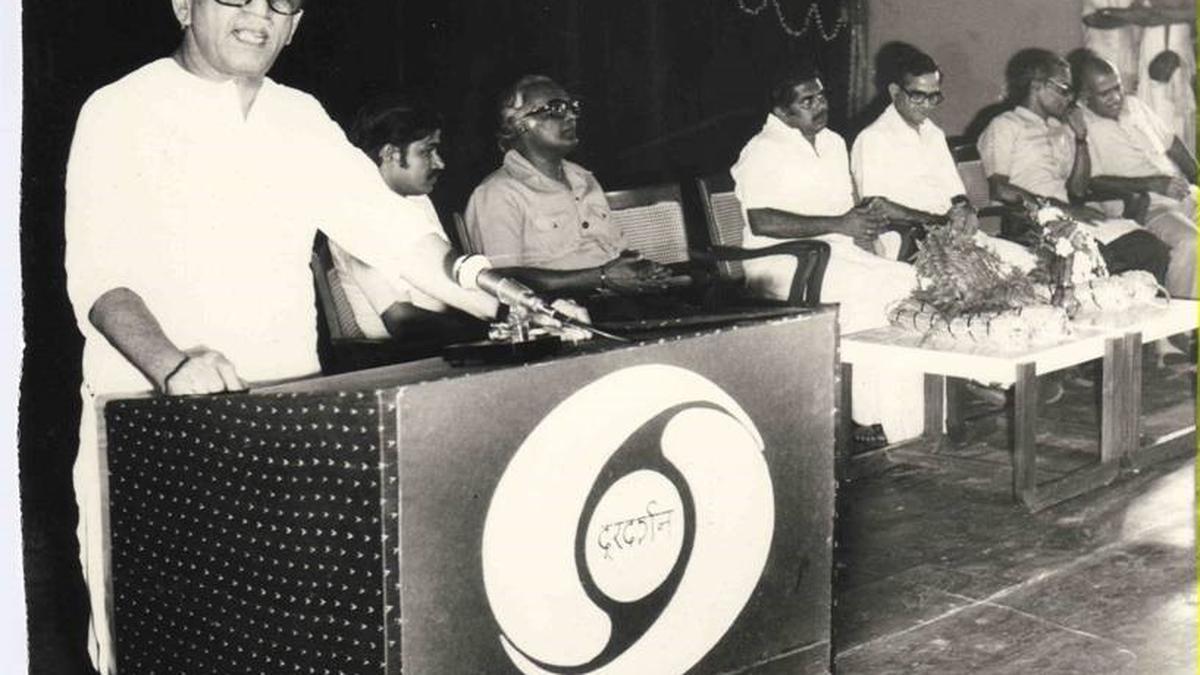
K. Karunakaran, the then Chief Minister of Kerala, inaugurating the Malayalam programme transmission by Doordarshan on January 1, 1985.
| Photo Credit: Special Arrangement
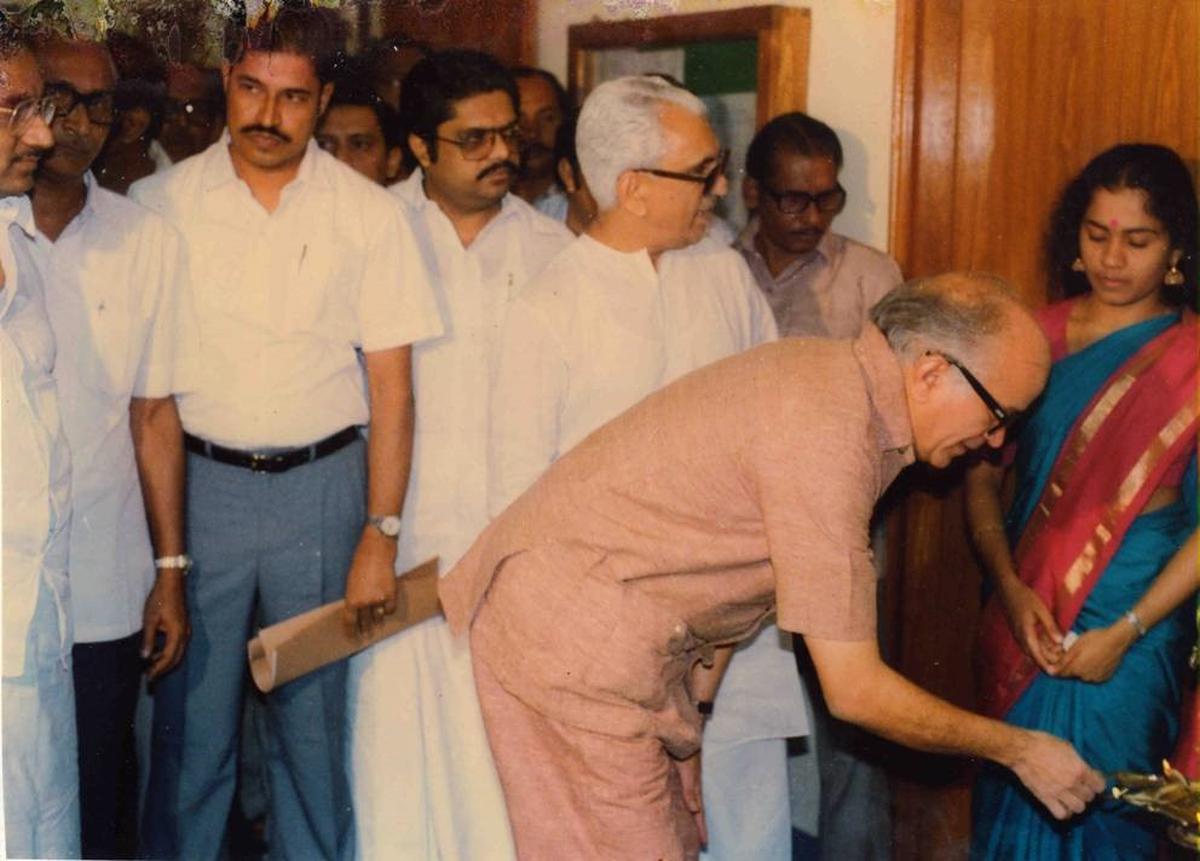
V.N. Gadgil, then Minister for Information and Broadcasting. inaugurating a 10-kW transmitter. With this transmitter, TV signals would reach a radius of 80 km.
| Photo Credit:
Special Arrangement
January 1, 2025 marks the 40th anniversary of Doordarshan’s Malayalam telecast from Thiruvananthapuram. With advancement of technology and proliferation of channels, it may sound ordinary, but in 1985, this was an epochal event for television broadcast in Kerala.
On October 31, 1984, while working at Doordarshan in Madras (now Chennai), I was assigned to assess the facilities in Thiruvananthapuram and report to my bosses in Delhi on possible TV programme productions. A low-power transmitting centre, relaying Delhi station’s Hindi programmes, had been functioning in Thiruvananthapuram since the November 1982 Asiad. In the two years since, a new office building was added to the transmitting centre. A new terrestrial transmission tower, standing 120 metres tall and capable of broadcasting up to 80 kilometres in all directions, was under construction. The programme production studio was far from ready. The staff in 1984 were made up of a few producers, production assistants, cameramen, editors, technical staff, sound recordists and graphic artists. At the time, though equipped and ready, there was no work for them. Four low-band video camera units and two 16mm film cameras were available. Doordarshan Jalandhar had sent us a condemned outside broadcast (OB) van and the technical staff were repairing it to make it functional.
When I arrived at the remote Doordarshan television centre at Kudappanakkunnu in Thiruvananthapuram, I received a call from the Additional Director-General, Shiv Sharma, informing me of unconfirmed reports about the assassination of Prime Minister Indira Gandhi. Prior to receiving the call, my brief had been to meet Chief Minister K. Karunakaran. But the Chief Minister had already left for Delhi, upon hearing the news about Indira Gandhi. Shiv Sharma asked me to stay back to record condolence messages of prominent personalities of Kerala. The available staff were galvanised to make the recordings, and the tapes with cue sheets were flown to Delhi. Our very first assignment was a success, thanks to the experienced cameramen, who were old colleagues of mine.
Upon Karunakaran’s return to Thiruvananthapuram, I met him and he was at his cajoling best, promising us the entire State government machinery for any assistance. But he insisted that we start Malayalam television programming in the New Year. Given the ground realities, that was a tall order. Except a few engineering officers from Madras, most of the staff had not even seen a television set. The Relay Station Engineer, P.R.S. Nair, and the Installation Engineer, N.C. Pillai, assured me that we could spring miracles and make the dream of broadcasting Malayalam television in the New Year come true. Recording and transmission could be done in a makeshift studio, and the black-and-white OB van could be turned into the production control panel. We informed the bosses in Delhi about our plans.
On seeing our proposal, Shiv Sharma cautioned me, “Television is a hungry monster. Once you start, there is no going back. Anything wrong, your head will roll!” I humbly conveyed our resolve and again he counselled me to wait till April. Finally, the proposal to produce and broadcast one hour of original programming was permitted. Without a news broadcast, I knew we would not make any impact in Kerala. Later, a 10-minute news bulletin was sanctioned. While shuttling between my two assignments in Madras and Thiruvananthapuram, I prepared the fixed-point chart, or the programming timetable.
On December 10, 1984, I was transferred to Thiruvananthapuram as the station’s first Director. Just three weeks remained for the first broadcast and the challenges appeared insurmountable. Everything was to be built from scratch, and at breakneck speed. Many tangles had to be untangled. Though budgeted, payments had to come from the pay and accounts office in Madras. We could only spend ₹10,000. Incredible as it may seem now, we purchased two office tables, by splitting quotations for parts from a public agency, and furniture for staff from a State government company. Transport for the 130 staff members was provided by running of two services, especially for Doordarshan, by the Transport Corporation. Water supply and uninterrupted heavy-load power supply to the station was another hurdle that needed to be overcome. Teleprinter services of the news agencies PTI and UNI were installed after tremendous efforts.
Content was a prime concern. Malayalam titles for timeslots, montages and signature tunes for each were tasks achieved with gusto.
Selecting anchors, announcers, comperes and news readers was a demanding task. The queues for application forms were so long that they made headlines on the front pages of local newspapers. From a few thousand applications, it was an uphill task to empanel a few youngsters and then train them to perform with the correct poise, diction and modulation.
The inaugural function on January 1, 1985 was colourful and was broadcast live. It was applauded and welcomed by the public. For the live telecast, cameras were brought in from Bombay Doordarshan, and for sending the signals to the transmitter, Madras Doordarshan provided the microwave link, evincing the camaraderie in the Doordarshan family.
Mistakes and interruptions were many in the first weeks. Inexperience in makeup, lighting and sets showed on the screen. Production staff were ignorant of daily programming cue sheets, scheduling and promotion of the programmes. To train them, two colleagues from Madras were brought to Thiruvananthapuram for a short while. Teething troubles were addressed in the early days of the operation and the television centre produced top quality programming soon after. The variety in programme content and formats, began by Doordarshan, are still imitated by private television channels.
In retrospect, I am gratified for having substantially and comprehensively contributed and played a decisive role in Malayalam television.
kkunhikrishnan@gmail.com
Published – December 29, 2024 03:33 am IST

