

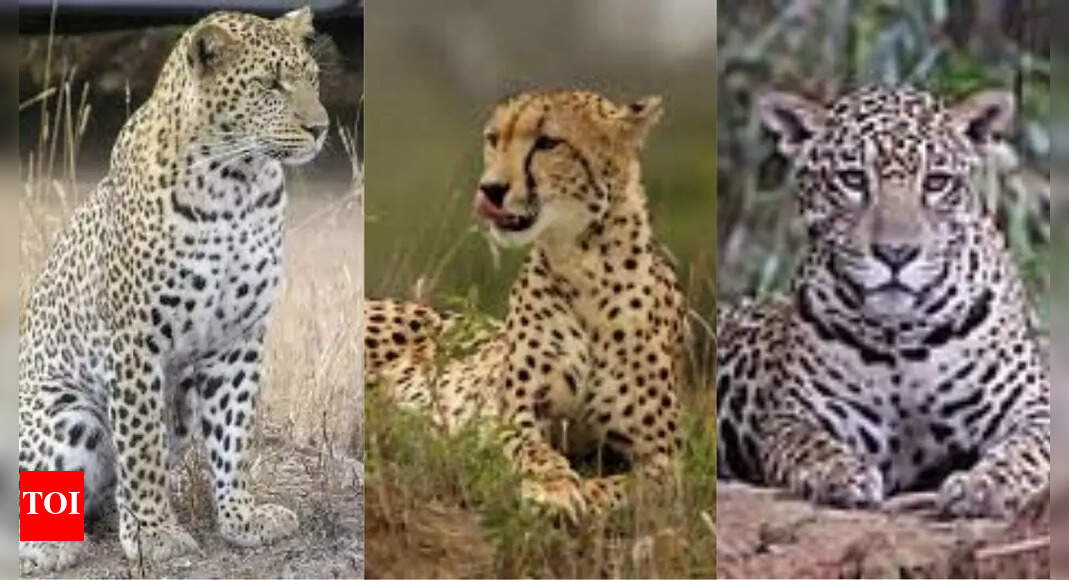
In the world of big cats, the leopard, cheetah, and jaguar each bring their own unique traits to the wild. While all share the title of “feline royalty,” they stand out with their incredible abilities and personalities. From the lightning-fast cheetah to the powerful, stealthy jaguar, and the adaptable leopard that thrives in diverse habitats, these majestic creatures are more than just impressive, they’re truly fascinating. In this article, we’ll explore the key differences and surprising similarities between these iconic predators, revealing what makes each one a true marvel of nature. Get ready to dive into the world of big cats.
Difference between leopard, cheetah and jaguar
Leopards, cheetahs, and jaguars are different species of big cats with different characteristics. Leopards are solitary hunters that thrive in a range of habitats. Cheetahs are the fastest land animals and are built for speed, specialized to chase prey in open grasslands. Jaguars are the largest cats in the Americas and are characterized by their strength and preference for dense forests.
- Scientific Name: Leopards are scientifically known as Panthera pardus, cheetahs are Acinonyx jubatus, and jaguars are Panthera onca. These species belong to different genera within the Felidae family.
- Habitat: Leopards can be found everywhere, from open woodlands to savannas. Cheetahs have a habitat of mostly arid, savannas, and the open plains; they use these areas for speed hunting. Jaguars are mainly based in the tropical rainforests of Central and South America, often in wetland and grassy areas, within dense, warm environments.
- Racing speed: Cheetahs are renowned for their speed, reaching up to 130 km/h in short bursts. Leopards can run at 58 km/h, and jaguars reach 80 km/h. While cheetahs prioritize speed, leopards and jaguars rely more on strength and stealth during hunting.
- Height & weight: Leopards typically weigh 31 kg, cheetahs range from 21–72 kg, and jaguars, being the heaviest, weigh 56–96 kg.
- Fur color: Leopards have golden coats with dark rosettes, cheetahs have a tan coat with black spots, and jaguars possess golden or orange fur with rosettes containing central spots.
- Lifespan: Leopards live 12–17 years, cheetahs 10–12 years, and jaguars 12–15 years in the wild.
7 similarities between leopards, jaguars, and cheetahs
- Same family: All three animals are part of the Felidae family, which constitutes all big cats. Though the three are distinct, they are still part of the felines.
- Spotted fur patterns: These big cats are known for their spotted coats. Leopards and jaguars have rosettes- spots in circular patterns, whereas cheetahs have black spots on their golden coats, but all have that unique feature.
- Carnivorous diet: All three are technically carnivorous, though some of them may have a slight omnivorous nature and they do consume a few non-meats, including fruits or grass, just to digest sometimes. Their major source of diet comprises smaller animals and ungulates.
- Powerful jaws and teeth: All three have strong jaws with sharp teeth to help them catch their prey. All three hunt different ways, though. Jaguars are powerful in the force of their jaws and teeth in biting their prey.
- Territorial behavior: All three, leopards, jaguars, and cheetahs, are territorial. They mark their ranges with scent glands and maintain control over specific areas to prevent other animals from intruding.
- Solitary nature: Big cats are generally solitary animals. While cheetahs do form temporary groups, leopards and jaguars prefer to live alone, especially when hunting.
- Adaptability: these cats are also adaptable, capable of living in diverse environments. From the savannas and grasslands of cheetahs to forests and jungles occupied by leopards and jaguars, they tend to be more flexible and adaptable to ecosystems in order to stay alive.
Also Read: 7 fascinating animals found in Belgium
var _mfq = window._mfq || [];
_mfq.push([“setVariable”, “toi_titan”, window.location.href]);
!(function(f, b, e, v, n, t, s) {
function loadFBEvents(isFBCampaignActive) {
if (!isFBCampaignActive) {
return;
}
(function(f, b, e, v, n, t, s) {
if (f.fbq) return;
n = f.fbq = function() {
n.callMethod ? n.callMethod(…arguments) : n.queue.push(arguments);
};
if (!f._fbq) f._fbq = n;
n.push = n;
n.loaded = !0;
n.version = ‘2.0’;
n.queue = [];
t = b.createElement(e);
t.async = !0;
t.defer = !0;
t.src = v;
s = b.getElementsByTagName(e)[0];
s.parentNode.insertBefore(t, s);
})(f, b, e, ‘https://connect.facebook.net/en_US/fbevents.js’, n, t, s);
fbq(‘init’, ‘593671331875494’);
fbq(‘track’, ‘PageView’);
};
function loadGtagEvents(isGoogleCampaignActive) {
if (!isGoogleCampaignActive) {
return;
}
var id = document.getElementById(‘toi-plus-google-campaign’);
if (id) {
return;
}
(function(f, b, e, v, n, t, s) {
t = b.createElement(e);
t.async = !0;
t.defer = !0;
t.src = v;
t.id = ‘toi-plus-google-campaign’;
s = b.getElementsByTagName(e)[0];
s.parentNode.insertBefore(t, s);
})(f, b, e, ‘https://www.googletagmanager.com/gtag/js?id=AW-877820074’, n, t, s);
};
function loadSurvicateJs(allowedSurvicateSections = []){
const section = window.location.pathname.split(‘/’)[1]
const isHomePageAllowed = window.location.pathname === ‘/’ && allowedSurvicateSections.includes(‘homepage’)
if(allowedSurvicateSections.includes(section) || isHomePageAllowed){
(function(w) {
function setAttributes() {
var prime_user_status = window.isPrime ? ‘paid’ : ‘free’ ;
w._sva.setVisitorTraits({
toi_user_subscription_status : prime_user_status
});
}
if (w._sva && w._sva.setVisitorTraits) {
setAttributes();
} else {
w.addEventListener(“SurvicateReady”, setAttributes);
}
var s = document.createElement(‘script’);
s.src=”https://survey.survicate.com/workspaces/0be6ae9845d14a7c8ff08a7a00bd9b21/web_surveys.js”;
s.async = true;
var e = document.getElementsByTagName(‘script’)[0];
e.parentNode.insertBefore(s, e);
})(window);
}
}
window.TimesApps = window.TimesApps || {};
var TimesApps = window.TimesApps;
TimesApps.toiPlusEvents = function(config) {
var isConfigAvailable = “toiplus_site_settings” in f && “isFBCampaignActive” in f.toiplus_site_settings && “isGoogleCampaignActive” in f.toiplus_site_settings;
var isPrimeUser = window.isPrime;
var isPrimeUserLayout = window.isPrimeUserLayout;
if (isConfigAvailable && !isPrimeUser) {
loadGtagEvents(f.toiplus_site_settings.isGoogleCampaignActive);
loadFBEvents(f.toiplus_site_settings.isFBCampaignActive);
loadSurvicateJs(f.toiplus_site_settings.allowedSurvicateSections);
} else {
var JarvisUrl=”https://jarvis.indiatimes.com/v1/feeds/toi_plus/site_settings/643526e21443833f0c454615?db_env=published”;
window.getFromClient(JarvisUrl, function(config){
if (config) {
const allowedSectionSuricate = (isPrimeUserLayout) ? config?.allowedSurvicatePrimeSections : config?.allowedSurvicateSections
loadGtagEvents(config?.isGoogleCampaignActive);
loadFBEvents(config?.isFBCampaignActive);
loadSurvicateJs(allowedSectionSuricate);
}
})
}
};
})(
window,
document,
‘script’,
);
Source link

