

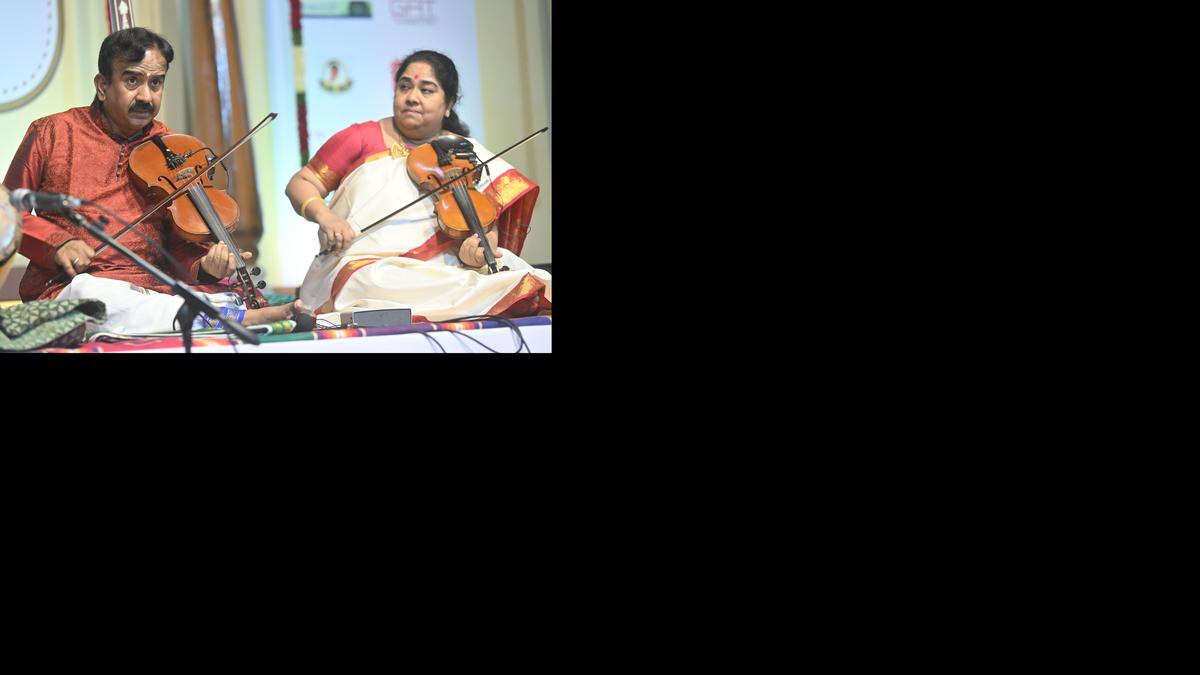
Lalgudi GJR Krishnan and Lalgudi Vijayalakshmi, performing at Narada Gana Sabha in Chennai.
| Photo Credit: RAVINDRAN R
The rain pattered softly outside, setting a prelude to the concert. Inside, the Lalgudi siblings — G.J.R. Krishnan and Vijayalakshmi — took the stage with their signature poise, supported by Thiruvaarur Bakthavathsalam on the mridangam and K.V. Gopalakrishnan on the kanjira.
The concert opened with ‘Sri mahaganapathi’ in Gowla, a timeless composition by Muthuswami Dikshitar. The mridangam set off with a crisp and confident start, and the kanjira’s entry from the anupallavi added depth to the rhythmic structure.
The evening moved forward with the Nagaswarali kriti ‘Sri shankara guruvaram’, a composition by Maha Vaidyanatha Iyer. Brisk and engaging, the piece showcased tonal diversity between two violins, each articulating the raga’s character in its own hue.
The concert was impacted by unsatisfactory audio output, with excessive high-end frequencies dominating the mix.
The third piece, ‘Kaa vaa vaa’ in Varali by Papanasam Sivan was layered with energetic sollus and kuraippus from the percussion. While technically impressive, the rhythmic density slightly overshadowed the innate emotional depth of the composition.
Vijayalakshmi took the lead for the Bilahari alapana, which preceded Tyagaraja’s ‘Naa jeevadhara’ set to Adi tala. The medium-fast tempo once again placed rhythm at the forefront. Krishnan handled the lower-octave phrases with commendable control, and the presentation overall felt engaging. ‘Gaanamurthe’ in raga Ganamurthi, another Tyagaraja composition, followed. The violin duo maintained musical balance and grace.
The main piece featured Hindolam, where Krishnan began with a bold exploration utilising vaadi and vivadi swaras. This lent a distinct western-leaning contour enhanced by agile playing techniques and rapid gamakas, while holding creativity strong. Krishnan’s style emerged assertive and sharp, while Vijayalakshmi’s contribution felt gentler and more deeply rooted. After an elaborate alapana, the duo unfolded ‘Neerajakshi kamakshi’ by Muthuswami Dikshitar in Rupakam.
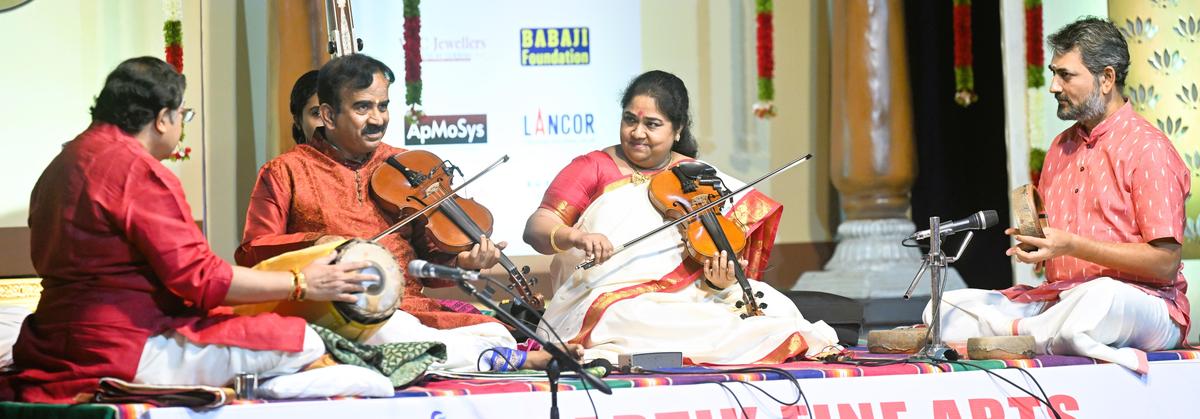
Lalgudi GJR Krishnan and Lalgudi Vijayalakshmi accompanied by Tiruvaarur Bakthavathsalam on the mridangam, K.V. Gopalakrishnan on the kanjira.
| Photo Credit:
RAVINDRAN R
The accompaniment interchange at the kalpanaswara — Krishnan with the kanjira and Vijayalakshmi with the mridangam — added variety. The duo’s expressive rhythmic interplay, mirrored by the percussion team, was ambitious. The final kalpanaswara section, with double-string techniques, enhanced the energy.
The tani avartanam began on a powerful tone, leaning towards thavil-style aggression. The softer, controlled kanjira by K. V. Gopalakrishnan stood out in contrast, clean and measured with elegant patterns. In the combined section, mismatches again appeared, particularly when a three-beat stroke by Bakthavathsalam went unanswered by the kanjira. A beautifully slow mohra followed with a complex korvai by Bakthavathsalam closed the thani.
A delightful change of atmosphere arrived with Papanasam Sivan’s ‘Idathu padam thooki aadum’ in Khamas, bringing devotional sweetness brimming with bhakti. This was followed by a deeply moving Sindhu Bhairavi, as the duo gave a different dimension to the raga. ‘Chandrashekara’ was meditative.
The concert approached its finale with a Mohana Kalyani thillana composed by Lalgudi Jayaraman (the duo’s guru and father), performed on the special request of Bakthavathsalam. The duo’s bowing radiated joy and camaraderie across the stage.
Published – December 16, 2025 01:27 pm IST

