

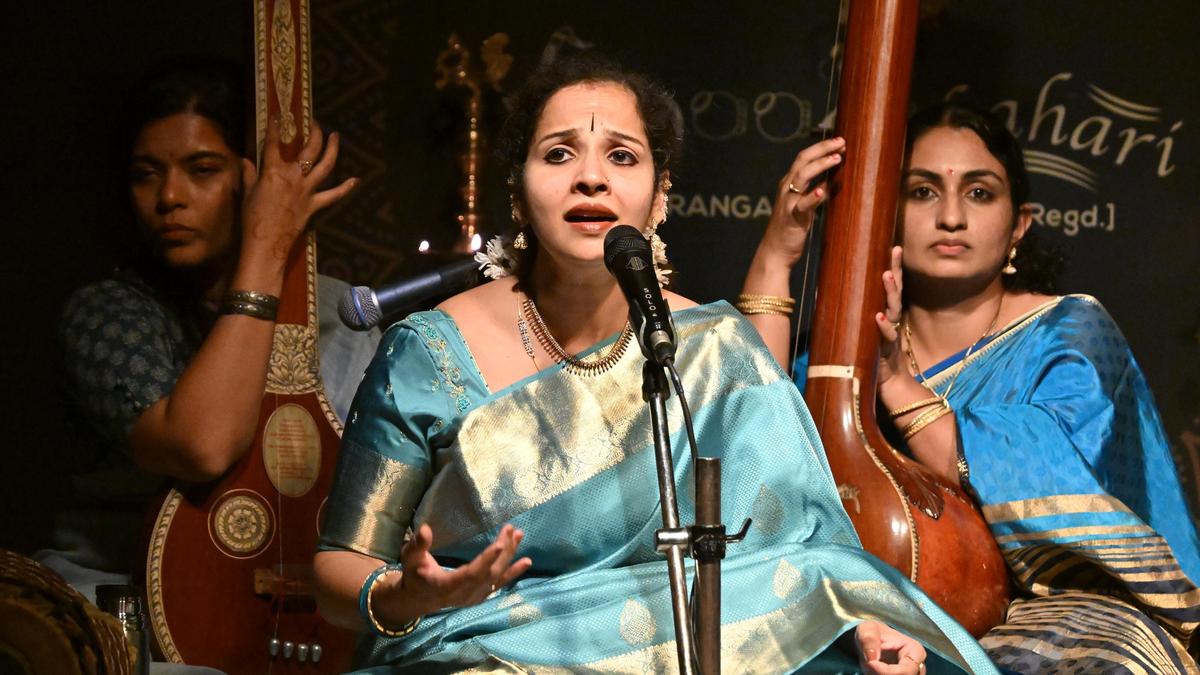
K. Gayatri at the Suguna Purushothaman Memorial concert, hosted by Sunaada Lahari.
| Photo Credit: SRINATH M
Few contemporary Carnatic musicians have the privilege of serving as custodians of their guru’s compositional legacy, and presenting concerts drawing entirely from that repertoire. K. Gayatri, the principal disciple of musician-composer Suguna Purushothaman (1941–2015), offered a heartfelt tribute to her guru, enriched by the versatile ensemble of R. Hemalatha (violin), N.C. Bharadwaj (mridangam) and S. Sunil Kumar (kanjira).
Organised by the Indira Ranganathan Trust at Sunaada Lahari, the memorial concert was both an emotional homage and a showcase of Suguna Purushothaman’s remarkable creativity. A pioneering woman vaggeyakara, she left behind around 150 songs, predominantly in Tamil, spanning varnams, kritis, thillanas, ragamalikas and compositions featuring nadai variations and even talamalikas. Her songs are marked by lyrical felicity, melodic charm and rhythmic vitality. An exponent in the realm of tala, she specialised in Dwi-tala Avadhana — the complex art of singing while keeping two different talas simultaneously — a skill she imparted to Gayatri.
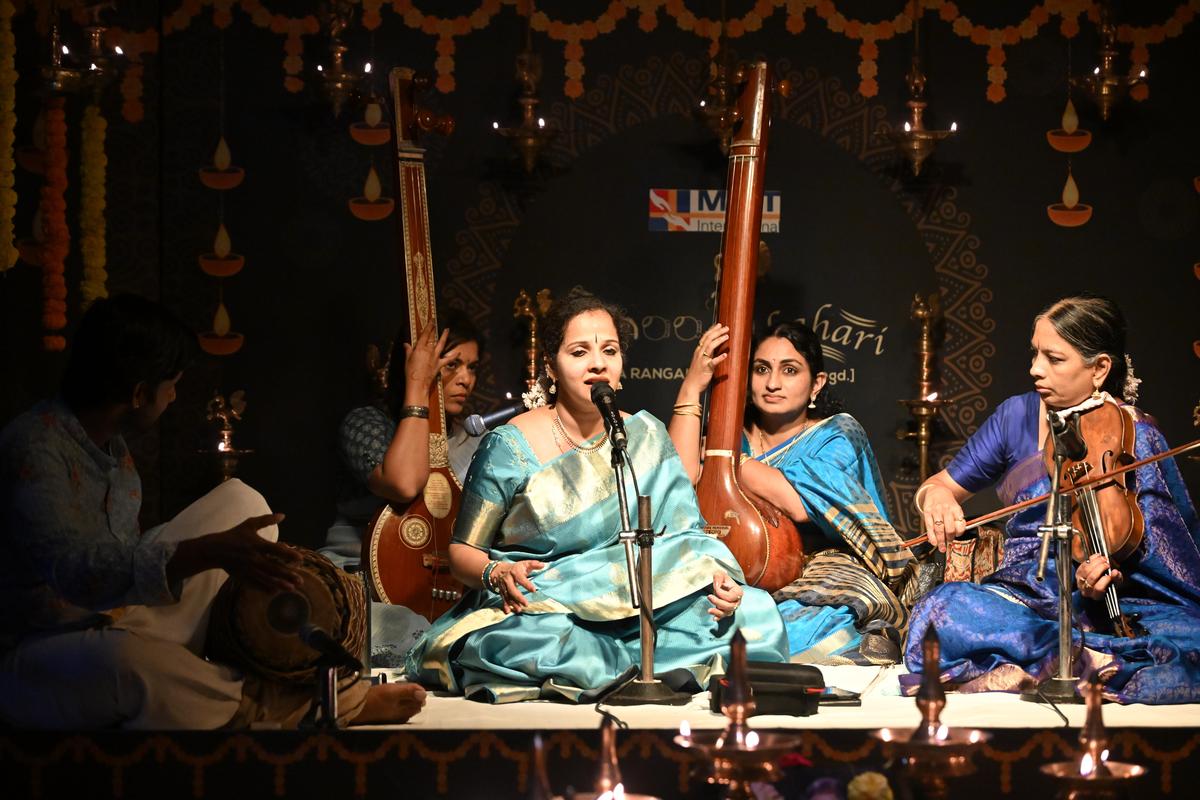
K. Gayatri accompanied by R. Hemalatha (violin), N.C. Bharadwaj (mridangam) and S. Sunil Kumar (kanjira).
| Photo Credit:
SRINATH M
Variety defined the concert’s 12 compositions, many of them carrying special significance. The Mukhari varnam ‘Rama raghava rajeeva’ — which the vocalist mentioned she learned after a chance discovery of its manuscript — interestingly contained the word ‘Purushothaman’ though her guru’s mudra was ‘Suguna’. The blend of Valaji’s melody and tisra jhampa (tisra gati) in ‘Thirumagale kadaikkan’ was a delight, while lyrical beauty stood out in the Navagraha kriti ‘Thannoli pozhiyum thingale’ in Mohanakalyani. It is noteworthy that Suguna has composed kritis dedicated to all the nine celestial bodies.
Gayatri’s Kokilapriya alapana flowed soothingly, filled with the raga’s characteristic phrases, a mood mirrored by Hemalatha in her violin solo. The kriti ‘Arangaa nee irangayenil’ and the niraval thereupon evoked a yearning for divine grace. The charanam opening ‘Andaalai thirumanam kondaay; azhwargalin manam kondaay’ made a distinct impression for its subtle wordplay.
‘Srinivasan sridevi nesan’, a lilting swarajathi in Kedaragowla, was rendered next. Its symbolic structure saw successive charanams take off from a higher starting point in the raga’s ascending scale, musically mapping the climb to the Lord’s hilltop abode. The journey then descended to Thiruvallikkeni with ‘Parthasarathiyai orumurai’ in Salagabhairavi-Misra Chapu, a song Gayatri rendered with keen attention to the raga’s distinctive hues.
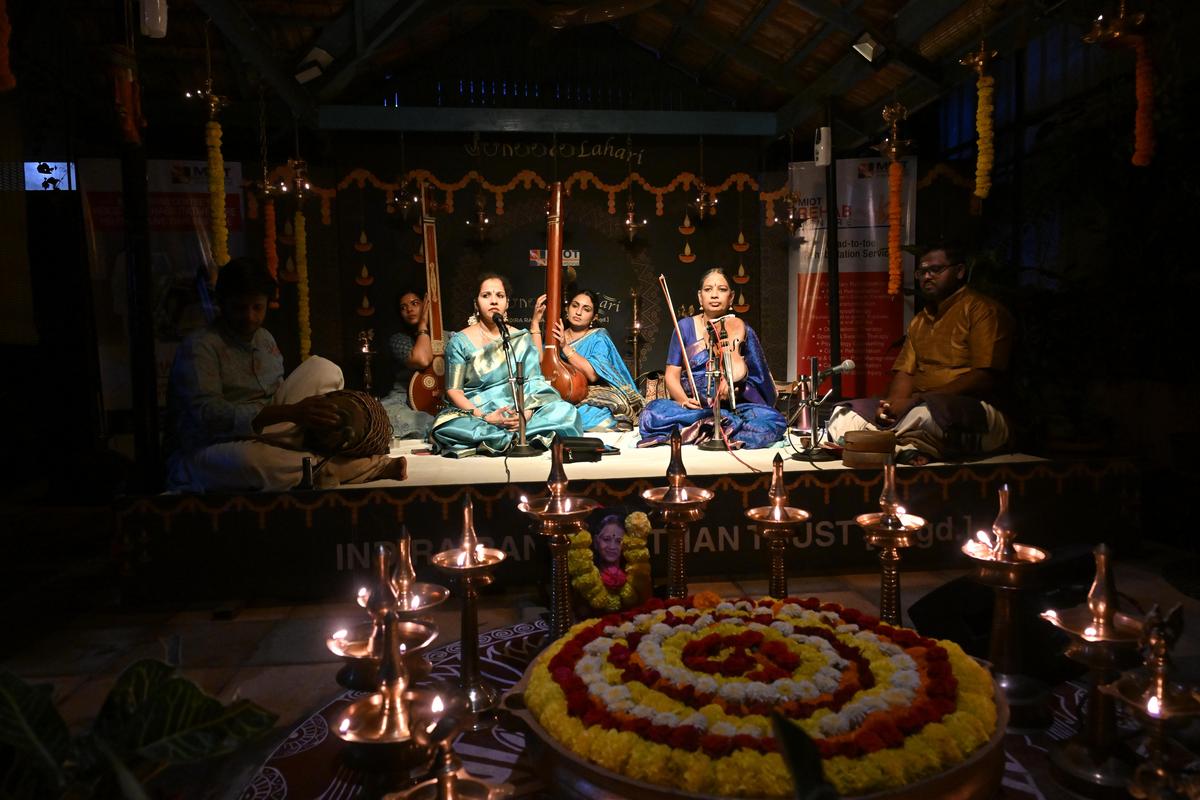
From varnams to talamalikas, K. Gayatri brought alive Suguna Purushothaman’s diverse oeuvre.
| Photo Credit:
SRINATH M
Ramapriya, chosen for the central suite, proved to be the recital’s high point. Fluency reigned and sublime phrases rained through the raga essay as Gayatri’s manodharma took a measured flight. Hemalatha responded with matching poise and silken touch. The composition ‘Rama namame thunai’ served as self-counsel on holding on to the Lord’s name for solace. The team seamlessly launched into the niraval and swara exchanges at ‘Raghava ravikula aadhava’ in the charanam, where the second-speed exploration was vigorous, yet polished. Percussionists Bharadwaj and Sunil Kumar, who provided excellent support throughout, delivered a precise and lively tani avartanam in two-kalai Adi tala.
This was followed by ‘Garuda vahana’ in Bhavapriya (on Kanchi Varadar) and ‘Navamanigalile’ in Yamunakalyani (on Sarada Devi). ‘Chaturmukhan nayaki’, a kriti aptly tuned in Saraswathi and set to Chaturmukhi tala (an anga tala of 28 syllables: 1 guru + 2 laghus + 1 plutham), was a logical inclusion considering the guru’s rhythmic mastery. The disciple navigated the challenge with ease and grace.
Gayatri then presented another innovative kriti ‘Panchabhuta thalangalil vaazhum’, a raga-tala malika on the Shiva shrines corresponding to the Five Elements. The pallavi of this Panchabhuta Linga Malika is set in Sankarabharanam-Misra Chapu, while its five charanams — each dedicated to an element, tuned in different ragas, but all set to Adi tala — correspond to: Earth (Kanchi Ekamresa, Bhupalam), Water (Thiruvanaikka, Amrutavarshini), Fire (Thiruvannamalai, Chandrajyothi), Air (Kalahasti, Malayamarutam) and Space (Chidambaram, Nilambari). Notably, the names of the chosen ragas aligned symbolically with the elemental nature of each kshetra.
The ragamalika thillana in Valaji, Varamu and Hamsanadam, set to the grand Simhanandana tala, the longest one (128 aksharas per avartanam), brought a memorable and thoughtfully curated recital to a close.
Published – December 16, 2025 01:45 pm IST

