

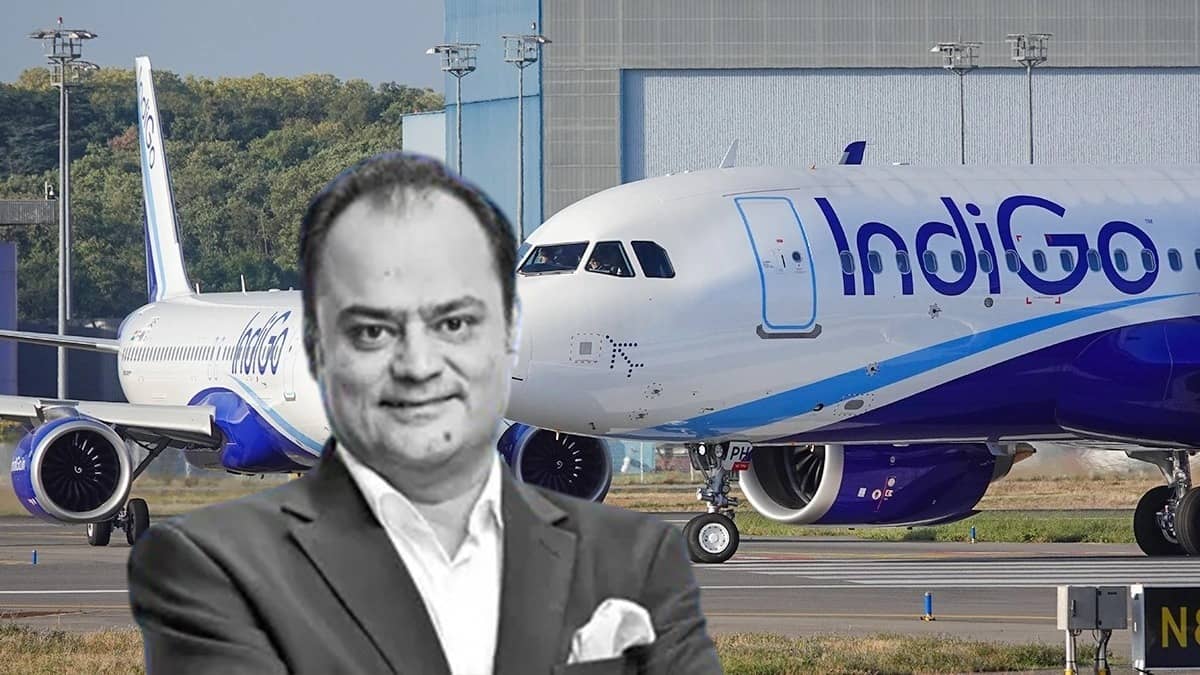
Indigo Needs To Land This One: Reputation In A Time Of Crisis | Image:
Republic
Every large brand eventually reaches a moment when the machinery it depends on breaks down .
What’s significant is not how large a disruption occurs, but whether the organisation recognises the nature of the moment.
Some firms slow themselves deliberately so as to repair the damage while others accelerate straight into their own suicide.
IndiGo now finds itself confronting such a decision point and , as it appears, seems to be making a right royal mess of it.

Indigo is a marvelous brand so sharp in its differentiation. The airline’s success rested on an unusually disciplined operating rhythm. Flights turned around faster than much of the industry, arrival times held with statistical consistency, and the experience of travelling with IndiGo seemed engineered around reliability rather than embellishment.
It was a model that treated punctuality as service. That is what customers internalised first even before a low fare , no frills proposition (although a sandwich all the way to Singapore is a bit extreme!) .
It was a brand that stabilised a traditionally unstable category culture.
The disruption unfolding over these past couple of days does not resemble external shocks or sudden weather induced paralysis.
It appears instead to be a slow accumulation of strain with staffing cycles that did not anticipate regulatory change, scheduling logic that assumed continuity, and an operational system stretched until its margins frayed.
In aviation, fragility arrives all at once. It’s more like a landslide and less a glacial movement. When that does happen, passengers encounter not a delayed journey but a broken promise.
What is worth studying is how some organisations respond when the foundational promise is jeopardised. Several prominent examples come to mind.
Toyota grappled with product failures more than a decade ago and it shrank its operational footprint before reopening it.
When Southwest Airlines in the U.S. faced a scheduling breakdown, it recalibrated publicly gradually allowing full capacity back into the system. The instinct has to be corrective rather than defensive.
Disruptive crisis puts you naked inside a glass house. Visible action becomes the right minded mode of recovery.
I was at Mumbai T2 yesterday. I walked out leaving baggage behind. Sadly, in IndiGo’s case, the corrective instinct has been harder to detect. Operations have continued, schedules have compressed, and the customer front remains open even as internal systems appear to strain. This is where brand memory forms, from inconvenience, from opacity, from abandonment.
People tend to forget a disrupted journey but they rarely forget abdication. The queue becomes a huddle. The unanswered question becomes the enduring memory.
There is still room for the airline to treat this period as an internal reset rather than a public disruption. A temporary deceleration, accompanied by measurable clarity on how operations will stabilise would communicate intent rather than helplessness. Above all speak the truth CONTINUALLY.
Reputation, once frayed , does not come apart only at the edges. It cuts across each part of the fabric.
Customers shift quietly, not dramatically. They do not abandon a brand all at once (given the limited and sad choice spectrum) but they simply begin selecting alternatives one booking at a time. That drift, if unchecked, becomes structural. IndiGo has, until now, benefited from the absence of equivalently reliable options. That advantage is real, but not inexhaustible.
Moments like this tend to define the character of a company more than its periods of growth. What IndiGo chooses to do now may matters symbolically. It has the opportunity to treat its crisis as a recalibration rather than an apology. The disruption is not incidental. They should fess up.
In the long arc of brands that have encountered breakdowns, the ones that eventually regained stature were those that paused long enough to repair the logic of their promise before inviting customers back into it.
That is the real learning here . It’s the essence of reputation that bad times make it more than good times.

