

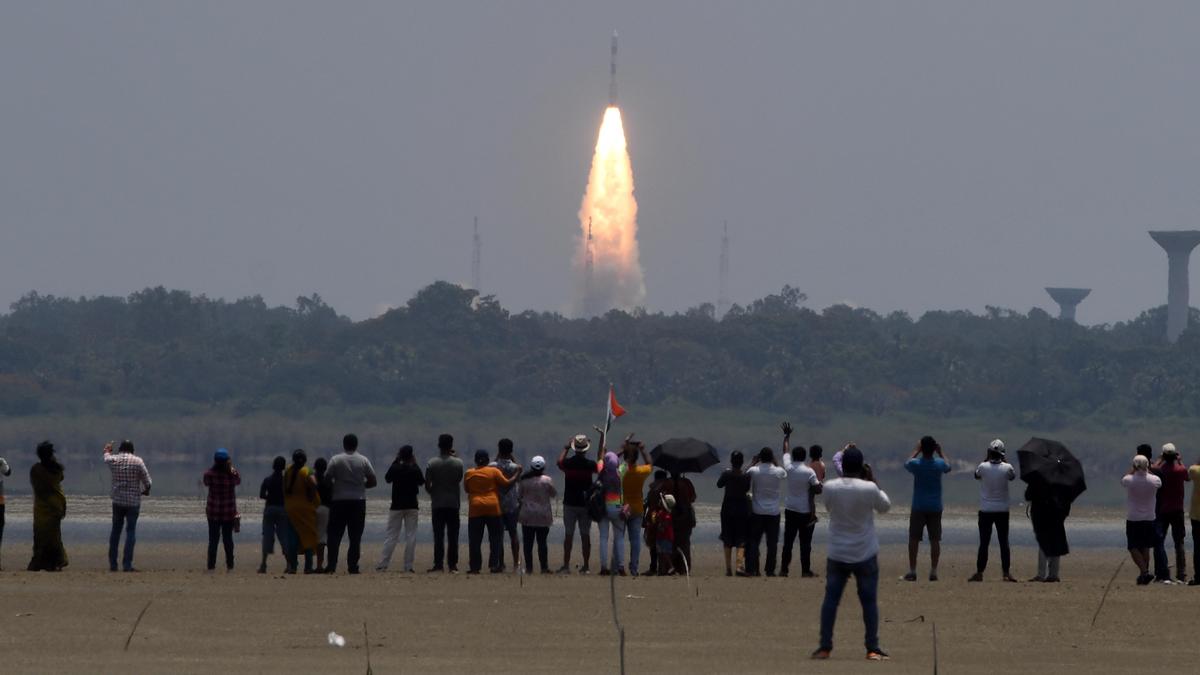
India’s space journey has evolved beyond a string of spectacular missions. It has the national pulse and is a source of daily inspiration. In June 2025, when Group Captain Shubhanshu Shukla displayed the Tricolour aboard the International Space Station (ISS) and spoke to Prime Minister Narendra Modi, it was a moment of pride for every Indian. The Prime Minister called it a “defining chapter” of Amrit Kaal (‘era of nectar’), and for many, that moment felt like India’s ascent was a part of their own heartbeat. It was not just science. It was identity being reshaped through vision and purposeful programmes.
That same spirit has been echoed earlier, on August 23, 2023, when Chandrayaan-3 made India the first nation to land near the lunar south pole. “India is now on the Moon,” declared Mr. Modi — words which rippled through classrooms, villages and living rooms alike. India’s lunar programme has been truly path breaking: Chandrayaan-1 (2008) confirmed the presence of water molecules; Chandrayaan-2 (2019) mapped the moon with high precision and prepared the ground for Chandrayaan-3 (2023), which achieved the world’s first soft landing near the south pole. When the Vikram lander and Pragyan rover explored the lunar surface for a full moon day, this led children to draw depictions of lunar landscapes in notebooks, it left researchers feeling vindicated, and inspired citizens who saw India’s story in space as also their own future.
India has become a trusted global partner in space. Over 400 foreign satellites have been launched aboard Indian rockets. In 2014, India became the first Asian nation and only the fourth in the world to reach Mars orbit — and on its maiden attempt, with the Mars Orbiter Mission (Mangalyaan). The Aditya-L1 mission (2023), built through multi-institutional collaboration, is providing unprecedented insights into the sun’s corona and its impact on space weather. XPoSat (2024) is studying black holes, while SpaDeX (2024) has demonstrated in-orbit docking for future space stations and lunar missions.
A new space vision
These milestones are reshaping policy, culture, and aspiration. The road map is bold: continuation of the Gaganyaan programme for human spaceflight, Chandrayaan-4 and 5 for deeper lunar exploration, a dedicated Venus mission, a Bharatiya Antariksh Station (BAS) by 2035, and an Indian human landing on the Moon by 2040. These are not distant dreams but national goals, aligned with the spirit of Amrit Kaal.
The Prime Minister has called for building a pool of 40 to 50 trained astronauts for future missions. On National Space Day 2025 (August 23), he urged young citizens to see themselves as participants in India’s human space programme. Gaganyaan, with an approved outlay of over ₹20,000 crore, is advancing steadily. Four Indian Air Force test pilots are undergoing training, and a series of uncrewed and crewed flights will culminate in India’s first indigenous human space mission, presently targeted for 2027.
Space technology today is woven into the fabric of governance and daily life. Satellites deliver disaster warnings, guide fishermen, assess crop yields and insurance claims, enhance railway safety, and power the geospatial backbone of the PM Gati Shakti programme. Space is no longer a distant luxury but a democratic utility — accessible to every citizen.
At the same time, space exploration fuels Science, Technology, Engineering and Mathematics (STEM) education, advanced research, and workforce development. Future-ready technologies in space operations autonomy, robotics, in-space manufacturing, surveillance and interplanetary travel are being developed, ensuring that India retains leadership in this strategic frontier.
The transformation of India’s space sector is deliberate and ambitious. The opening of the field to private players, creating a thriving ecosystem of more than 350 startups building satellites, launch vehicles, and ground systems. The space budget has nearly tripled — from ₹5,615 crore in 2013-14 to ₹13,416 crore in 2025-26 — and has been augmented by nearly ₹5,000 crore in user funds. India’s space economy, currently valued at $8 billion, is projected to grow to $44 billion in the years ahead, creating jobs, industries and innovations that orbit around this sector.
Inspiring the next generation
The Prime Minister has challenged the ecosystem to deliver five space unicorns within the next five years and to scale up annual launches, nearly ten-fold, to 50 a year. With private participation, India is advancing technologies related to semi-cryogenics, electric propulsion, quantum communication and in-orbit servicing.
Youth are at the heart of this vision. The International Olympiad on Astronomy and Astrophysics hosted in India (August 2025) drew nearly 300 participants from over 60 countries, with Indian students winning medals. Initiatives such as the ISRO Robotics Challenge and Indian Space Hackathon/Bharatiya Antariksh Hackathon are bringing school and college students into direct contact with rovers, satellites and rockets, building confidence that the laboratories and launchpads of tomorrow are theirs to claim.
At the policy level, the National Meet 2.0 held just before National Space Day produced 5,000-plus pages of documentation across 300 user interactions. This 15-year road map aligns every mission with the vision of Viksit Bharat 2047.
Global collaborations and leadership
Space has been consistently projected as a global commons, where India’s leadership translates into shared progress. The South Asia Satellite has provided neighbours with communication capacity, while during India’s G-20 Presidency in 2023, India announced a “G20 satellite” for climate and environmental monitoring with data shared with all nations. Collaborative missions such as NASA-ISRO Synthetic Aperture Radar (NISAR) with the National Aeronautics and Space Administration (NASA), Thermal infraRed Imaging Satellite for High-resolution Natural resource Assessment (TRISHNA) with CNES (French space agency), Lunar Polar Exploration (LUPEX) with Japan Aerospace Exploration Agency (JAXA), and India’s participation in the European Space Agency (ESA)’s Proba-3 demonstrate India’s rise as a global partner, guided by the ethos of Vasudhaiva Kutumbakam (‘the world is one family’).
India’s space journey is more than rockets and satellites. It is about a nation discovering new ways to see itself. The salute of Shubhanshu Shukla aboard the ISS, the landing of Chandrayaan-3, 350 startups from small towns designing space systems, young students competing in Olympiads, and satellites quietly serving national security and citizen services are all part of the same story.
In this Amrit Kaal, India is not simply participating in the space age. It is shaping it. With ambition, confidence, and purpose, Bharat looks to the stars knowing that the horizon belongs to it too.
S. Somanath was former Secretary, Department of Space, and Chairman of the Indian Space Research Organisation (ISRO). He is now Distinguished Visiting Professor, Indian Institute of Science (IISc), Bengaluru, and Adviser (Space Technology), Government of Andhra Pradesh. The views expressed are personal
Published – January 01, 2026 12:16 am IST

