

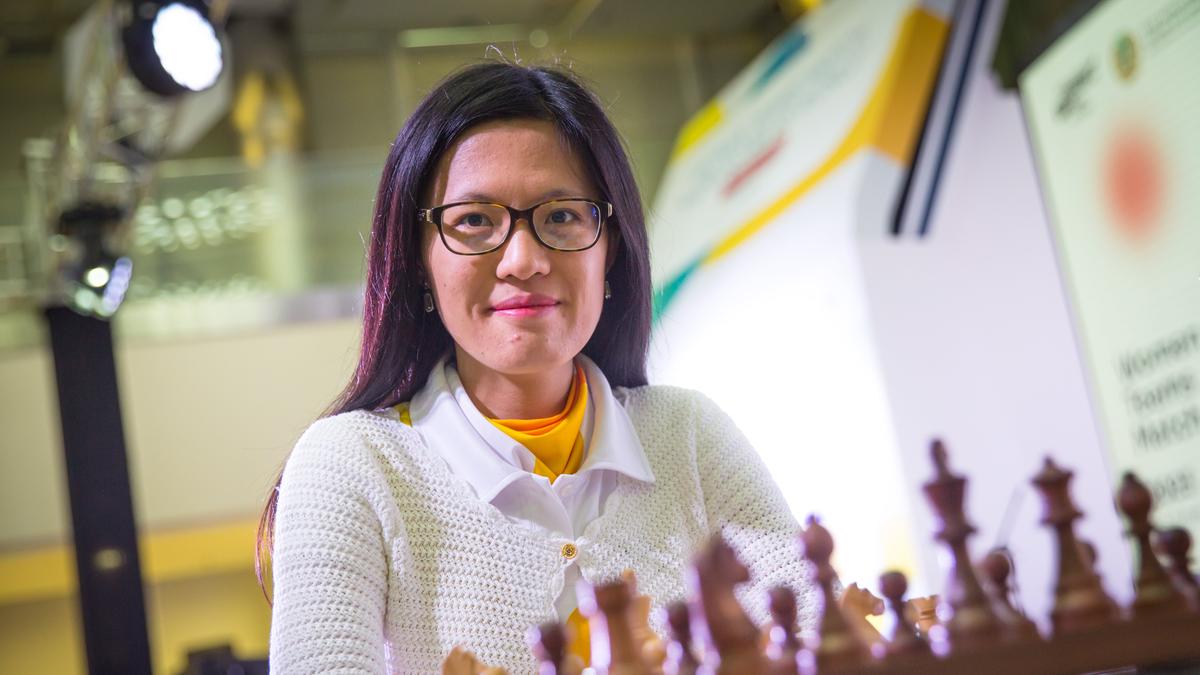
Hou Yifan became the women’s World chess champion at 16 and abdicated her crown seven years later. In all her title matches, she never lost a game. She is the second-strongest female player of all time, behind Judit Polgar. Chess may no longer be her only interest in life: she is a professor at Peking University and is planning to pursue a PhD in neuroscience.
But Hou still remains the women’s No. 1. She occasionally reminds the world of that fact. Like she did recently in Mumbai, where she played a stellar role in Alpine SG Pipers’ triumph in the Global Chess League. She won her last four games in the league phase to help her team make the final. Excerpts from an exclusive interview Hou gave The Hindu:
You have been a regular at the Global Chess League.
This league is very important for the chess world, no matter the format, which is innovative. It is not just the world’s top male players, there are women and juniors. In an elite event, girls and juniors usually don’t get the chance. There is the entertainment aspect of chess too, while keeping intact the professionalism of the sport. This was my second time with SG Pipers, and it was nice being a teammate of players like Fabiano Caruana, Anish Giri and R. Praggnanandhaa.
And how did you find working with coach Pravin Thipsay?
He is an experienced Grandmaster and has really good theoretical knowledge. We were surprised by some of his understanding of the position, especially the endgame. We later found out that Mumbai is his hometown. This is my first visit and I have liked the city, the hotel, the location and the food.
You don’t play as often as you used to.
Chess is not my entire life now. I have the passion for it, but it is mainly like a hobby instead of a profession. I am trying to participate in the events in the way I can. Sometimes you miss the game and also you miss the people.
Do you miss that winning feeling as well?
Not really. Personality-wise, if you’re not talking about chess, I think I am not that competitive. Of course, when I play, I fight for that win, but outside the chess world, I am not like that. Chess for me represents not just the results. For instance, there is the beauty and philosophy of chess. That I find is more attractive than winning a game. Imagine if you luckily win a couple of games, when the position was not winning. So you win by chance, or luck. Let us imagine you are a professional player and you play chess for decades. You won maybe half of them. You didn’t win half of them. That is suffering. Yes, I have relatively attained a certain level in my career. I have won most of the games.
You never lost a game in a World title match. After winning your first championship, in the knockout format, you won three title matches without dropping a single game.
Yes, actually I was surprised. All my three matches, yes. And I finished the match even before all the games had to be played.
You have not just been the World champion but one of the best of all time. So stepping away from that, when you were still in your prime and very young and beginning a new career… How did you find that transition?
It is not difficult. I am just following my heart to make the decision at the moment I want. Let us say I know that chess is part of my life, but I also understand that my life could not be lived only with chess. That is why I felt like, you should remember first you are a human, then you are a chess player. The world is huge, right? It is not just a chessboard and the pieces. I do not want, you know, when you visit a place, when you think about something, when there are some stories, you connect only with chess. I know some of the others may not be like that, and I fully respect them, but I enjoy this kind of lifestyle more.
Do you remember when you made that decision? Was lack of motivation after winning successive World titles a factor?
A bit, but I think I didn’t really reach my maximum potential. My rating could have been higher. I just thought that I should get a certain education and explore. Maybe that had also something to do with my family background. But I didn’t think making such decisions were hard because I always kept in mind that if I wanted, I could come back to the chess world at any time. I normally do not regret what I did. So I enjoy who I am right now, pretty much. But at the same time, I have to admit, yes, if I spent those years on chess, I believe I should have been stronger; my peak should have been at least a bit higher.
Win-win situation: Hou believes the Global Chess League is ‘very important for the chess world’, not least because of the opportunity it offers women and juniors.
| Photo Credit:
GCL
Why international relations?
I am interested in diplomacy. So I thought that international relations, when it connected with geopolitics and negotiations, maybe there was something in common. But later I did my Masters in public policy. Now I am working for the physical education department. And I am actually applying for my PhD in neuroscience. I know it is a little cross-field. The subject I want to research is the connection between the brain and chess patterns. If you wanted to find something scientifically connected with chess, this is one of the obvious parts. As a chess player, I felt such research could be beneficial to the players, too.
How do you look back at your first World title?
The first title is always more meaningful and exciting. It was something special for me. More so because I broke the [32-year-old] record of Maia Chiburdanidze as the youngest champion. And she was a legend who inspired a lot of girls. But I didn’t really aim for the record, but the coach and my team kept telling me about it. I thought, OK, if I can try, that is good, but that is not easy, to be honest, because most of the players, if you want to achieve it at 16 or 17, it means you study chess for about 10 years. So that is why I thought D. Gukesh was amazing, because to win in the open section at a very young age is even much more difficult. Before my World Championship, I had played a rapid match with Anatoly Karpov in China, and he said I could win the World title. Coming as it did from a legend, it was very inspiring.
In 2011, you beat Koneru Humpy in the match to defend your World title.
That match was the toughest. Not just rating-wise, Humpy was at her peak. She had a very good home preparation, because I remember most of the games, after the opening, I was really in trouble. But I think I was lucky, I tried my best to fight back in the middle game.
Are you surprised that Humpy hasn’t won the classical World Championship yet?
Yes, she is one of the strongest players not to have won the World title. But she still has chances. She is playing the next Candidates, isn’t she?
Published – January 02, 2026 11:21 pm IST

