

In the minutes before the deadliest tsunami in India’s memory tore through its south-eastern shores on December 26, 2004, people living in those parts were just being themselves — laughing, crying, quarrelling, making love, lamenting or celebrating their destinies.
Seconds before wildfires gutted a huge swathe of Los Angeles’ beautiful landscape earlier this very month, people there were in different states of exhilaration — with the sheer loveliness of their surroundings, the blue of the sky, the reflection of that in the azure of the sea, shopping, discussing the future of their country under Trump and Musk, wringing their hands or raising them in celebration.
‘We could never have imagined…’ is how those affected put it. The calamities were put down to the caprice of nature which cannot be predicted or prevented.
But we can imagine; in fact more than imagine, we can see with the clarity with which the high-end scientific team in Los Alamos saw the first detonation of a nuclear weapon, conducted by the United States under the instructions of U.S. President Harry S. Truman at 5:29 a.m. on July 16, 1945, as part of the Manhattan Project. The sight was piercingly sharp. General Thomas Farrell, who was a witness, said in his official report: “The lighting effects beggared description… It lighted every peak, crevasse and ridge of the nearby mountain range with a clarity and beauty that cannot be described but must be seen to be imagined….” If Farrell saw the fury as beauty, the physicist Kenneth Bainbridge who planned and executed the test exclaimed ‘We are all sons of …now’. I leave the elided word to the reader’s imagination.
‘Perish or use common sense’
This year, 2025, is the 80th year of that test, the world’s first nuclear weapon test. It is also the 80th year of the first use of the bomb that had been tested over the Japanese cities of Hiroshima and Nagasaki less than one month later, killing between 1,50,000 and 2,46,000 people, mostly civilians, leading the Director of the project, J. Robert Oppenheimer, to cite the Bhagavad Gita’s stunning imagery of Death by the light and heat of a thousand suns. On the very day that the bomb fell on Nagasaki, Bertrand Russell began drafting a statement that said: “The prospect for the human race is sombre beyond all precedent. Mankind are faced with a clear-cut alternative: either we shall all perish, or we shall have to acquire some slight degree of common sense. A great deal of new political thinking will be necessary if utter disaster is to be averted.”
Ten years later, in 1955, Russell and Albert Einstein led nine other scientists to issue an appeal to the leaders of governments to avert nuclear disaster. Joseph Rotblat, the only scientist to have left the Manhattan Project on moral grounds convened a press conference at which the Manifesto was released. The manifesto called for “a conference where scientists would assess the dangers posed to the survival of humanity by weapons of mass destruction”. One particular phrase from the Manifesto has become lore: Remember your humanity, and forget the rest.
This is the 70th year of the Russell-Einstein Manifesto, the platinum anniversary of that expression of faith and hope for humanity. But in the intervening years, ‘humanity’ has been forgotten, ‘the rest’ has been pursued relentlessly. Glimmers of hope for humanity have risen through breakthrough arms control agreements and partial test bans, which have brought the world’s arsenal of nuclear weapons down, but the genii keep escaping from the vat of controls.
Today, the danger of a nuclear conflagration is more real than ever. Much more real and immediate than the ‘caprice’ of nature is the finger that can press a nuclear button annihilating all life on planet earth. The fingertip is dangerously close to that little surface and before we can say ‘Stop!’, we may be cinder. Or worse, may be becoming cinder. This is not fantasy. This is not science fiction. And we are all doing exactly what we were when calamity struck us in 2004, and struck California earlier this year. We are in dangerous denial.
The Avadi resolution
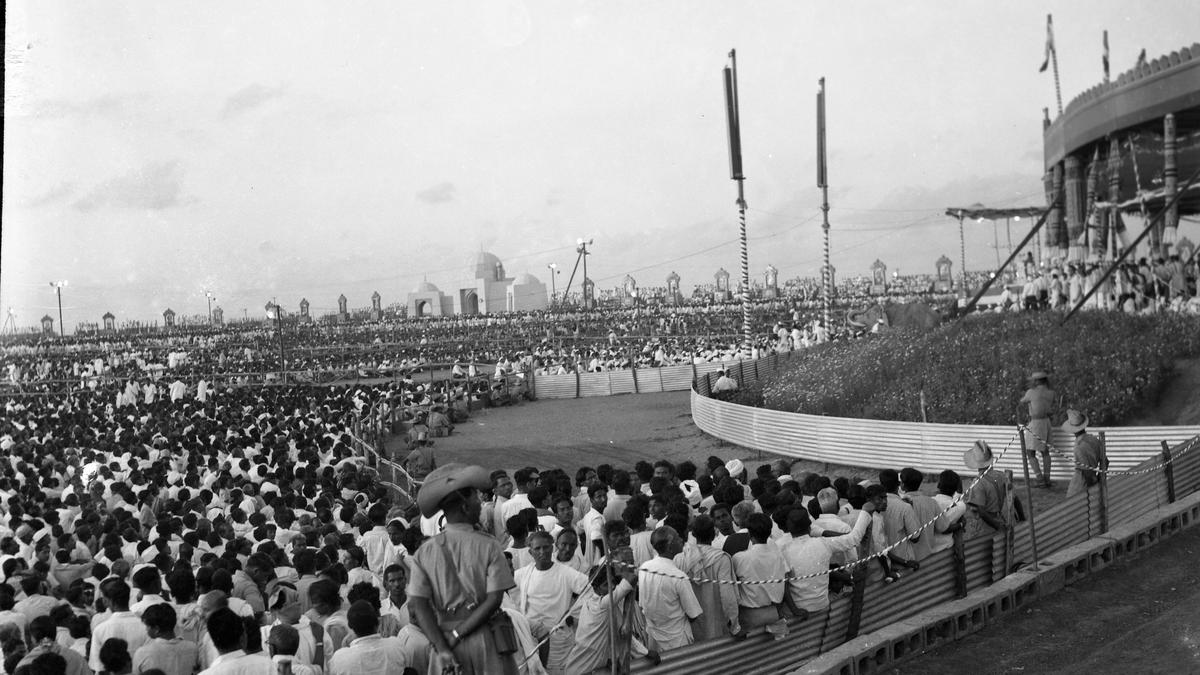
This year, 2025, is also the platinum anniversary of another event in India that is scarcely remembered now but was sensationally important at the time. On January 17, 1955 (70 years ago to the date today), the Indian National Congress met in plenary at Avadi, in what was then Madras State, and with Jawaharlal Nehru and C. Rajagopalachari present, passed important resolutions among which was one that anticipated the Russell-Einstein Manifesto. It said: ‘The ominous development in respect of atomic and hydrogen bombs are a menace not only to world peace but to civilisation itself. ..The total prohibition of the manufacture and use of atomic and hydrogen and other weapons of mass destruction as well as conventional atomic weapons such as atomic artillery is imperative if civilisation is to be saved from destruction.’
The Avadi resolution then called for the matter to be taken up by the Disarmament Commission of the United Nations ‘so that the public of all nations might become fully aware of the grave menace of war today’.
With Russia having revised its nuclear doctrine and officially declared arms control as ‘a thing of the past’, and North Atlantic Treaty Organization (NATO)-made and NATO-provided missiles being sent deep into Russian space, the stage is all but set for Moscow to implement what it has declared to be its option. The Israel-Palestine theatre wobbles on the nuclear tight rope. These ‘state players’ apart, non-state entities acquiring access through cyber and Artificial Intelligence pathways to nuclear weapons of the subsidiary type that the Avadi resolution mentioned is not just a possibility but a high probability.
There are no Russells, Einsteins and Rotblats among our science leaders to warn the world and India — now a nuclear weapons state in itself — of what can happen to us. Deterrence is now the esoteric shibboleth of specialists who have made of negotiations for arms control and test bans a self-perpetuating ritual. The world may well negotiate itself to an upstart annihilation or a carefully designed Armageddon ignited by delusions of avenging grandeur. Nine countries are said to be ‘nuclear weapons countries’, India being one of them. And, by a broad reckoning, as of 2024, the world has some 12,100 nuclear warheads. This number is staggering and unbelievable to any sane mind. But let us note that it is lower than the roughly 60,000 weapons that existed during the Cold War. There is reason to not lose hope.
There may well have been scientific inputs that went into the Avadi resolution, but the propulsion came from the leadership of the day. More recently, Rajiv Gandhi’s ‘Action Plan for a Nuclear Weapons Free and Non-Violent World Order’ of 1988, showed that India ‘remembered humanity’ in the Russellian and Nehruvian way as of 37 years ago. Mani Shankar Aiyar’s book (just out), A Maverick in Politics, vivifies that initiative and the cause of humanity as few books have in recent times.
India must lead
It is high time India did something for peace, beyond what it has to impress upon Moscow and Kiev the importance of negotiation. As the Avadi resolution put it, the issue is not just about the need to halt belligerence but the need to save humanity. That ‘something’ has to be at the very least a conference on preventing mass annihilation, leading to a new Action Plan, which includes action by India as well. This year of great anniversaries of peace initiatives can, given a stunning new initiative, save the world from inviting Bainbridge’s self-mocking lament.
Gopalkrishna Gandhi is a former Governor
Published – January 17, 2025 12:16 am IST

