

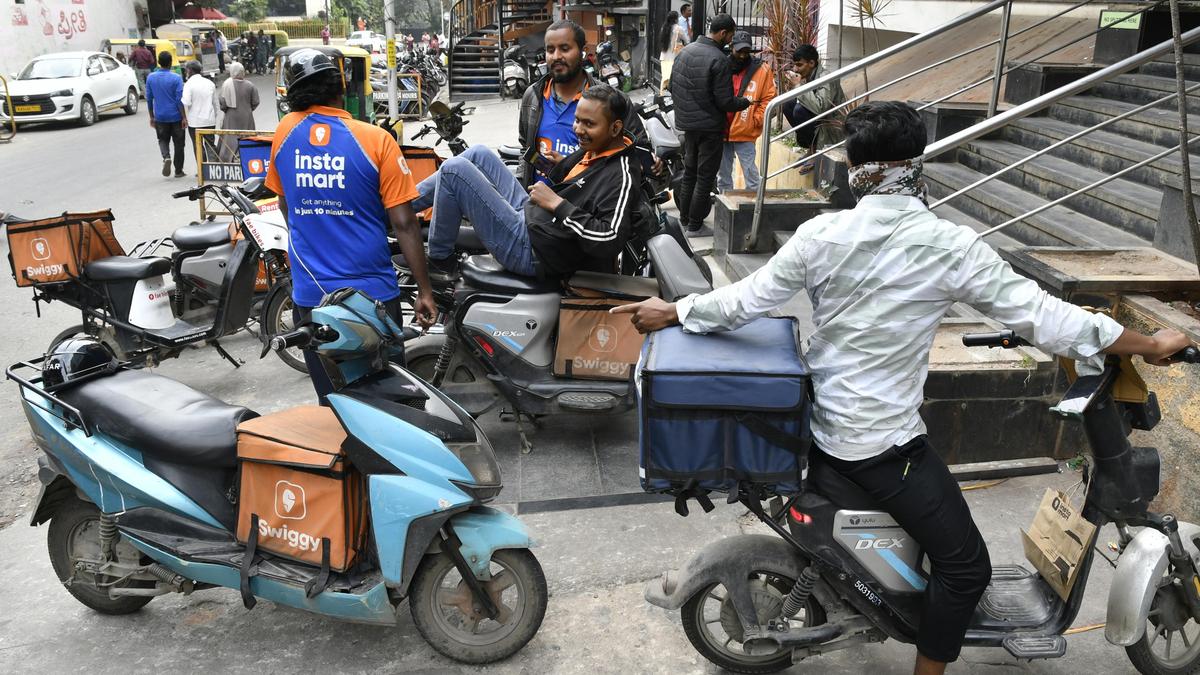
On New Year’s eve, one of the most lucrative days for app-based platforms, tens of thousands of platform workers across India chose to log out. For workers who live off daily earnings, shoulder debt, and have invested heavily in vehicles, fuel, and phones, this decision is not merely symbolic. It is existential. When workers struggling to meet basic needs give up a peak-demand day, it signals two clear things: how intolerable working conditions in the platform economy have become, and how heroic their collective act of resistance is. The strike signals the arrival of a conscious and organised platform workforce with a new commitment to take the fight for platform regulation head-on and sustain it in pursuit of rights, safety and dignity.
Decisive shift
Across the world, the trajectory of platform work is shifting slowly but decisively. On December 18, the New York City Council passed legislation against unfair ID deactivation with a whopping majority — 40 votes in favour and just five against, making it veto-proof. Widely recognised as one of the strongest laws on the issue, the legislation establishes clear standards of due process, requiring platforms to demonstrate just cause before cutting workers off from their livelihoods. In effect, it recognises that algorithmic decisions cannot substitute for evidence, transparency, and accountability.
Crucially, this regulatory momentum is not confined to the Global North. Over the past year, the federal government of Mexico passed legislation ensuring that a vast majority of platform workers are treated as employees, entitled to minimum pay standards, paid leave, health and safety protections, bonuses, and even profit-sharing. In Colombia, platform workers are to be classified as employees based on the degree of control exercised by platforms — a direct challenge to the fiction of “flexibility and freedom” in tightly managed app-based work. In Brazil, even as the Supreme Court leaned towards classifying platform workers as independent contractors, it simultaneously affirmed their rights to health, safety, and social security, and awarded damages to a delivery worker fired without substantive evidence. In Chile, the Supreme Court recently upheld a transport authority decision to treat platform-based drivers as employees. Earlier, New York City had already imposed minimum wage/pay requirements and capped the number of platform vehicles on city streets. In response to a complaint filed against Uber by the International Alliance of App-based Transport Workers, the Dutch National Contact Point has reprimanded the company and urged it to meet higher standards of evidence and governance.
Taken together, these developments point to a clear global movement: to discipline platform companies and bring them under stronger regulation — particularly on the questions of employment, minimum wage/pay, algorithmic decision-making, grievance redressal, health and safety, and unfair ID deactivation. These international trends also make clear that the debate is not merely about classification — “gig workers,” “independent contractors”, or something else — but about recognising that they are, first and foremost, workers. Under the International Labour Organization’s Fundamental Principles and Rights at Work, all workers are entitled to basic labour protections, irrespective of contractual form.
The New Year’s eve strike exposes how far India has drifted from this principle and lags behind these global regulatory shifts taking place in the favour of workers. Here, platform workers are still fighting, not only for the most basic safeguards, but also against the hyper-exploitative models such as the dangerous 10-minute deliveries that push risk entirely onto the workers.
Long hours
This reality is backed by statistical evidence brought to light by various studies. A PAIGAM (People’s Association in Grassroots Action and Movement) study, entitled “Prisoners on wheels”, supported by the University of Pennsylvania and covering over 10,000 app-based workers in India, offers one of the most comprehensive pictures of platform work globally. Over 80% of workers surveyed reported working more than 10 hours a day, while over 30% worked beyond 14 hours. The largest share of drivers earned below ₹15,000 a month, while the largest share of delivery workers earned under ₹10,000. Nearly half were unable to take even a single day-off in a week. More than 99% reported physical and mental health issues, and around half of them reported facing violence at work. A large majority said arbitrary ID deactivation had severely disrupted their livelihoods and about 90% of them rejected “10-minute deliveries” as “completely unacceptable”.
These arrangements shape everyday working lives in India’s cities, where platform workers are among the most exposed — navigating traffic, pollution, heatwaves, freezing temperatures, and rain under constant pressure. Speed targets and delivery timelines turn the city itself into a hazardous workplace, revealing how value is extracted from workers’ bodies and time in increasingly sophisticated ways, as platforms retain tight control over pricing, incentives, and access to work. It is, therefore, unsurprising that so much is at stake for platform companies when workers strike. Following the Christmas log-outs that preceded the New Year’s eve strike, shares of major platform companies fell, signalling investor unease and threats of losses to companies.
It is in this context that the platforms’ response to the strikes must be understood. Workers reported union-busting tactics: targeted surveillance of those participating in or supporting the protest, ID deactivations, police harassment, and pressure strategies designed to fracture solidarity. Alongside coercion, platforms have deployed inducement — temporary spikes in per-delivery payouts, promises of exceptional New Year earnings, and celebrity-led campaigns to lure workers back online. The contradiction is revealing. If higher payouts are possible today as incentives, and crores can be spent in star advertising, workers are right to ask why rates were relentlessly pushed down in the first place.
As Shaik Salauddin, founder of the Telangana Gig and Platform Workers Union and general secretary of the Indian Federation of App-Based Transport Workers, has observed, platforms routinely impose intense mental and physical pressure on workers through targets, ratings, and penalties; this strike reverses that dynamic. By collectively logging out, workers are now exerting counter-pressure on platforms — forcing capital to confront its dependence on labour.
What makes this moment particularly significant is the broader solidarity it has generated. For the first time, even sections of the urban middle class are rightly asking a fundamental question: why should convenience come at the cost of someone else’s pain and indignity? Smaller unions, collectives, and worker associations across the country have expressed support, giving this digital protest a distinctly pan-India character.
Challenge to the state
The strike, therefore, is not only a confrontation with platform companies but also a direct challenge to the state, underlining why regulation can no longer be postponed in this industry. Merely including platform workers within the Social Security Code — without enforceable standards on wages, working hours, data transparency, grievance redressal, or algorithmic accountability — is little more than a BandAid on a gushing wound. Even state-level initiatives, while marginally better, stop short of guaranteeing income security or safeguards at work. At both Central and State levels, governments appear far more concerned about protecting company profits than safeguarding workers’ incomes and lives. Breaking this tacit pact between governments and platform companies is imperative, as genuine economic growth must be measured by what reaches workers’ pockets, not by soaring valuations alone.
It is this failure of the state to regulate platform companies that makes continued worker mobilisation not only inevitable, but necessary.
For years, we have been told that unions and strikes are relics of an industrial past, rendered obsolete by technology. The New Year’s eve strike challenges that claim. In the digital economy, logging out has emerged as a powerful form of collective action. It shows how platform workers can organise, resist, and reshape the labour landscape in India. As the New Year begins, this strike stands as both a warning and promise: a warning that unchecked platform capitalism deepens inequality and insecurity, and a promise that a conscious, organised platform workforce is ready to push for strong regulation, political accountability, and a future of work grounded in dignity rather than disposability.
Akriti Bhatia is a post-doctoral fellow at Jawaharlal Nehru University and Founder of PAIGAM (People’s Association in Grassroots Action and Movements; Biju Mathew is the president of the International Alliance of App-based Transport Workers and Co-Founder, New York Taxi Workers’ Alliance. Views expressed are personal

