

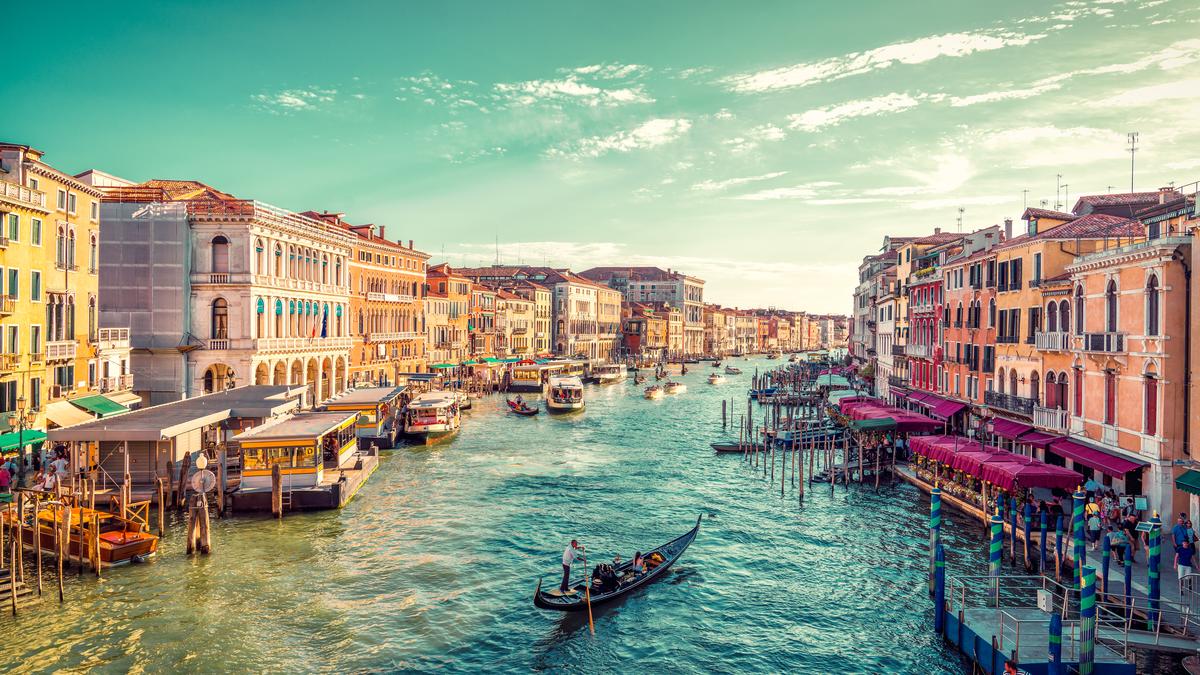
Following an odyssey of navigation and negotiation, we finally procured a place of repose, whereupon the initial fatigue gave way to an effervescent sense of exhilaration. As we immersed ourselves in the midst of Venice’s art festival, the city’s labyrinthine topography was transformed into a vibrant tableau of creative expression. It was then that Venice’s ineffable charm asserted itself, its seductive power transcending the mundane.
The Adriatic shimmered in the distance, breathing salt and history, while La Parata, with its waterborne pageantry, offered the spectacle of a city that long ago decided to live both on land and sea. And as we stood on the Bridge of Sighs, its baroque archway, whisperings of prisoners gazing their last at the lagoon, recalled for me the Bridge of Sighs in Oxford, spanning the New College Lane. Two bridges, continents apart, yet bound together in my memory, one an emblem of scholarship, the other of longing and exile. To me, Venice is always both eternal and fleeting. Its stones speak of endurance, yet its waters remind us that all is flux.
Moreover, the city embodies the quintessence of literary nostalgia, a storied landscape haunted by the spectral presence of writers who have long since departed, yet remain indelibly etched in the city’s collective memory. At Harry’s Bar, a venerable institution that has borne witness to the city’s most intimate moments, Ernest Hemingway once sat, sipping whiskey and pouring his fiery thoughts onto paper. His words, “It is good to have an end to journey toward; but it is the journey that matters, in the end,” resonate deeply within the city’s labyrinthine alleys, where the very fabric of existence seems to be woven from threads of experience and remembrance. In Across the River and into the Trees, Hemingway’s lyrical meditation on love, mortality, and the human condition, Venice stands out as a city where “the light was as old as the city itself”, a phrase that haunts me still, particularly as dusk descends over the lagoon, distilling the essence of the eternal and the ephemeral.
A smile comes on my face as I visualise Byron, restless as always, swimming across the Grand Canal that filled his verses with Venetian excess: “Oh Venice! Venice! when thy marble walls/ Are level with the waters, there shall be/ A cry of nations o’er thy sunken halls.” And at the back of my mind, I see Thomas Mann relishing the city’s languid beauty with its seeds of mortality so explicitly depicted in Death in Venice. It was Joseph Brodsky, who, in his Watermark, found in the city’s winter fog the perfect metaphor for exile and remembrance: “Venice is a city of daily miracles, but it is also a city of recurring funerals.” To sit in a café or stroll by the lapping waters is to inhabit the same spatial and sensory contexts as these literary luminaries. Indeed, sitting in Hemingway’s accustomed seat can be seen as a form of literary pilgrimage, one that confers a sense of continuity with the past while also inaugurating a new narrative thread, as my friend astutely observed, joking that henceforth, the seat would be forever associated with his own presence, thereby displacing the legendary author in a playful gesture of literary appropriation.
And then there was that night, when Venice offered us its most unforgettable scene. Almost midnight, in Piazza San Marco, before the luminous façade of St. Mark’s Basilica, the true gateway and beating heart of the city. The crowd had thinned, and the music that always seems to hang in the air had slowed to a softer rhythm. We began to dance, careless of the passing time. I had smuggled a bottle of champagne in my inner pocket. As the waltz of our steps echoed in the ancient stones, the cork suddenly shot out with a sharp bang, startling pigeons into flight and sending a ripple of laughter through the square. For a moment, Venice itself seemed to join the revelry, its centuries of grandeur meeting our impromptu burst. That moment was ours, a flash of intimacy woven into the public theatre of Venice. The square had seen emperors, merchants, artists, and exiles; now it witnessed a pair of wanderers toasting midnight, their laughter mingling with the salt wind off the Adriatic.
Venice’s enduring enchantment may be attributed to its capacity to inspire subjective interpretation and personal narrative, inviting each visitor to construct their own idiosyncratic Venice, woven from disparate threads of art, memory, and serendipity. For me, the city remains an evocative palimpsest, layered with the spectral presence of past experiences and connections that transcend geographical boundaries. The bridges, in particular, serve as potent symbols, bridging not only physical spaces but also disparate continents of my life, their gentle curves and rustic stonework evoking a sense of continuity and cohesion. The memory of that midnight square, where laughter rose like effervescent champagne bubbles into the night air, continues to haunt me, imbuing the city with a sense of longing and nostalgia.
shelleywalia@gmail.com
Published – December 28, 2025 02:45 am IST

