

November 18 marks what may well be the final chapter in the decades-long Maoist insurgency in India. Deep inside Papikonda National Park in Andhra Pradesh’s Alluri Sitharama Raju district, security forces killed Madvi Hidma, the elusive commander of the Central Military Commission (CMC) and the Maoists’ last hope for military revival. His death, coming six months after the killing of General Secretary Nambala Kesava Rao alias Basavaraju in May, signals not just a tactical defeat but the effective collapse of the armed struggle that once threatened to engulf vast swathes of India’s forested heartland.
Hidma’s killing is significant not just for who he was — a tribal leader in a Telugu-speaking dominant party leadership and who rose meteorically to the top echelons of the CPI(Maoist) — but for where it happened. He did not fall in his familiar terrain of Bastar’s dense jungles, which he knew “like the back of his hand”, but in unfamiliar Andhra territory, a testament to how far the movement had been pushed from its strongholds. Gunned down alongside his wife Madakam Raje and four trusted bodyguards, his death was immediately followed by the elimination of seven other cadres, including Metturi Joga Rao alias Tech Shankar, and the arrest of 50 Maoists across Andhra Pradesh within 24 hours.
The last warrior
Born in 1981 in Purvati village in Chhattisgarh’s Sukma district, the Gondi-speaking Hidma joined the movement at 16 and swiftly became what surrendered Maoists describe as a “gifted fighter” — fierce, motivational, and an excellent strategist. Despite lacking formal education, he was tech-savvy, always carrying a laptop or tablet, and possessed legendary communication skills that helped him extract the best from his cadres. Basavaraju, himself an expert in guerrilla warfare reportedly trained by the Liberation Tigers of Tamil Eelam in the 1980s, spotted Hidma’s talent early and elevated him to command the Dandakaranya Special Zonal Committee. He became the only tribal leader from Bastar to reach the Maoist Central Committee.
After Basavaraju’s death in an encounter, Hidma assumed control of the CMC and its premier fighting unit, Battalion 1 of the People’s Liberation Guerrilla Army (PLGA). His record was devastating: at least 26 major attacks, including the 2010 Tadmetla assault that killed 76 CRPF personnel, the 2013 Jhiram Ghati ambush that killed Congress leaders Mahendra Karma and Nand Kumar Patel, the 2017 Burkapal attack that claimed the lives of 25 CRPF personnel, and the Tekulguda ambush that left 21 security personnel dead.
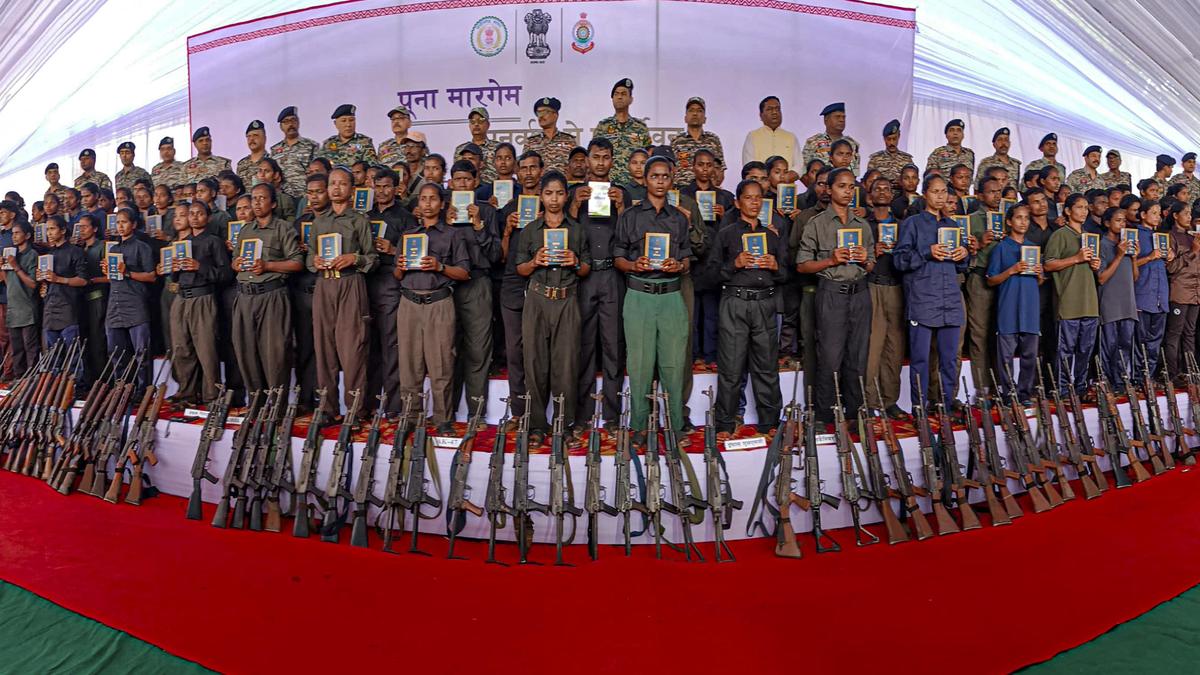
Yet, for all his prowess, Hidma commanded a shrinking force. The CPI(Maoist), which boasted 45 Central Committee members in 2010, now has barely 10-12 left. Since 2024, approximately 2,120 Maoists have surrendered and over 560 killed, including top leaders. The statistics tell a story of inexorable decline.
Final defeat
To understand this denouement, one must return to the movement’s origins in Chhattisgarh’s Dandakaranya forests. The Maoist presence there began not as an offensive but as a strategic retreat. Following the collapse of the Naxalbari movement in the 1970s, leaders concluded they had erred by not preparing a “rear area” for regrouping. In 1980, seven squads totalling 49 cadres were dispatched to the roughly 100,000 sq. km “Dandakaranya region”, spanning four States. Their mission was to establish it as a safe rear sector for the Telangana guerrilla zone.
The cadres won tribal trust by addressing grievances — forcing contractors to raise tendu leaf prices, tackling forest department abuses, and confronting sexual harassment by officials. A high-ranking tribal Maoist leader once explained the core issue: tribals felt they weren’t “treated as humans”, lacking respect for their language, religion, and way of life. Despite infrastructure like school buildings and electric poles, teachers and electricity remained absent.
Ironically, state-sponsored counter-insurgency campaigns proved the movement’s best recruiters. The 1980s Jan Jagran Abhiyan, which arrested and killed suspected Naxal sympathisers, pushed tribal leaders to advise youth to join the Maoists for safety. The 2005 Salwa Judum campaign, declared illegal by the Supreme Court, forced villagers to choose sides — and many chose the Maoists, causing the party to grow manifold.
As ranks swelled with tribal recruits, military operations escalated. The first PLGA company formed in 2001, followed by the formidable Battalion-1 (later led by Hidma) in 2009. The period saw devastating attacks: the 2007 Ranibodli assault killing 55 personnel and the 2010 Mukram ambush claiming 75 CRPF lives.
Yet, the movement always carried the seeds of its own destruction. As academician Nirmalagshu Mukherji noted in 2010, rather than organising tribals into cooperatives or building health and education institutions, the Maoists maintained the exploitative contractor system to tax and garner revenues. Their aim wasn’t socio-economic development but recruitment for armed struggle.This emphasis on armed struggle flowed from a flawed understanding of the Indian state and a determination to replicate China’s 1920s revolutionary path. Former General Secretary Ganapathi warned against “getting bogged down in legalism and economism“ and forgetting that “masses have to be prepared for seizure of power’. This iron grip in Abujhmarh created discontent among tribals, which intensified as they gained greater connection to the outside world in the 2010s and 2020s.
The state’s comprehensive counter-strategy combined security operations with developmental outreach. The Union Home Ministry established a dedicated Left Wing Extremism Division in 2006, providing financial support for fortifying police stations and strengthening state forces. The CPI(Maoist) was banned under the Unlawful Activities (Prevention) Act in 2009. Crucially, welfare measures — Public Distribution System shops, Anganwadi centres — were routed through new forward security camps near Maoist areas. By the mid-2010s, the same tribal leaders who had encouraged joining the Maoists began showing wariness about their presence. The period of 2024-25 proved decisive. Over 50 new forward camps in South Bastar and Narayanpur restricted the movement of the PLGA, while nearly 2,000 local ‘Bastar Fighters’ with superior terrain and language knowledge addressed the Maoist threat significantly. ‘Operation Kagar’, launched in April 2025, systematically targeted the leadership — claiming Basavaraju in May and Hidma in November.
In August 2024, the Maoist Politburo acknowledged nationwide setbacks and failure to achieve 2020 targets, reframing its strategy toward tactical retreat and protecting the party. It restructured battalions into smaller units to avoid encirclement. Yet even this couldn’t save Basavaraju or Hidma.
The road ahead
Just before Hidma’s death, surrendered Central Committee Member Mallojula Venugopal alias Sonu (younger brother of erstwhile Maoist senior leader Mallojula Koteswara Rao alias Kishenji) appealed to remaining Maoists to lay down arms, stating bluntly that armed struggle was “no longer relevant” and their force “no match for present well-trained and well-equipped security forces”.
The party’s Central Committee responded by expelling Venugopal as a “traitor” and pledging in an October 2025 statement that it would “never surrender to the enemy”. Yet, such defiance cannot obscure the movement’s collapse — the statement itself admitted the enemy had “gained an advantage” and acknowledged the need to rebuild “while protecting the Party”. The insurgent party is now led by Thippiri Tirupathi alias Devuji, though its Central Committee is yet to meet, fearing security forces’ reprisals, to endorse this decision.
As the guns increasingly fall silent, the challenge shifts. A focus solely on security could create new grievances. Only a welfare-minded approach allowing tribal integration with dignity can prevent resurgence. For the Maoists, with leadership depleted through age, imprisonment, or death in encounters, the movement faces its severest crisis. The story of their vicissitudes should suggest a serious rethink on their understanding of the Indian state and the futility of an armed struggle that relegated mass mobilisation and socio-economic organisation. The dream of revolution, it appears, has finally died in the forests of south-central India.
Published – November 23, 2025 02:17 am IST

