

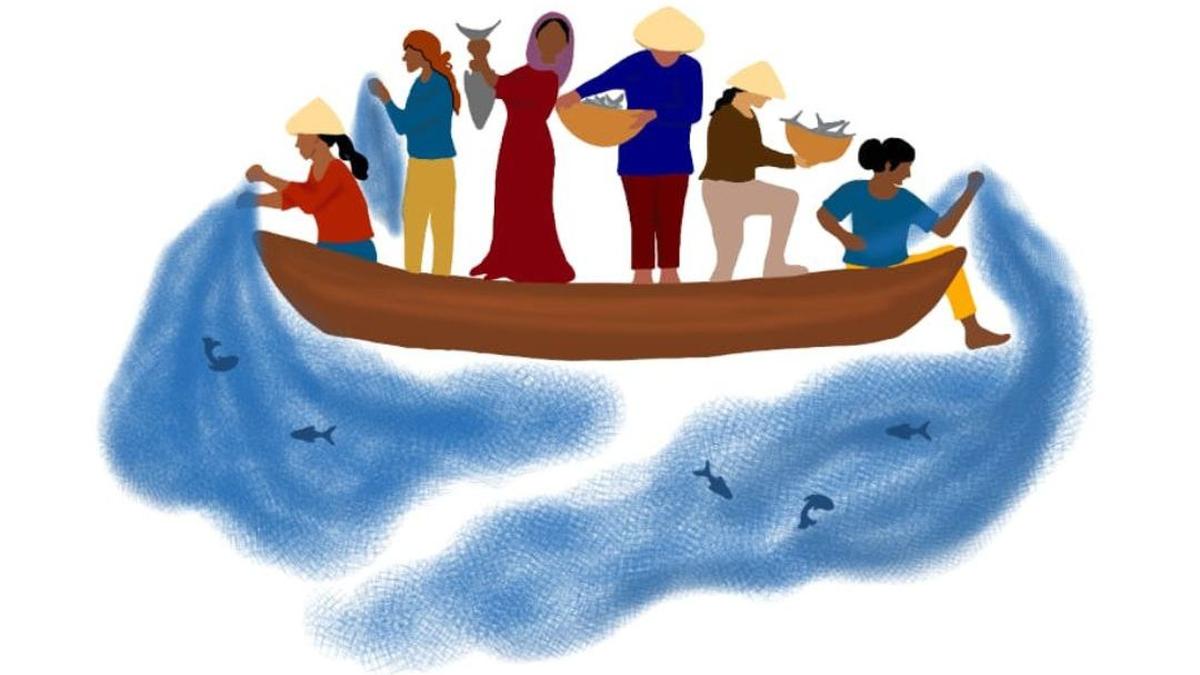
Though women constitute nearly half of the employed fisheries’ workforce globally, fisheries, traditionally, has been a male-dominated sector. Indian fisherwomen account for about 44% of the total fisher population, according to the government. Photo: wffp-web.org
On November 5, I travelled to Khar danda, a fishing settlement in the northern part of Bandra in Mumbai, to witness the celebration of the first International Fisherwomen’s Day. A post by the World Forum of Fisher People, announcing the celebration of the day, read, “For the first time ever, the world will celebrate International Fisherwomen’s Day. Join us for a powerful social media campaign themed ‘Every wave carries her labour, every shore her claim’, honouring the fisherwomen who have worked in the shadows for far too long. From rivers to seas, from valleys to coasts — fisherwomen are rising to demand the recognition and equal rights they have been denied.”
The event had been jointly organised by the World Forum for Fisher Peoples, the National Fishworkers’ Forum, the Maharashtra Macchhimar Kruti Samiti, and the Daryawardi Mahila Sangh, to highlight fisherwomen’s roles, struggles, and rights. The event did not receive as much publicity as other events of fisherfolk. Apart from me, only one woman photojournalist had turned up. Journalists always look for stories. Perhaps some of those who knew of the event but did not attend it assumed that there was not much of a story there.
Though women constitute nearly half of the employed fisheries’ workforce globally, fisheries, traditionally, has been a male-dominated sector. Indian fisherwomen account for about 44% of the total fisher population, according to the government. They form a workforce of more than 1.24 crore in fisheries and handle the bulk of pre- and post-catch work. Fisherwomen are mostly involved in various fish-harvesting activities, small-scale near-shore fishing, seaweed cultivation, fish cleaning, drying, salting, and industrial processing of fish. Yet their contributions are not recognised and their incomes are not commensurate with the work they put in.
There were 16 people on the dais to celebrate the first International Fisherwomen’s Day event in Mumbai. But only four of them were women and only one of them spoke of the daily struggles of fisherwomen and the humiliations they face. She described her exhausting routine, the abuse she faces at the fish market, the denial of her agency by men who want to sell in the market, and her worry that her children had failed to recognise the hardships their parents endured. “Instead, they serve the very builder lobbies that are trying to seize our lands,” she said. The woman was feisty and loud, and her words resonated with the audience. Other women cheered, clapped, nodded vigorously, and supported her.
The remaining three fisherwomen spoke of the lives of fishing communities in general. They said they were being marginalised in a fast-expanding city that viewed the coasts as prime property for infrastructure projects.
None of the fishermen leaders on stage spoke of the struggles of fisherwomen. They talked of all that they had done to mobilise fisher communities. They spoke authoritatively of political struggles and of negotiations with different stakeholders. They gave the impression that they were the ones fighting on the forefront, and called for women’s support. Off stage, they felicitated the women.
When the event came to a close, one of the female organisers rued, “In a patriarchal set-up, women’s leadership is neither encouraged, nor appreciated.” I know the organiser: she has been instrumental in working for the causes of fisherfolk and in mobilising fisherwomen for decades. Yet, she felt marginalised, she said. She went on to blame herself for not being able to bring women’s voices to the forefront. The bitterness was evident in her tone, but she feared verbalising it on stage. The event highlighted how deeply the gender imbalance persists, even in spaces meant to celebrate women.
Published – December 05, 2025 01:36 am IST

