

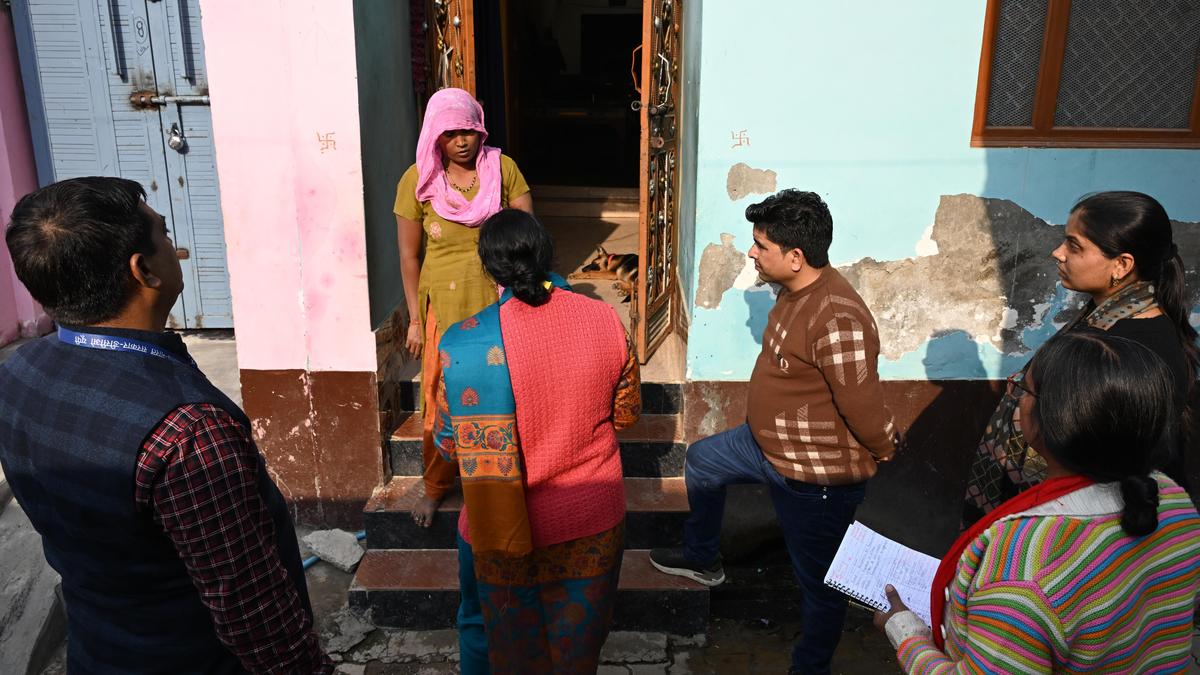
Officials conduct a pre-test exercise of Census 2027 at Anupshahr in Uttar Pradesh’s Bulandshahr on November 19, 2025.
| Photo Credit: The Hindu
The 2027 Census will be the world’s largest administrative exercise of its kind. The bedrock of India’s policy, scheme design, and fiscal allocations, the Census provides a snapshot of the lived reality of citizens. The 2027 Census will have dedicated mobile apps for digital data collection, geo-tagging of buildings, and a real-time digital monitoring platform to improve the accuracy and efficiency of the exercise.
Recognising transitional areas
Capturing a comprehensive snapshot of the Indian populace requires another critical step: recognising transitional urban areas. According to official communications, Census 2027 proposes to retain the same definition of an urban area that was used in Census 2011 to ensure uniformity of comparison.
However, India already has a comparatively conservative definition of what constitutes ‘urban’ with a threefold criterion: population size, population density, and economic parameters. It also follows a binary classification of urban and rural, which does not capture peri-urban areas that are often located on the peripheries of cities and in villages that are transitioning to urban in situ. For instance, studies by the World Bank show that even in 2010, the share of India’s population living in areas with urban-like features was 55.3%. However, Census 2011 recorded only a 31% urban population share, suggesting the existence of significant unseen and unrecorded urbanisation.
The UN Statistical Commission has introduced a global method, the ‘Degree of Urbanisation’, for a clearer delineation of urban, peri-urban, and rural areas. The Census 2027 could adopt a similar intervention to recognise peri-urban areas that typically fall under rural governance, and could benefit from targeted attention for planned growth and provision of basic services.
Delhi is set to be among the world’s five largest agglomerations (by population), based on UN estimates. The ‘true extent’ of Delhi’s agglomeration includes the contiguous cities of Gurugram, Faridabad, Noida, and Ghaziabad that span three different States/Union Territories. The UN considers such agglomerations by their true extent rather than by administrative boundaries, but the Census records them separately by their constituent urban local bodies, districts, and State boundaries, thereby obscuring the scale of their massive, interconnected urban footprint. Such agglomerations should be recognised endogenously as well in the Census, as they have interconnected economies and shared labour markets.
A spatial approach
How can this be done? The Census 2027 could adopt a spatial approach through an open-access geo-statistical portal with due regard for data anonymity, security, and interoperability with other national datasets. Such visual dashboards can dynamically reveal the true spatial extent of agglomerations highlighting where peri-urban growth is occurring. In addition to standard tabular data downloads, thematic visualisations like maps can spotlight areas that are under-provisioned in basic services or have high population density, thus providing deeper insights for effective implementation of municipal schemes. Municipal bodies could also be encouraged to update their information in real-time (instead of waiting for the next decennial Census) based on agreed protocols and processes with the Census. This will also foster a spirit of healthy competition among urban local bodies to showcase their progress in improving access to basic services. The dynamic modifications to ward and municipal boundaries to which statistical data are tagged often make it difficult to study the changing patterns over time. One of the ways to mitigate this issue is to use static spatial grids (such as a 1×1 km grid) as an additional overlay, amenable to administrative boundaries. Data interpolation from irregular administrative boundaries to regular grids could lead to distortions, and if the grids are too minute, they can also pose privacy and social concerns. This can be overcome with blended indicator-based themes that only show underserved areas and mask sensitive information such as caste or income groups. Similarly, blended data of age, ability, housing conditions, and service provision levels, when overlayed with climate hazard data, provides insights on vulnerable areas that require climate-proof investments. The overlays could also enable trend analysis once time series data get spatialised into the grid.
Globally, such geo-statistical formats have been adopted successfully by Mexico’s INEGI and Britain’s Ordnance Survey and Environmental Information Data Centre. India could also explore adopting a similar context-relevant and anonymised adaptation to enable targeted actions for a rapidly urbanising India.
Even as India’s fertility rates decline, the country continues to grow on the back of its past population momentum. In this context, adopting a geostatistical approach with a modular framework along with the current statistical portal can greatly support policymakers, academia, the private sector, civil society groups, and home-grown startups to build innovative solutions. The approach can also be integrated with other government platforms such as Gati Shakti or Digital Postal Index Number, which divides India into a 4m X 4m grid-addressing system and is aligned with the 2022 National Geospatial Policy. A geo-statistical approach holds the potential to maximise impact while steering India towards a more inclusive and resilient urban future.
Rejeet Mathews, Program Director in the Sustainable Cities and Transport Program at WRI India. Raj Bhagat Palanichamy, Senior Program Manager in the Sustainable Cities and Transport Program at WRI India. Views are personal
Published – December 02, 2025 02:04 am IST

