

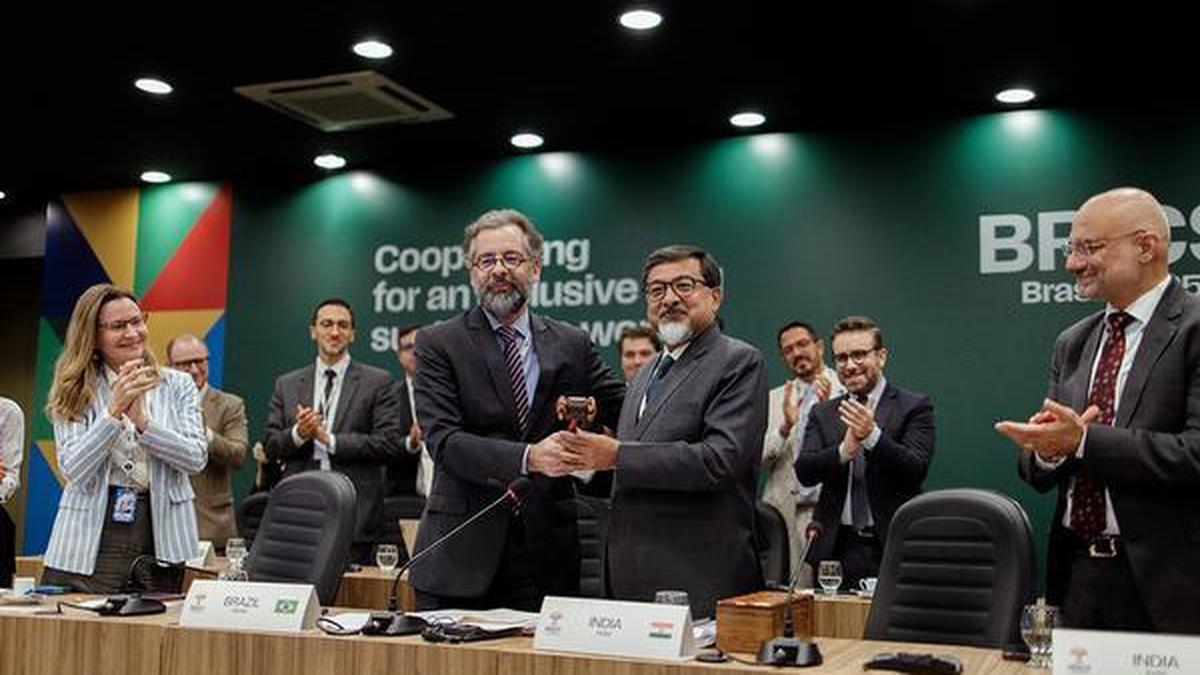
The handover of the BRICS presidency is steeped in symbolism. In 2024, Brazil had received from Russia a steel gavel — a symbol of industrial strength. As Brazil passed the presidency to India last Friday, it handed over a gavel made of recycled wood from the Amazon rainforest. The gesture, according to Brazil’s BRICS sherpa Mauricio Lyrio, was meant to carry forward the ethos that defined his country’s presidency. “The gavel represents both sustainability and the deep roots of cooperation that unite the countries of the group. Through this gesture, confidence in India’s upcoming presidency is reaffirmed, along with the commitment to support its efforts to advance the BRICS agenda,” said Lyrio, as he handed over the gavel to Sudhakar Dalela, India’s sherpa to BRICS.
The BRICS sherpas’ meeting in Brasilia on December 11 and 12 went beyond symbolism as it assessed the outcomes of Brazil’s presidency, which formally ends on December 31. Bringing together negotiators from all 11 members, the meeting was a stock-taking exercise of achievements through 2025. Brazilian Foreign Minister Mauro Vieira described the process as an effort that moved well beyond BRICS’ traditional agenda as he emphasised that the grouping’s relevance would increasingly be measured by its impact on the everyday life of people. “Major international issues will remain central to our work, but our societies also expect us to deliver concrete results from our initiatives,” Mr. Vieira said.
Challenges aplenty
Brazil framed its BRICS presidency around sustainability and inclusive development, with emphasis on deliverables. This translated into three declarations at the Rio de Janeiro summit in July — on the governance of artificial intelligence, a climate financing framework and a partnership to eliminate socially determined diseases. Mr. Lyrio acknowledged that Brazil’s presidency unfolded amid growing mistrust of multilateralism, but this only enhanced BRICS’ relevance. “These trends underscored the centrality of BRICS as a platform for dialogue, bridge-building and the articulation of perspectives that could not be ignored,” Mr. Lyrio said, adding that the final declaration of the summit reaffirmed a shared commitment to multilateralism.
A direct challenge to multilateralism — and BRICS — emerged in June, just days before the Rio de Janeiro summit, when U.S. President Donald Trump warned of “punitive consequences” if the grouping sought to “weaken the U.S. dollar”. Mr. Trump threatened 100% tariffs against countries he accused of undermining the American currency. Days later, in a barely veiled message to India, U.S. Commerce Secretary Howard Lutnick said New Delhi’s purchase of Russian military equipment and its alignment with BRICS had “rubbed the United States the wrong way”.
The pressure notwithstanding, India participated in the Rio summit wholeheartedly and helped in making the meeting a defining moment for the grouping. The Rio summit, on July 6-7, became the first BRICS meeting that brought together all 11 full members alongside 10 partner countries, eight invited nations and representatives of all major multilateral institutions as leaders endorsed key declarations on finance, climate action and technology. Speaking after the summit, Mr. Vieira had said BRICS was “the cradle of a new development model”, and the Global South was “no longer peripheral but central to defending multilateralism”.
Brazil’s BRICS presidency leaves behind a clear roadmap, articulated at the summit by President Lula da Silva through a critique of the global financial architecture. “The structures of the World Bank and the IMF reflect a reversed Marshall Plan, wherein emerging and developing economies finance the more developed world,” Mr. Lula said, urging systemic reform. In addition, health cooperation and global governance were reinforced during Brazil’s tenure, while artificial intelligence emerged as a BRICS priority. “Emerging technologies must operate within a governance framework that is fair, inclusive and equitable,” Lula said at the summit, warning that AI must not become “the exclusive privilege of a handful of nations, nor a tool for manipulation concentrated in the hands of billionaires”.

Economic autonomy forms another important pillar of Brazil’s legacy. New Development Bank (NDB) president Dilma Rousseff said at the Rio summit that the NDB’s mandate is to finance infrastructure, innovation and sustainability “by promoting social justice, sovereignty and sustainable growth”, reaffirming BRICS’s ambition to shape its own development path.
Now, as Brazil passed the BRICS gavel to India, the transition is being framed as one of continuity. At the handover ceremony at Brazil’s Foreign Ministry in Brasilia, Mr. Dalela acknowledged the depth of Brazil’s stewardship, noting that progress across political and security cooperation, economic and financial coordination, and people-to-people exchanges reflected a presidency taken seriously at every level. “This year was especially significant as it coincided with the consolidation phase of the expanded membership,” he said, adding that integrating new partners required a careful balance between preserving BRICS’s founding principles and responding to shifts in global governance. “Brazil’s leadership has been exemplary,” he concluded, setting the tone for an Indian presidency.
Trying times
The year 2025 has been a particularly testy one for BRICS in its 17th year. With Mr. Trump back in the White House, almost all major international institutions have been rattled and global trade unsettled by a wave of unilateral sanctions. Brazil and India, both founding members of BRICS, have found themselves at the receiving end of Mr. Trump’s trade war — facing tariffs of nearly 50%, although most of the measures against Brazil have been rolled back. Rather than yield to pressure, Brazil used its BRICS presidency to steer the grouping through a complex phase with no real damage — a possible template for future presidencies.

Taking charge of the grouping for 2026, Mr. Dalela, Secretary (Economic Relations) in India’s Ministry of External Affairs, said New Delhi would carry forward the collectively endorsed agenda. India’s presidency will rest on four pillars of resilience, innovation, cooperation and sustainability, with ongoing initiatives on climate change, artificial intelligence and scientific cooperation set to continue.
As the BRICS presidency passes from Brazil to India, the next chapter will most likely be based on continuity and consolidation.
Published – December 18, 2025 09:07 am IST

