

From harbouring Osama bin Laden in a house that was just a stone’s throw away from its own military academy, to training and backing groups such as the Lashkar-e-Taiba (LeT) and Jaish-e-Mohammad (JeM), Pakistan’s role in fuelling cross-border terrorism is no longer an allegation. It is a matter of record. The 2008 Mumbai attacks, the 2019 Pulwama bombing and the attack on tourists in Pahalgam on April 22, 2025, are events that bear the unmistakable marks of a terror infrastructure being nurtured across the border. In response to the Pahalgam attack, India launched Operation Sindoor, striking at the roots of this terror network along the Line of Control. Pakistan faces growing accusations not only from India but also from Afghanistan to Balochistan — of fostering regional instability, crushing dissent and deepening unrest.
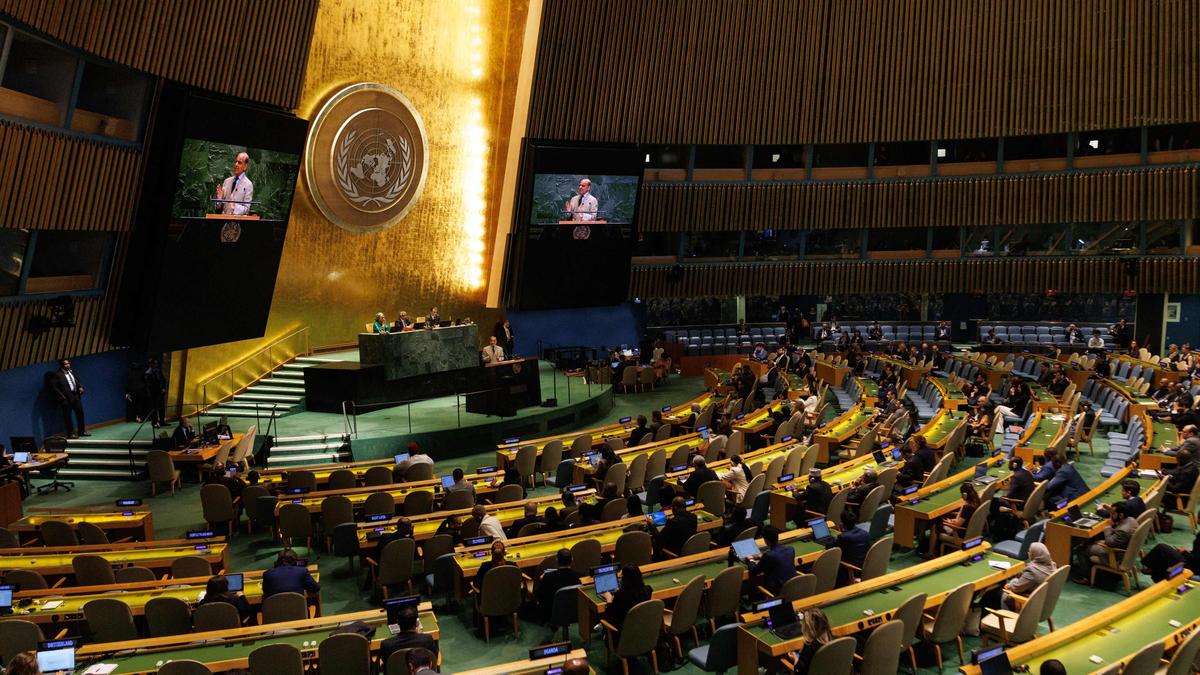
Just a few days ago, India delivered a sharp rebuttal to Pakistan Prime Minister Shehbaz Sharif’s speech at the United Nations General Assembly. Therefore, when a nation long accused of harbouring terrorists is given the reins of global counter-terrorism efforts — despite clear evidence of its terror links — the world should pause and ask questions.
In June this year, in a decision that sparked disbelief, Pakistan was to lead two critical United Nations bodies: the Taliban Sanctions Committee of the United Nations Security Council (UNSC) and as the vice-chair of the Counter-Terrorism Committee of the 15-nation UN body. This development also came at a time when Pakistan’s credibility on counter-terrorism was under scrutiny. On July 1, Pakistan also officially assumed the Presidency of the UNSC for the month of July.
In the past, the UN’s decisions to make Libya as the chair of the UN Human Rights Commission and Saudi Arabia as the chair of UN Women’s Rights Commission have come under scrutiny. In May 2025, the International Monetary Fund (IMF) approved a $1 billion loan to Pakistan, despite concerns over its potential misuse for terror financing. These developments expose significant loopholes in the UN’s foreign policy and raise questions about the UN’s commitment to combating global terrorism.
Terror shelter
The Pahalgam attack highlighted Pakistan’s continuing role as a haven for terror groups. Hafiz Saeed, a UN-designated terrorist, has made several public appearances in recent years despite serving a sentence for terror financing. He has often been seen at terror launchpads in Pakistan-Occupied Kashmir (PoK) but is “in custody” on paper. The presence of Pakistani Army personnel, the Pakistani police and members of civil bureaucracy at the funeral procession of terrorists killed in Operation Sindoor, further indicates Pakistan’s open support for terrorist organisations.
The inclusion of Pakistan in the UN’s counter terrorism mechanisms exposes troubling gaps and issues with the global body’s moral and strategic compass.
First, Pakistan’s long-standing support for terror groups such as the LeT and JeM, directly contradicts the objectives of the Counter-Terrorism Committee. There is adequate evidence linking Pakistan’s military and Inter-Services Intelligence (ISI) to logistical and tactical support for terror modules. Yet, the UN prioritised geopolitical considerations over moral and security imperatives.
Second, the UN’s selection process for committee leadership lacks stringent vetting for a country’s compliance with counter-terrorism standards. Pakistan’s removal from the Financial Action Task Force (FATF) grey list in October 2022, despite ongoing concerns about terror financing, exemplifies this leniency.
Third, the decision also reflects a broader trend of geopolitical manoeuvring within the UN, where powerful nations support Pakistan’s elevation to secure economic or strategic interests. This bias compromises the UN’s impartiality and risks legitimising Pakistan’s duplicitous stance on terrorism.
Fourth, by rewarding duplicity with leadership, the UN sends a dangerous message: state-sponsored terror can be overlooked if packaged diplomatically.
The IMF loan to Pakistan — part of a $7 billion Extended Fund Facility — fuelled controversy despite India abstaining from the vote. The risk of funds being misused for terror activities was cited. However, the timing of the loan, just weeks after the Pahalgam attack raised ethical questions on the UN’s commitment to combat global terrorism.
The UN’s dangerous gamble
In May this year, the Pakistan government announced a compensation of ₹14 crore to the families of terrorists, including relatives of JeM chief Masood Azhar, who were killed in Indian strikes When a nation equates terrorists with martyrs, one does not need to imagine its commitment to peace.
The UN’s decision to entrust Pakistan with key counter-terrorism roles, despite its explicit ties to terrorism, casts a shadow over UN’s integrity and suggests a troubling disconnect between the UN’s stated goals and its actions.
Such moves will only help Pakistan legitimise its narrative and project itself as a responsible global actor in counter-terrorism. It will also undermine India’s efforts to portray Pakistan as a state sponsor of terrorism. Pakistan could shape narratives around regional stability, potentially deflecting blame for regional terrorism on India, particularly in the context of Balochistan.
Pakistan’s role as vice-chair in the Counter Terrorism Committee allows it to influence global counter-terrorism policies. This may have serious repercussions for India’s push to bring Pakistan-based terrorists under UN sanctions. Pakistan could also derail India’s growing diplomatic ties with the Taliban.
Counter-measures by India
India’s failure to block Pakistan’s appointments, despite its outreach to most UNSC members following the Pahalgam attack, signals a diplomatic challenge.
In counter strategies, India must leverage its strategic alliances with other UNSC members to counterbalance Pakistan’s influence.
That Pakistan is at the centre of attention at the White House also raises doubts on the U.S.’s commitment to combat terrorism for the sake of trade and business.
India should actively participate in discussions at crucial UN bodies to highlight Pakistan’s history of harbouring terrorists. These committees are operated by consensus and India’s growing global influence can limit Pakistan’s ability to push biased agendas. It is essential that India and its allies monitor Pakistan’s role and push for periodic performance reviews and stringent accountability.
India should aim to deepen its ties with the Taliban regime — humanitarian aid missions in Kabul is one possibility — to counter Pakistan’s influence in the Taliban Sanctions Committee.
India must proactively pursue an international campaign that engages the global media, academia and diaspora, exposing Pakistan’s terror links and pushing for more accountability.
Pakistan’s enhanced diplomatic position is likely to encourage asymmetric warfare, infiltration and cyber-attacks. Therefore, India must strengthen its national security and intelligence networks.
The Indian government’s silence on the appointments suggests a cautious approach, but proactive diplomacy will be crucial to maintain India’s narrative on the global stage. The world must be alert because what begins as a seat at the table can turn into control over the agenda. The real danger is not about Pakistan at the high table. It is the world pretending that it does not matter.
Gauri Mishra is a highly decorated naval officer with a career of around two decades in the Indian Navy, from where she retired as Commander. She is also a motivational speaker, author, skydiver, and an international track cyclist representing India
Published – September 30, 2025 12:16 am IST

