

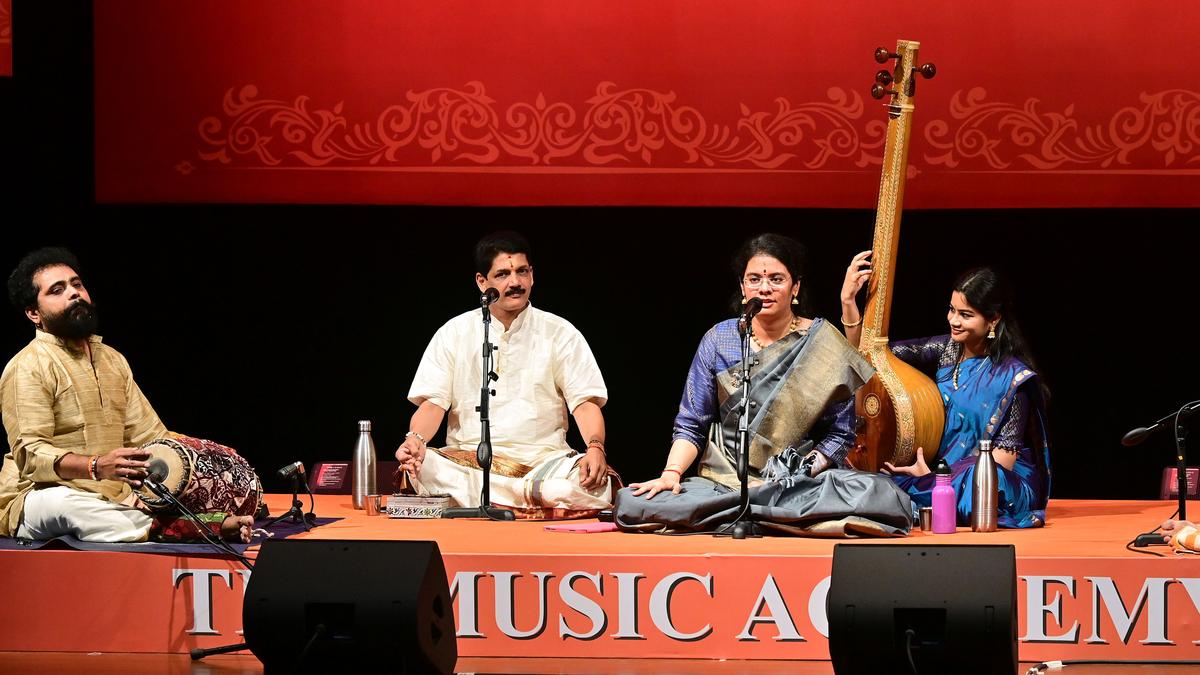
Amrutha Venkatesh supported by Bombay R. Madhavan (violin), S.J. Arjun Ganesh (mridangam) and Payyanur T. Govindaprasad (morsing).
| Photo Credit: K. Pichumani
Amrutha Venkatesh’s concert for The Music Academy showcased her academic and technical expertise. She was supported by Bombay R. Madhavan (violin), S.J. Arjun Ganesh (mridangam) and Payyanur T. Govindaprasad (morsing).
Amrutha Venkatesh, who has trained under multiple teachers, including M.T. Selvanarayana, Charumathi Ramachandran, Rama Varma and Parassala B. Ponnammal, brings in a unique analytical nature to her concerts.
The recital opened with the Mysore Sadashiva Rao varnam ‘Intha chauka’ in Pantuvarali set to Adi tala. This was followed by ‘Brova samayamide’ in Gowri Manohari (Adi), where the artiste wove kalpanaswaras into the rendition, underscoring the framework of the raga while maintaining clarity of sahitya and pronunciation.
In Saveri, Amrutha chose the classic ‘Muruga muruga’. Her aesthetic embellishments around each sangati demonstrated an experiential engagement with the pulse of the raga. A sketch of Niroshta preceded ‘Raja raja radhite’, and the subsequent kalpanaswaras navigated its limited scalar swaras with inventive phrases.
An expansive alapana in Nattakurinji stood out for its breadth and developed contours. Nattakurinji lends itself to expressive improvisation and Amrutha thoroughly utilised this. Her alapana highlighted phrase continuity, clear anchoring on key swaras and a gradual widening of range, making the raga feel complete without relying on speed or loudness. Swati Tirunal’s ‘Jagadeesha sadaa maamava’ was rendered with a detailed niraval at ‘Khagav aahana sura shoaka vibhanjana’. Her niraval exemplified focused expansion on chosen melodic ranges. Substantial duration was dedicated to swarakalpanas as well.
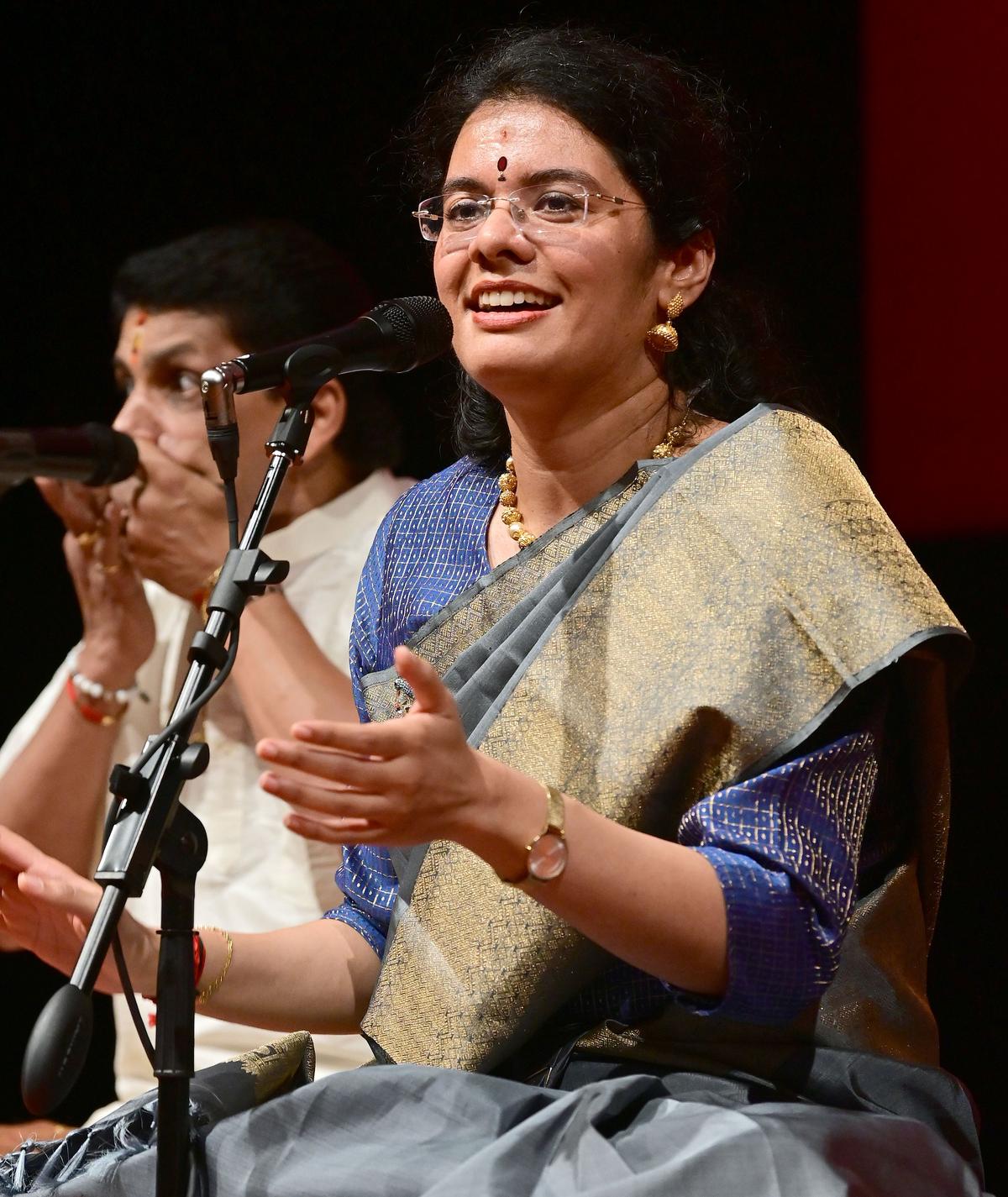
An intellectually driven concert by Amrutha Venkatesh.
| Photo Credit:
K. Pichumani
Rhythmically complex material followed with a Ragam-Tanam-Pallavi in Sucharitra, set to a 27-beat tala also with the same name whose structure corresponded to the vowels and consonants of the word ‘Sucharitra’, articulated through a framework of guru, chaturasra jathi laghu, druthashekara viramams and anudhrutam. The close alignment of raga and tala recalled themes explored in an academic session held at The Music Academy earlier. The pallavi text, drawn from a composition by M. Balamuralikrishna — ‘Chintayaami santatam sri muthuswami dikshitham parama pavitram’ — was followed by ragamalika swaras set to contrasting talas.
The pallavi demanded sustained academic rigour, bringing together linguistic structure, tala mathematics and raga grammar. Its design foregrounded Sucharitra as a rhythmic and melodic idea, reflected an analytical approach to pallavi construction, and served as a considered tribute to Muthuswami Dikshitar in his 250th birth anniversary year, linking scholarship and concert practice without overt emphasis.
Throughout, the accompanists provided attentive support; Madhavan’s violin echoed the vocal lines with textural sensitivity and Arjun Ganesh’s mridangam and Govindaprasad’s morsing contributed measured rhythmic dialogue.
Published – December 30, 2025 12:32 pm IST

