

‘In the midst of the aatmanirbharta thrust, the only element driving decision making should be professionalism’
| Photo Credit: The Hindu/Akhila Easwaran
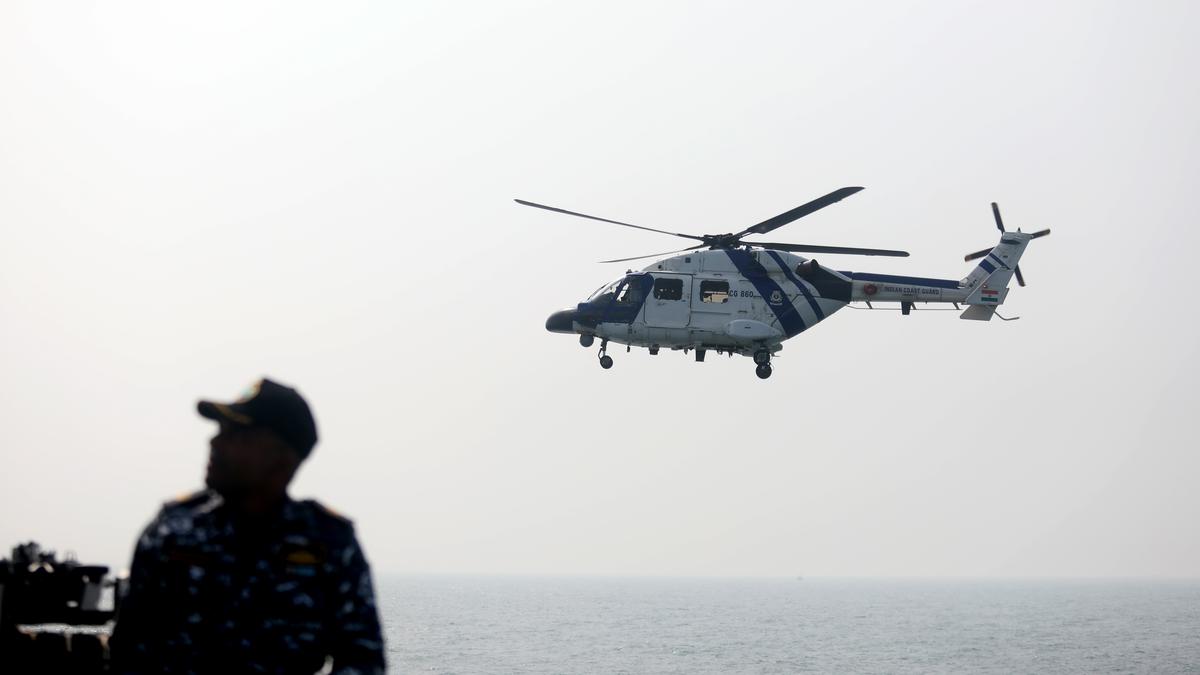
The fatal accident on January 5, 2025, where an Advanced Light Helicopter, Dhruv, of the Indian Coast Guard, had a fatal accident, has triggered the grounding of what is the workhorse of the country’s armed forces. In aviation, accidents happen. But this does not reduce the gravity of the flight safety issues that India’s flagship helicopter programme faces; flagship, because it is tailor-made for India’s demanding operating conditions.
This writer was first associated with the project in 1988 when it was in the mock-up stage and engineering drawings were being converted to real parts which were being fused in the Hindustan Aeronautics Limited (HAL) hangar. Those were heady days as we, the test aircrew, reviewed the prototype coming up adjacent. To view one’s recommendations bear fruition was pure bliss. This writer moved on for a staff course abroad and one’s satisfaction knew no bounds when he read in the foreign press about its first flight on August 20, 1992. That the project had its fair share and more of problems is well documented but the initial decade of its operational service was, to put it mildly, very challenging.
As this writer had the unpleasant task of being the presiding officer of the court of inquiry of the first fatal Dhruv crash (in 2007) and later as Assistant Chief of Air Staff at Air Headquarters looking after helicopter operations, here are a few suggestions for the decision makers.
Search for the reason
The world over, new aircraft face problems in the induction phase. The Dhruv has had its own long list — from serious ones such as premature main gear box withdrawals and cabin vibrations to operational irritants such as rainwater leaks in the cabin.
Also read: 16 accidents involving Dhruv helicopters since 2002
There has also been the poor supply of spares and the exasperatingly long overhaul times whenever a machine entered an HAL hangar for maintenance. Though these have been, hopefully, addressed over time to some extent, a new and worrying problem of flight controllability has emerged. After each such accident, short and long-term fixes have been made to keep the Dhruv flying. The fact that three weeks (and counting) have passed and the Dhruv has still not been cleared to fly, shows that something more serious has happened, and/or the cause has not yet been determined. It is no shame to keep the machine grounded till the root cause is found and a permanent fix implemented; the Boeing 737 MAX remained grounded for almost two years till its flight control problem was resolved.
Involve domain specialists
The composition of a court of inquiry in India, even where such a basic characteristic such as flight controllability has been affected, is still no different than a ‘normal’ accident inquiry. Thus, as in the media, HAL (which could be blameworthy), the Centre for Military Airworthiness and Certification, or CEMILAC (the certification agency which could be blameworthy too), and the Coast Guard are the main investigators in the January 5 accident. Considering that the Coast Guard mishap is, at a minimum, the sixth accident involving the loss of flying control, the problem should, logically, have been found by now.
Since this has been a repetitive problem, should not there be a de novo look at the design issues for studying stresses, the metallurgy used and the fabrication process of flight critical components? Thus, a fresh fault analysis is necessary by co-opting outside specialists, say from academia or any other relevant field, to ferret out the root cause. Having an independent committee to holistically look at the Dhruv programme would be ideal.
Where rectification action is required from HAL, the speed of the implementation of recommendations leaves a lot to be desired. In the fatal accident of 2007, referred to earlier, our recommendation for the institution of measures to warn a pilot of an impending ‘flight control saturation’ situation took the better part of a decade. One understands that even the fitting of the new stainless steel control rods — after an investigation of the earlier flight control-linked accidents — is still an ongoing process.
Apportioning of responsibility
HAL is the primary organisation for the production of airworthy assets. While design is frozen earlier, it is the quality of production that needs monitoring with a hawk eye too. CEMILAC’s responsibility is to ensure both — the soundness of design and production quality control. These two organisations too must be held responsible for the proper discharge of their duties since the combat fleet of the nation and its security posture get affected. To aid CEMILAC in the discharge of its task, having flight test crew on its rolls could result in an element of greater inquiry.
One needs to remember that the Prachand (Light Combat Helicopter), which is planned as the mainstay of the attack helicopter fleet , has also been affected as its transmission system is the same as the Dhruv’s. We have the Light Utility Helicopter in its final flight-testing phase and the Indian Multi Role Helicopter, a 13-tonne heavy machine with greater complexities, is in the offing. The investigation of the Coast Guard accident could, thus, be an inflexion point in the journey of India’s helicopter programmes. In the midst of the aatmanirbharta thrust, which is laudable, and other pressures, the only element driving decision making should be professionalism.
Precious lives and the standing of India’s nascent helicopter industry are at stake.
Air Vice Marshal Manmohan Bahadur (retired) is former Additional Director General, Centre for Air Power Studies
Published – January 27, 2025 12:08 am IST

