

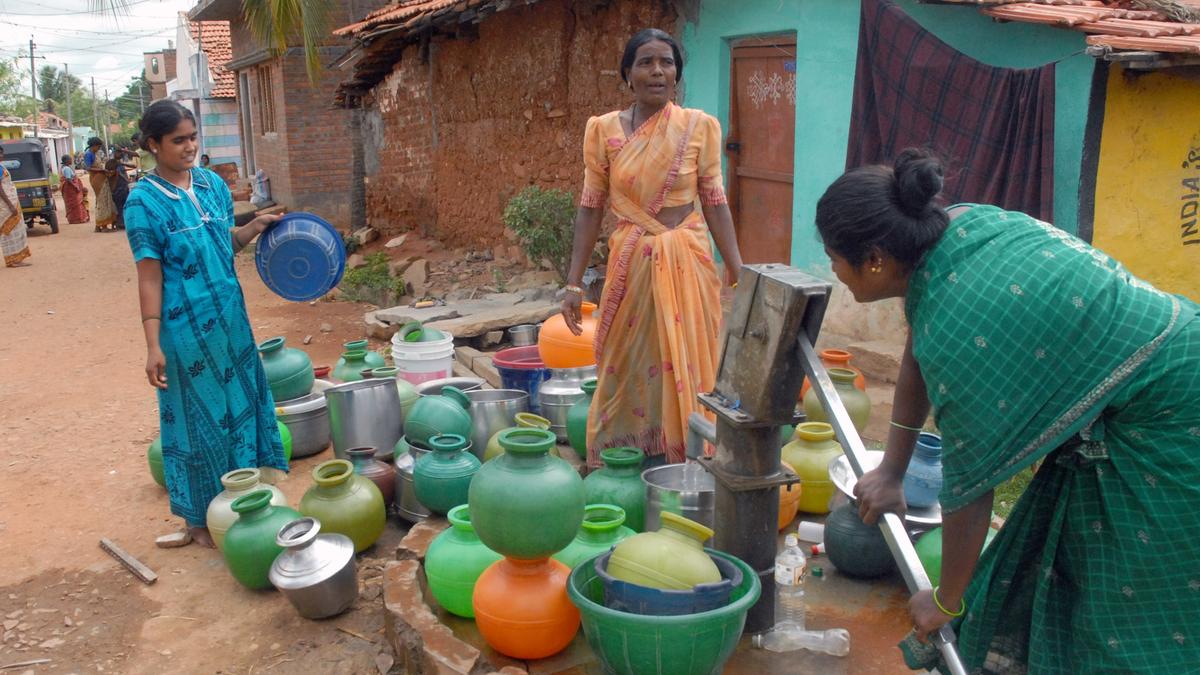
A file photo of people drawing water from a borewell. The study, conducted over 2021 and 2022, revealed that Chintamani is over-reliant on groundwater, which meets 80% of the freshwater needs of the town.
| Photo Credit: SRIRAM MA
As the water crisis that hit Bengaluru this summer hogged the headlines, turning the spotlight on water security in urban India, little attention has been paid to the rise in significance of smaller towns and cities in the country, which are charting the new phase of the urbanisation narrative.
A recently published study has highlighted this trend using the example of Chintamani, a town around 75 kilometres from Bengaluru. The study shows how these towns are feeling the pangs of urbanisation — from over-exploited groundwater and depleting aquifers to polluted lakes and fragmented planning.
The study — Mapping water in a small town: Data and insights on water management in Chintamani, Karnataka — was conducted by the Bengaluru-based WELL Labs, in partnership with Technology Informatics Design Endeavour (TIDE) and the Bremen Overseas Research and Development Association (BORDA)-South Asia.
The researchers chose Chintamani because the town is prone to water scarcity and is governed by a cash-strapped municipality while its proximity to a metropolis like Bengaluru makes it likely that the town will continue to expand.
The study pointed out that built-up spaces concentrated in the centre of the town have tripled in size in the past 25 years. Their spatial analysis showed that only 7% of the land was built up in 1994, but the figure increased to 21% in 2021.
According to the researchers, “Currently, small and medium towns, characterised by populations below 100,000, account for 44.2% of the overall urban area in India, and constitute 26% of the nation’s total urban population (Census 2011). Despite this transition, significant attention and resources continue to be directed towards large metropolises, neglecting towns and peri-urban areas. As a result, many towns grapple with meeting the requirements and ambitions of their growing populations, lacking essential infrastructure for even fundamental services, particularly in water and sanitation.”
The researchers believe that small towns could play a crucial role in advancing India’s economic growth, but addressing their water and sanitation challenges is key for sustained development.
Chintamani faces a cycle of drought and excess rainfall – drought prevailed in 2014, 2016 and 2018 while the town reported excess rainfall in 2015, 2017, 2020, 2021 and 2022.
What the study, conducted over 2021 and 2022, revealed was that Chintamani is over-reliant on groundwater, which meets 80% of the freshwater needs of the town. There is a significant burden on the aquifer underlying Chintamani, but there are data gaps that impede better aquifer management and recharge. Water supply accounts for nearly 40% of the operational expenses of the municipality.
The preliminary analysis showed that over 50% of the town’s drinking water needs could be met through local surface water. Chintamani’s largest water body is the Nekkundi lake, which could supply 1.5 to 2 Million Litres Per Day (MLD) when it is filled to capacity. Supplemented by smaller lakes in the region, up to 4 MLD could be drawn from surface water bodies as opposed to the meagre 1 MLD currently sourced from the Kannampalli lake.
The researchers point out that this overview of the water situation in Chintamani underlines how interconnected surface and groundwater sources are, and how important it is to adopt an integrated approach to water management.
According to a 2021 Niti Aayog report, over half of the 7,933 urban settlements in India lack any master plan.
According to the researchers, the case study of Chintamani offers valuable insights into the complexities of governance and finance surrounding water supply and sewerage infrastructure in towns. There is a high reliance on external sources – Central and State Government schemes and finance commission grants to fund capital expenditure – coupled with challenges in terms of navigating a complex institutional framework of district-level authorities and para-statal agencies in planning and implementing water supply and sewerage infrastructure at the town level.
Key insights
Groundwater is over-exploited
Around 100 municipal borewells run interchangeably 24×7 to meet 40% of the town’s needs. An additional 40% is met via private borewells and tankers.
The aquifer is depleting
Chintamani is underpinned by hard rock aquifers characterised by limited storage potential. This leads to limited recharge. Data and knowledge gaps prevent effective aquifer management.
Lakes are polluted
65% deficit in sewage treatment capacity results in raw sewage entering water bodies and rendering surface water unusable.
Electricity bills are high
Over 40% of the municipality’s operational expenses is spent on water supply infrastructure – mainly for power bills – and little is recovered through user fees as Non-Revenue Water loss is high.
Planning is fragmented
Multiple agencies are involved in water and sanitation schemes. They usually work in silos in the planning phase, which results in fragmented implementation and sub-optimal outcomes.

