

The year 2025 brought about unprecedented disruption in global geopolitics. The return of President Donald Trump to the White House has resulted in a significant churn in various strategic theatres across the world. The Indo-Pacific, arguably, has evolved as the most contested terrain marking the escalating competition between China and the United States. Notably, the Quad has remained a crucial facet of Washington’s engagement in the Indo-Pacific region.
The Quad, a group of four like-minded countries — India, Australia, Japan, and the U.S. — has evolved as a crucial forum with a robust and multifaceted agenda of delivering global good in the region. The overarching objective of the group, however, remains anchored in establishing and sustaining a rules-based order in the region, marked by the notion of a free, open, and inclusive Indo-Pacific.
A priority for Trump
Ever since the Quad’s revival in 2017, the group has evolved with critical momentum. Importantly, Mr. Trump has been one of the key architects of the 2017 revival. Given Mr. Trump’s emphasis on the ‘America First’ outlook, which later emerged as a core doctrine guiding Washington’s foreign policy, there were early suspicions on the extent of the U.S.’s interest in continuing to further cooperate with countries in the Indo-Pacific under the rubric of the Quad.
However, the initial Foreign Minister-level summits of the group, hosted by U.S. Secretary of State Marco Rubio, signalled that the Quad is indeed a priority for President Trump. However, despite its best efforts, the group was unable to convene a leader-level summit in 2025, which was scheduled to be hosted by India. While this has led to speculation over whether the group has indeed withered, the remarkable importance of the Indo-Pacific region and the Quad’s role as a force for global good in it, suggests that it may still be too early to write the group off; 2025 was, however, a year of interregnum for the Quad.
While the Quad was formed in 2004, in the aftermath of the tsunami in the Indian Ocean, the momentum of the group died following the steady withdrawal of member-countries in light of their own strategic compulsions. The group gained steam again in 2017, to set in motion a framework of cooperation among like-minded countries to establish a rules-based order, in the face of growing Chinese expansion in the region.
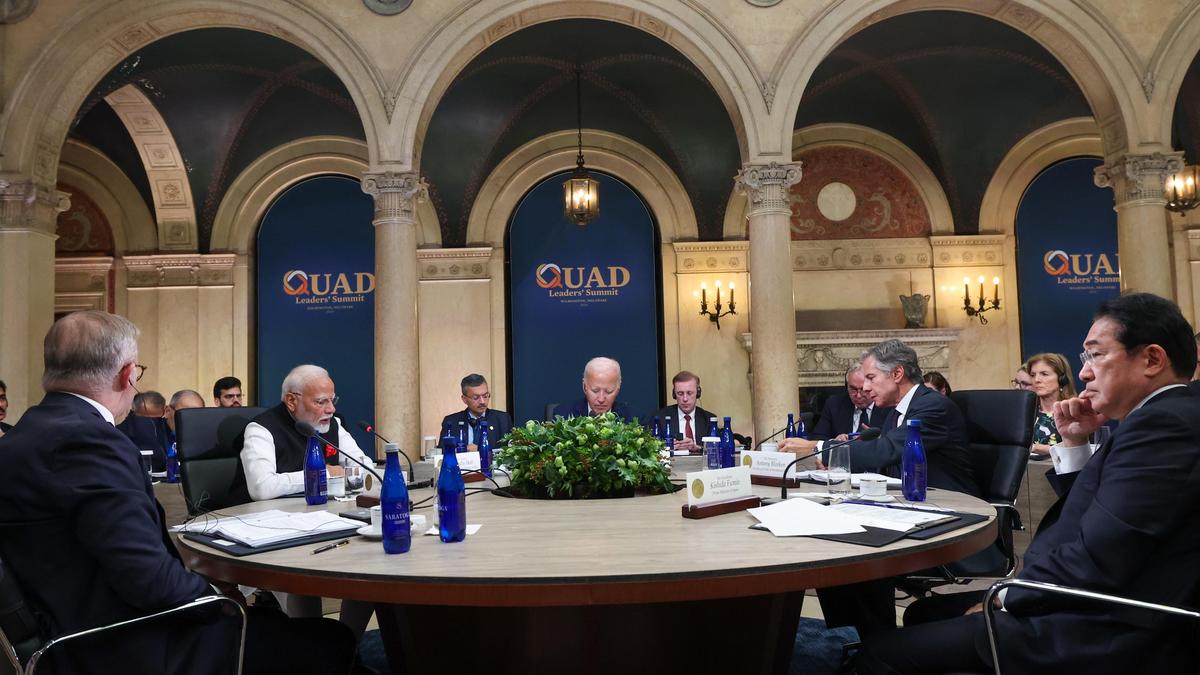
Since its revival, the Quad has hosted six leader-level summits between 2021-2024, along with several Foreign Minister-level summits. The sixth leader-level summit was held in 2024, in Wilmington, Delaware, U.S., hosted by the U.S., and which also marked the farewell of U.S. President Joe Biden.
That the Quad is a priority for the Trump administration was first signalled when Mr. Rubio hosted his counterparts of the group in Washington as his first major engagement, in January 2025 and again in July 2025.
Programmes held
The various initiatives of the group have remained active which include the Quad-at-Sea: Ship Observer Mission, which was operationalised for the first time in June 2025 to further Coast Guard-level cooperation. The Ports of the Future Partnership, an initiative to foster cooperation by way of promoting sustainable and resilient port infrastructure development across the Indo-Pacific, also witnessed its maiden meet in Mumbai, India, in October 2025. The ‘Malabar’ naval exercise, though not officially a part of the Quad’s roster of initiatives but involving the four countries, was held in Guam to enhance maritime cooperation and interoperability among the navies of the four countries.
These suggest that the group has indeed shown critical resilience even as it faced turbulence because of Washington’s shifts, resulting in the failure to convene a leader-level summit in over a year.
A leader-level summit is essential
However, for the group to continue with this momentum, it is vital for the Quad to ensure that a leader-level summit is held at the earliest. Since the last leader-level summit of the group, the administrations in two countries have changed.
In addition to Mr. Trump, Japanese Prime Minister Sanae Takaichi, too, has not attended a Quad engagement since she assumed office in October 2025. For a group such as the Quad, with no institutional anchor, leader-level summits serve as a vital platform to foster bonhomie and achieve strategic convergence on common issues.
Historically, it is at the Quad leader-level summits that new initiatives have been conceptualised and announced. The U.S. Ambassador to India, Sergio Gor, has said before the U.S. Senate Foreign relations Committee in October 2025, that the group is continuing diplomatic efforts to ensure that a leader-level summit takes place in early 2026.
Thus, 2025 was indeed a year that challenged the growing synergy of the Quad. However, the fact that despite not holding a leader-level summit, it has continued to operationalise its initiatives demonstrates its remarkable resilience. The Quad, indeed, continues to remain a force for good.
Harsh V. Pant is Vice-President, Observer Research Foundation, New Delhi. Sayantan Haldar is Associate Fellow, Maritime Studies, Observer Research Foundation, New Delhi
Published – January 12, 2026 12:08 am IST

