

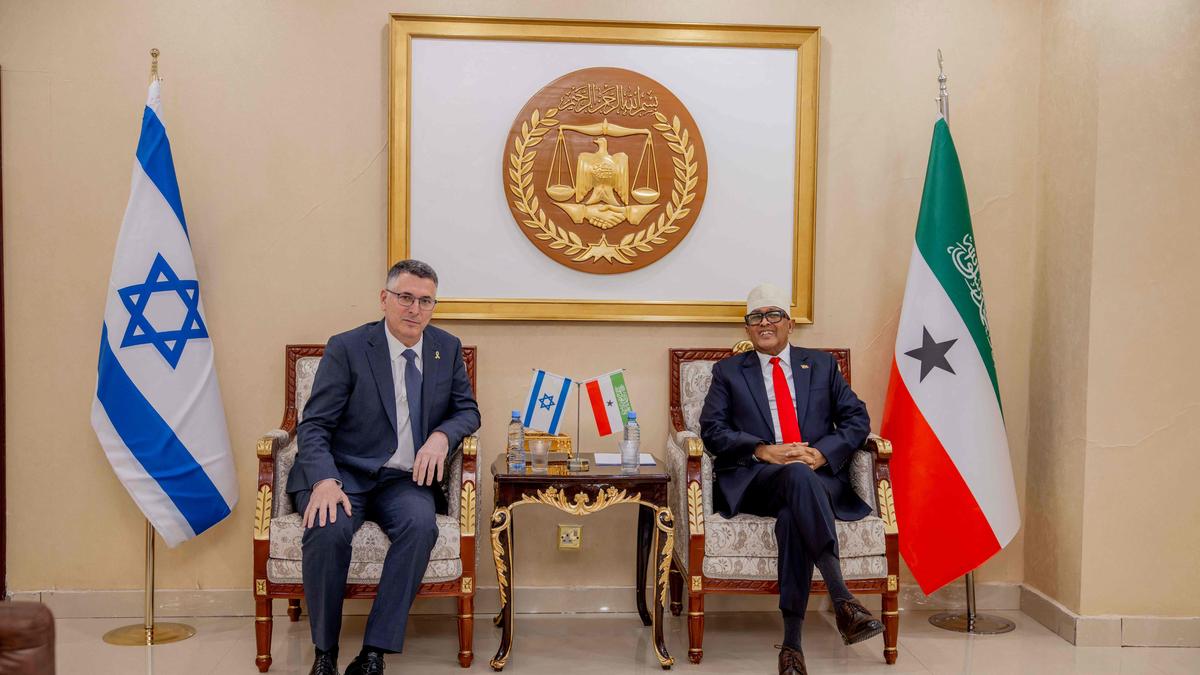
Israel’s decision, in December 2025, to recognise Somaliland as an independent sovereign state marks a significant diplomatic rupture in the Horn of Africa. Beyond the immediate diplomatic fallout, the move carries wider risks. It may intensify Cold War-style proxy conflicts, provoke economic and political coercion, and further militarise an already volatile maritime corridor of the Red Sea and beyond.
China’s dilemma
So far, most of the debates have focused on Israel’s maritime calculations and the reactions of regional actors, West Asian nations and Türkiye; the most acute strategic dilemma belongs to China. For Beijing, Somaliland sits at the intersection of three core interests: safeguarding the “One China” principle, securing the Red Sea corridor, and controlling the intensifying great-power competition in Africa.
From that perspective, Beijing’s response has been predictable. China has condemned Israel’s decision as an endorsement of separatism, reiterating that Somaliland is an “inseparable part” of Somalia. This language is consistent with Beiing’s long-standing position, driven primarily by its domestic sensitivities over Taiwan.
Yet, China may find it harder to reject Somaliland’s claim to sovereignty compared to many other contested territories. Unlike many separatist territories, Somaliland has maintained relative peace, built functioning institutions, and held competitive elections for over three decades. Its stability contrasts sharply with Somalia’s chronic insecurity. Although China continues to reject internal legitimacy as a sufficient parameter for statehood, Somaliland’s persistence as a de facto state exposes the limits of Beijing’s rigid sovereignty doctrine.
Furthermore, the Taiwan factor sharpens China’s dilemma considerably. In 2020, Somaliland decided to establish official ties with Taipei, which directly challenged the “One China” principle. Taiwan’s representative office in Hargeisa, alongside growing technical, medical, and economic cooperation, has turned Somaliland into an outlier in Africa, the small monarchy of Eswatini (formerly Swaziland) being the only other country to be aligned with Taipei.
The importance of the region
China’s concerns, however, extend beyond ideology. The Bab el-Mandeb Strait, linking the Red Sea to the Gulf of Aden, is a critical choke point for Chinese trade and energy flows under the Maritime Silk Road. Beijing has repeatedly described the route as a “jugular vein” for global commerce. Its first overseas military base in the neighbouring Djibouti was established in 2017 precisely to protect these interests and ensure a sustained Chinese security presence near this choke point.
Therefore, Israel’s recognition of Somaliland threatens to disrupt the carefully curated regional chessboard. If Somaliland gains wider international legitimacy, it may emerge as an alternative security and logistics hub along the Gulf of Aden, especially if backed by Israel, the United Arab Emirates (UAE), and potentially the United States. For China, the prospect of a rival intelligence and security ecosystem taking shape near Djibouti is deeply unsettling. It risks diluting Beijing’s leverage in a region where it has invested heavily in ports, bases, and political relationships.
Beijing thus faces an uncomfortable strategic trade-off. It is obliged to oppose Somaliland’s recognition by any country and block any diplomatic space for Taiwan. Yet, excessive pressure on Somaliland risks driving Hargeisa further into the arms of China’s rivals, particularly Taiwan, Israel, and western powers seeking alternatives to Djibouti. Heavy-handed economic coercion or overt political interference could also tarnish China’s carefully cultivated image as a partner that follows the principle of non-interference.
As a result, Beijing may resort to hybrid warfare, which will include economic coercion against Somaliland, lobbying political elites, as well as targeted information campaigns. There are signs that this approach may already be taking shape. For example, Chinese media networks, including StarTimes, which currently operates in over 30 African countries, provide tools to shape narratives around territorial integrity and external interference.
Diplomatically, China can leverage its position in the UN Security Council to block any momentum toward broader international recognition of Somaliland.
Complexities of other geopolitical factors
At the same time, China’s increasingly vocal pro-Palestinian stance adds another layer of complexity. By positioning itself as a champion of Palestinian rights and criticising Israel’s actions in Gaza, Beijing reinforces its moral opposition to Israel’s Somaliland move. This alignment plays well with Arab and Global South audiences but may also drag China into Middle Eastern political contests, complicating its traditionally pragmatic neutral stance in the region.
The wider geopolitical context makes China’s dilemma even sharper. Ethiopia’s memorandum of understanding, in 2024, to recognise Somaliland in exchange for port access, growing U.S. congressional interest in Somaliland as a democratic and strategic partner, and tacit support from the UAE, all suggest that Israel’s move could trigger a geopolitical recalibration. Each additional recognition would weaken China’s ability to isolate Somaliland diplomatically and increase the strategic costs of maintaining the status quo.
Ultimately, China’s challenge is not merely to block Somaliland’s recognition, but rather to prevent greater Taiwanese visibility, deeper Israeli and western access to the Red Sea, and the emergence of a rival security architecture near Djibouti. Israel’s decision has thus forced Beijing into an uncomfortable balancing act between principle and pragmatism.
What is clear is that Somaliland is no longer a diplomatic footnote. Israel’s recognition has pushed it to the centre of great-power competition in the Horn of Africa. In doing so, it has exposed the limits of China’s approach to sovereignty, security, and influence in a region that is becoming increasingly important to global trade and geopolitics.
Samir Bhattacharya is Associate Fellow at the Observer Research Foundation where he works on geopolitics with particular reference to Africa in the changing global order
Published – January 10, 2026 12:08 am IST

