

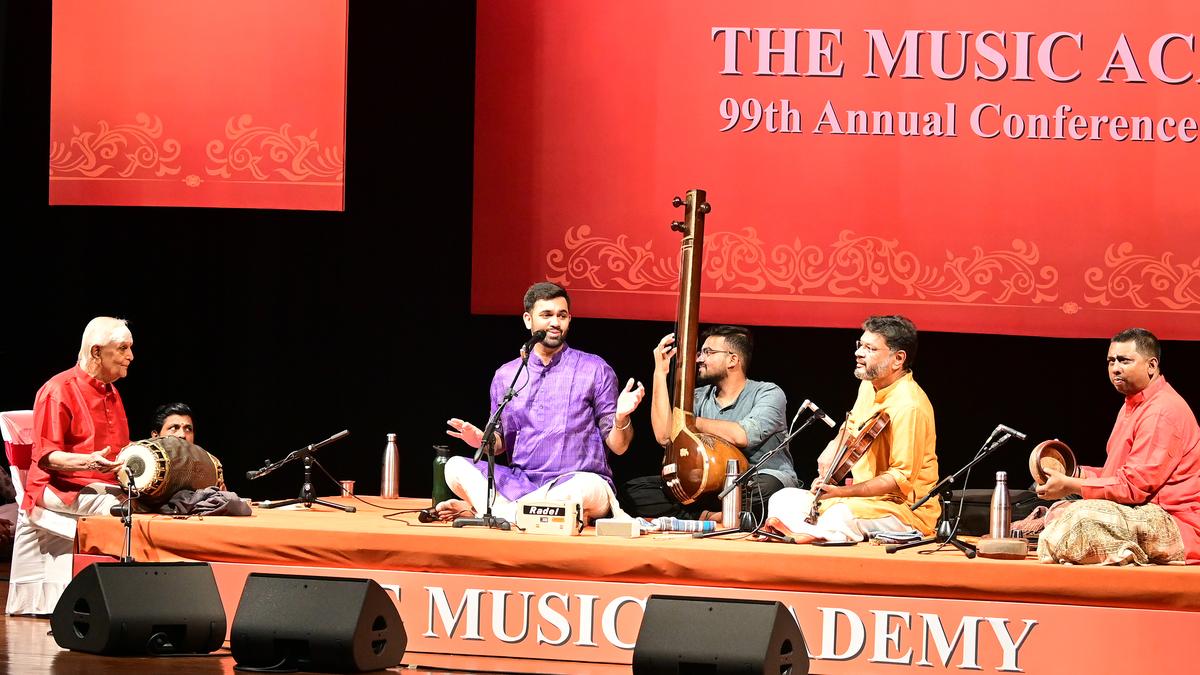
Ashwath Narayanan accompanied by mridangam vidwan Umayalapuram Sivaraman, B.U. Ganesh Prasad on the violin and B.S. Purushottam on the kanjira.
| Photo Credit: K. Pichumani
The contemporary concert hall is a space of mixed interests and multiple distractions. To hold an audience in thrall today, a musician needs not merely talent, but intelligence as well. Ashwath Narayanan demonstrated both in his recent kutcheri at The Music Academy. With a thoughtfully chosen repertoire presented in an unconventional sequence, he created moments of surprise for the listener.
Trained in the legendary K.V. Narayanaswamy bani under vidushi Padma Narayanaswamy, Ashwath evoked memories of the maestro while seamlessly integrating his own musical choices. The stage, thus, was well set.
The evening found its summit in the accompaniment of the mridangam vidwan Umayalapuram Sivaraman, who had turned 91 only the day before. Alert, buoyant and quietly commanding, he infused the concert with a life that lifted it far beyond its given moment.
Ashwath’s rendition of the varnam in raga Vasantha was brisk, punctuated by crisp swara passages that firmly set the concert’s tempo. The Tiruppavai in raga Arabhi, ‘Ongi ulagalandha’ — apt for the third day of Margazhi — was presented with similar restraint, its kalpanaswaras concise, yet rich in meaning. Sivaraman, who has accompanied Ariyakudi Ramanuja Iyengar himself, the creator of the Tiruppavai in musical form, enriched the swara exchanges with a seasoned musical instinct.
A compact yet vibrant Atana alapana, dense with briga phrases, followed. Ashwath then unfolded an exploratory niraval at ‘Rajakula kalashabdhi’, the second speed charged with moments of restrained drama. The rendition clearly evoked the KVN style, and Sivaraman’s accompaniment — measured, poised, and responsive — spoke of a profound internalisation of the kriti.
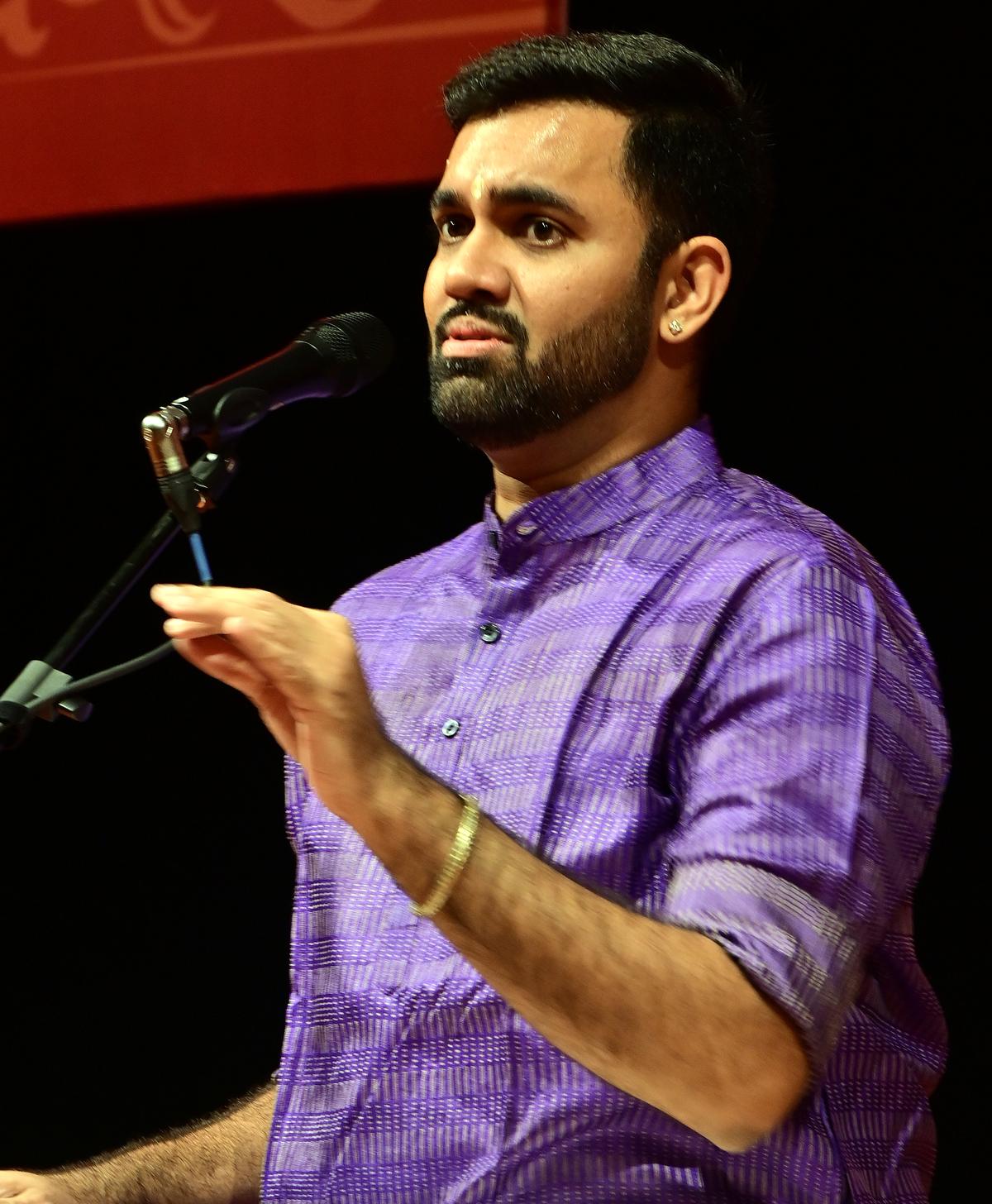
Ashwath Narayanan.
| Photo Credit:
K. Pichumani
The classic ‘Sri mathrubhootam’ in Kannada raga unfolded at a relaxed pace — perhaps, at moments, almost too unhurried. Yet the Mishra Chapu tala, with its innate scope for ideation, allowed Sivaraman’s judicious deployment of sarvalaghu patterns to subtly frame Ashwath’s rendition. The result was a serene atmosphere that gently foregrounded the compositional genius of Muthuswami Dikshitar.
Ashwath’s delineation of raga Kapi was memorable, its emotional gravity occasionally drawing the music inward. On the violin, B.U. Ganesh Prasad brought a soulful richness to Kapi, his phrases steeped in warmth and introspective depth. KVN’s immortal ‘Inta sowkhya’ hovered in the mind, as Ashwath came up with his own interpretation with imaginative niraval and swara patterns.
What followed was a tani. From a perfectly tuned mridangam, the meetu and chapu resonated through the auditorium. Sivaraman’s gumki strokes and finely accented sarvalaghu passages were brilliant. B.S. Purushottam, on the kanjira, extended the mood with sensitive use of gumki, the exchanges remaining brief, yet complete. His playing always demonstrates an insightful understanding of the stylistic nuances of various percussionists.
An apt and concise Purvikalyani alapana, followed by an engaging tana, set the stage as Ashwath rendered the famous pallavi ‘Kanakkidaikkumo sabesan darisanam’. The pallavi featured a challenging take-off point with an ateeta eduppu. The raga passages that followed — Anandabhairavi, Kedara and Sindhubhairavi — were handled with finesse. Ganesh Prasad’s Purvikalyani possessed a lingering and evocative quality.
The act of making music and the act of listening to it are both profoundly inward journeys, requiring an undivided attention from the musician and the listener. In recent times, the impulse to applaud at every turn in concerts has begun to interrupt this fragile continuum. Perhaps, the artiste should be allowed to delve into the music in silence, and the listener to be fully present in that shared moment.
Published – December 30, 2025 10:05 pm IST

