

“Desperate days. Justice nowhere. I fail. What of tomorrow?
We have no doubt about Tomorrow: There is always something in the thought of our Father
More profound, more beautiful than anything we can imagine.
Who has described the lilies that grow in His Garden of Tomorrow?
Not even the Angels of God.
Let us run with patience the race that is set before us.”
Eliamma Matthen wrote these words on November 4, 1938, on her knees in her prayer room in a desperate call to God for guidance at the start of five turbulent years. Days earlier, her husband CP Matthen had been arrested, along with KC Mammen Mappillai and fellow directors of The Travancore National and Quilon Bank. Pioneer bankers from Syrian Christian families, both men merged their enterprises in Travancore and expanded successfully into British India from Madras. Despite evidence to the contrary and after a protracted legal wrangle, they were extradited from Madras by the Dewan of Travancore, CP Ramaswamy Aiyar, acting hand-in-glove with the British Raj. They were given a show trial in Trivandrum and sentenced to rigorous imprisonment.
Eliamma’s tenacity and perseverance, alongside brother-in-law lawyer KP Abraham, meant that she, a homemaker from a backwater in the far southwest on India, was brought to the attention of the Viceroy, Lord Linlithgow himself. Her petition for his release was backed by a powerful 12-page opinion from the Advocate General of India, Sir BL Mitter, who declared the conviction “was illegal and was secured by means which no decent standard can be called fair”.
‘Letters weigh heavy’
East India Office papers reveal that the trial was motivated by malice: Ramaswamy Aiyar disliked Matthen personally and suspected the bank of funding the Travancore State Congress, which he viewed as a threat. The British, keen to maintain imperial control, sided with monarchy over equal rights for Indians, covered the back of their own political agent Resident CP Skrine and allowed personal frictions in imperial financial administration to dominate the Reserve Bank of India, the lender of last resort. Following review by the imperial legislative department and after months of unsuccessful attempts by Travancore to extract a confession, Matthen was quietly released in January 1942.
The events of 1938-1942 shaped Eliamma’s family for generations. She could not see the lilies in her future garden and yet here we are today, living testament to her resilience. This is her story, and a part of mine.

Lilies in the Garden of Tomorrow
| Photo Credit:
Sarah Chandy
About the exhibition
I am the mother of a daughter of India, and a daughter of colonisers of the imperial Raj. More specifically, I am the mother of Eliamma’s great grandson’s daughter: a white British woman with family who served in the Imperial Forestry Commission and elsewhere in the Indian Civil Service. I lived and worked in Chennai from 2005 to 2015. For the Time Being began with my attempt to make sense of my attachment to family and place, which endures in the 10 years since I returned to the UK. It is a presentation of layered memory across five generations, inviting viewers to engage with the story in their own way and connect it to their own histories. The goal is not to speak for, but to create space for conversation.
This conflicted positionality shaped the work I produced. Part insider and part outsider, I wanted to collaborate with family wherever possible. It was an iterative process, led by conversation, material shared, and places visited, rather than a premeditated attempt to present the work in a particular style or format.
Lilies in the Garden of Tomorrow
| Photo Credit:
Sarah Chandy
The importance of being Mrs Matthen
Mrs Matthen’s role in securing her husband’s release and a future for her children was pivotal. Many people across South India are familiar with the Mammen Mappillai Malaya Manorama story, and some with CP Matthen’s role in the context of the banking crisis. Eliamma Matthen’s story — like that of many women who live through political, personal, and economic upheaval — has remained largely untold. This exhibition activates her story for the first time.
Born Eliamma Varugis and baptised in Kochi, she came from a family for whom education, rather than ancestral wealth, enabled social mobility. Syrian Christian by culture and Anglican in faith, she was raised in an intellectually engaged household: her father was a Christian Missionary Service teacher, and her siblings went on to become professionals. She received her pre university education at the Basel German Mission College, an unusual opportunity for a woman of her generation. Her marriage in 1913 to CP Matthen from an orthodox Syrian Christian landowning family in Thiruvalla, likely curtailed further formal education, but not her intellectual life.
Eliamma and CP Matthen were married in 1913, and, after his years at university in Madras, began a family and the banking enterprise that became The Quilon Bank. These years saw mounting discontent in Travancore with monarchy, appointed Brahmin Dewans and British “stewardship” through Resident political agents. Agitation from Christians, Ezhavas and Muslims for greater representation in government gathered momentum.
For Eliamma and CP Matthen ‘the word’ was at the heart of their love and their life. They wrote copiously to each other in times of separation. Then in the early 1930s they began to be guided in faith by the Protestant Irish missionary Amy Carmichael of The Dohnavur Fellowship Mission, Tirunelveli. “Amma,” as she was known, encouraged a life of witness, quiet contemplation, and faith-led action. These values shaped Eliamma’s response to the crises that followed.
Between 1938 and 1942, during her husband’s imprisonment, Eliamma wrote daily in 10 volumes of diaries. These writings offer rare insight into her inner life and the world she inhabited. She recorded her views on local and national politics, the British Raj, the Church in India, student movements, and international affairs, alongside reflections on motherhood, household management, food prices, marriage, and ethical living. In her work, the intimate and the historical are inseparable, allowing micro-history to illuminate broader themes of decolonisation, emancipation, justice, gender, and secularism.
RK Jayasree, former Professor of English, who indexed the diaries, described Eliamma as “a remarkable woman and an original thinker” noting her critical engagement with figures such as Sir CP Ramaswamy Aiyar, Winston Churchill, and MK Gandhi, and her preference for the “quiet life” over public display.
Eliamma’s words reveal a formidable intellect working with humility, discipline, and moral courage. Her writing shows not a withdrawal from the world but an intense engagement with it: she reads widely, questions authority, and continually tests her responses against scripture, experience, and conscience. In the face of repeated miscarriages of justice — circumstances that might lead many to despair or abandon faith — she instead undertakes a rigorous rethinking of what justice itself might mean. This act of surrender is not passive; it becomes a source of endurance, clarity, and ethical resolve.
In activating Eliamma’s voice now, this exhibition honours women as custodians of memory and as imaginative agents capable of forging meaning, and futures, from within constraint.
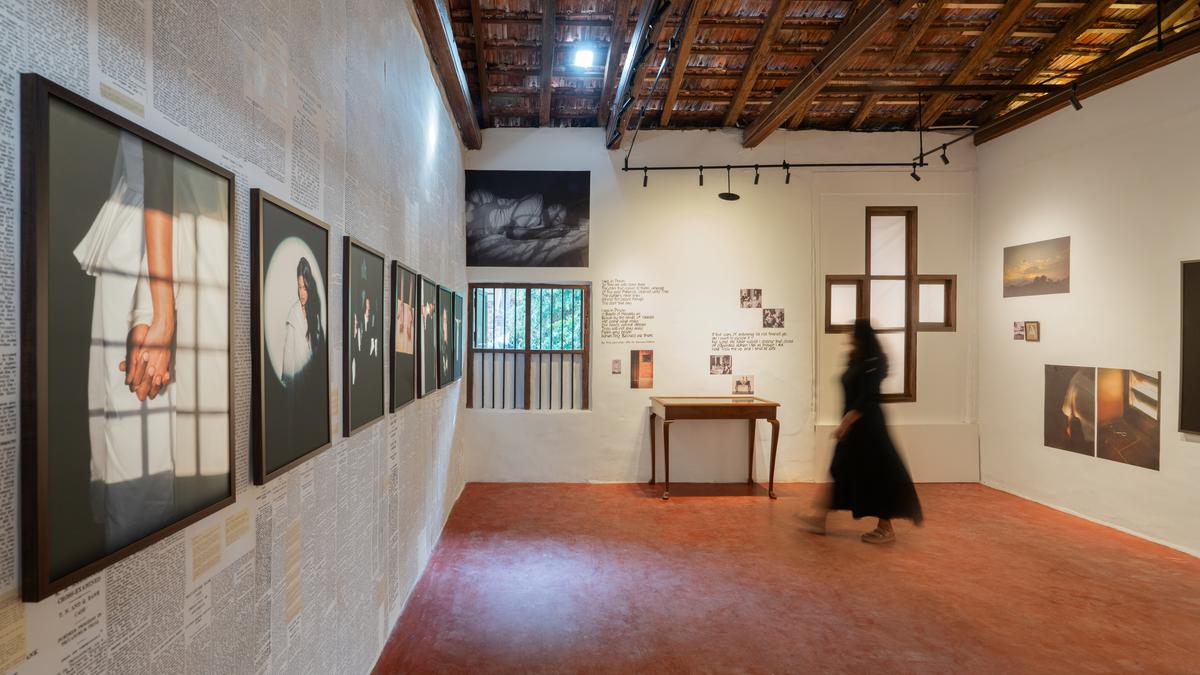
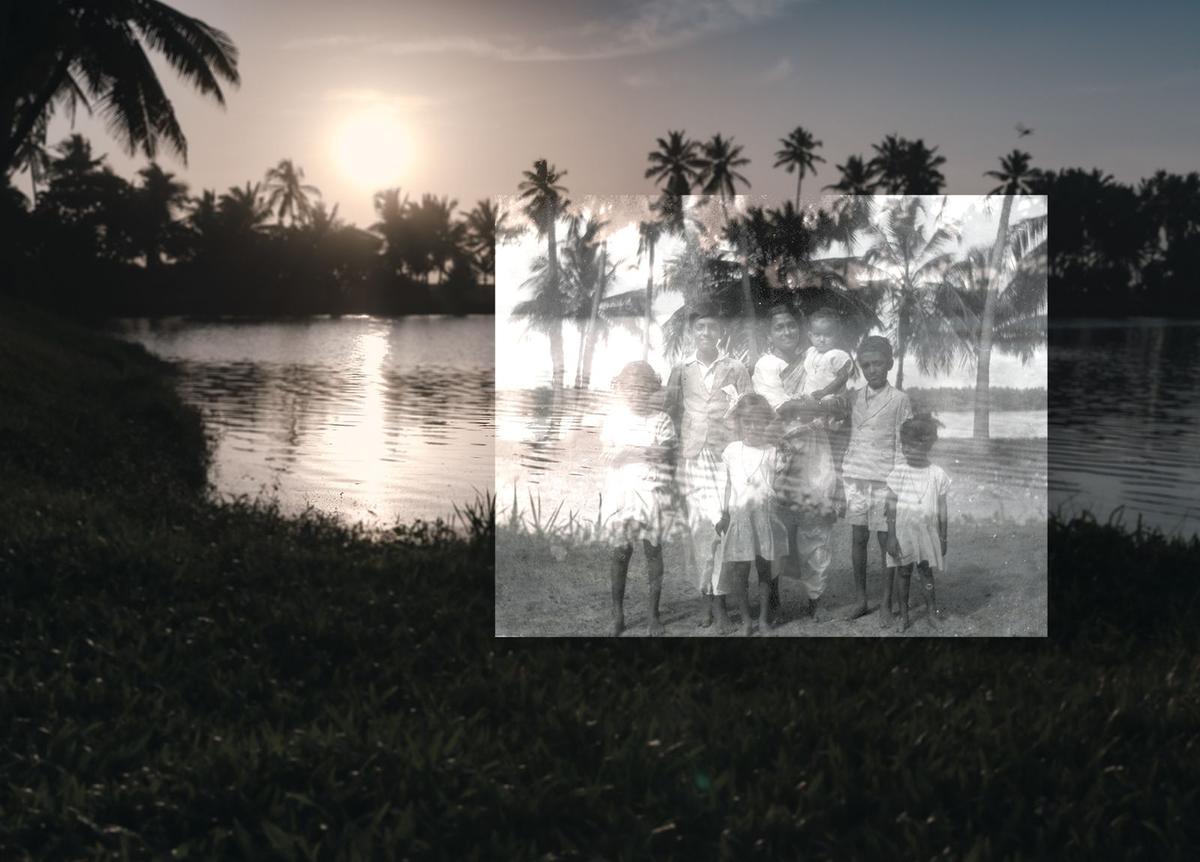
The exhibition is a dialectic of fragments across multiple styles and media. Studio work with my cousins and audio drawn from generations around the world make up embodied memory through sound and gesture. Documentary images of place sit alongside family archive photographs, sometimes intact, sometimes worked. The intimate words of family letters are set against the formal documents of government and newspaper archives.
Eliamma recorded events, thoughts, reflections, prayers and Bible quotations daily in 10 volumes between May 1938 and March 1942. Her practice of quiet reflection mirrored mine in times of anxiety. I was moved by her words, which offered a model of connection with inner life, and yet aware that vivid experience can demand forms beyond language. Photography offered a new voice, particularly for women’s stories.

From Lilies in the Garden of Tomorrow
This is a woman’s story of resilience, passed down largely woman to woman: daughters, daughters-in-law, in albums, stories, and written records. Archival work by Eliamma’s granddaughter Thankan Eappen and her husband Don Hansen predated my own research in British archives, including the East India Office and National Archives.
Arrow Mark | Nosh Haus, the exhibition site, is the former home of a Jewish family — home being the so-called site of “women’s work”. This is not to reinforce this work as separate or marginal, but to demonstrate its power as a site of change. The first room represents the family dining room as the locus of connection; the second reflects the imposition of the show trial on the family psyche and Eliamma’s flight into prayer; the third becomes the site of activation for Eliamma’s writing.
In this final space, viewers are invited to engage actively — with the work and with themselves — by sharing memories and messages within the gallery. We all carry fragmented histories within. When we understand who we are, and why we are, we are free to imagine alternative futures and be proactive in their creation.
Lilies in the Garden of Tomorrow, curated by Bakul Patki and produced by Kalpana Kumar at Yolk Studio, is open until March 31, 2026 at Arrow Mark | Nosh Haus, Jew Town Road, Mattancherry, Kochi.

