

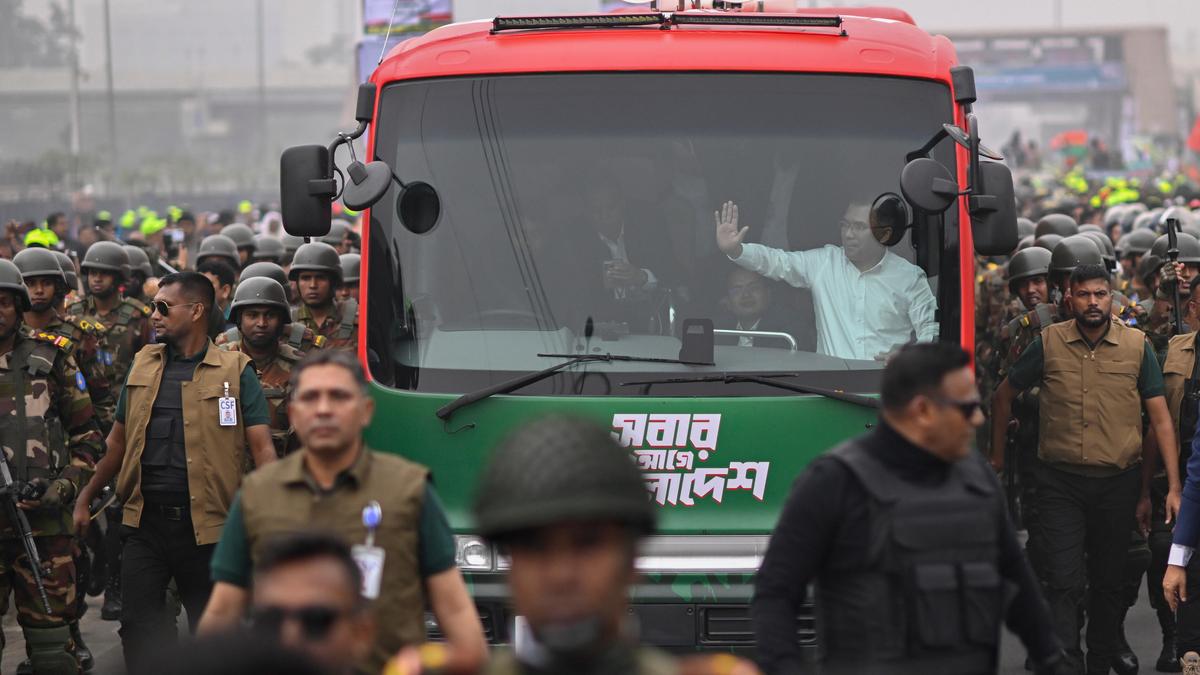
Bangladesh Nationalist Party (BNP) Acting Chairman Tarique Rahman waves to supporters from a bus in Dhaka after returning from London, ending more than 17 years of self-imposed exile, on December 25, 2025.
| Photo Credit: AP
Bangladesh should be a “secure” home for all communities cutting across religious and regional differences within the country, said Tarique Rahman the Acting Chairman of Bangladesh Nationalist Party (BNP) who returned home after nearly 18 years of exile in the United Kingdom.
Addressing a mammoth rally in capital Dhaka, Mr. Rahman made a strong pitch for restoration of law and order and cautioned against “spies of the hegemonic powers”.
“People from the hills as well as the plains live here. That apart we have people belonging to Islam, Buddhist, Christian and Hindu faiths and for them we want to build a secure Bangladesh,” said Mr. Rahman in a Bengali speech that was delivered at a public meeting in Dhaka’s Purvachal neighbourhood. His strongest criticism was reserved for the deposed Prime Minister Sheikh Hasina who fled to India, after being ousted in a ‘student-people’ uprising in July-August 2024.
“In 2024, people of all sections of society came together to preserve this country’s freedom and sovereignty just in the way they worked in 1971 to earn our freedom,” said Mr. Rahman announcing that he has a “plan” to place the country – which has been unstable after the fall of Ms. Hasina – back on track.
“Spies of hegemonic powers are currently engaged in conspiracies in various ways. We must remain patient. We must exercise restraint,” Mr Rahman further said,

Earlier, Mr. Rahman reached Dhaka from London in a Biman Bangladesh flight and was greeted by hundreds of thousands of his supporters on the streets of Dhaka. He called Chief Adviser of the interim government Prof. Mohammed Yunus and thanked him for his support.
In his speech he did not target the interim government or any other political stakeholders who will compete with his party in the February 2026 election but in an oblique criticism of the prevailing law and order situation in the aftermath of burning down of offices of two prominent newspapers, he said, “Today Bangladesh wants to get its freedom of expression back. They want to get their democratic rights.”

Mr. Rahman’s arrival in Dhaka was preceded by days of violence that intensified after the death of Islamist youth leader Sharif Osman Hadi on December 18 which was followed by escalating attacks on minority Hindu community of the country. BNP had strongly condemned the attacks, especially the brutal lynching of Dipu Chandra Das that took place in Mymensingh hours after Mr. Hadi’s death.
In view of the worsening security situation in the country, in his speech, Mr. Rahman urged for protecting the administrative machinery of Bangladesh and said, “We must preserve law and order in this country at any cost and we must remain calm and composed in the face of any provocation.”
Mr Rahman was accompanied from the Hazrat Shah Jalal International Airport till the venue of the rally at July 36 Expressway by the members of the BNP Standing Committee, Mirza Fakhrul Islam Alamgir, Amir Khosru Mahmud Choudhury, Gayeshwar Chandra Roy, Salauddin Ahmed and Iqbal Hasan Mahmud Tuku. Bangladesh Jamaat-e-Islami’s Ameer Dr. Shafiqur Rahman and leader of Islami Andolan Bangladesh, Mufti Syed Mohammed Rezaul Karim have welcomed Mr. Rahman’s return to Bangladesh’s political landscape. Leaders of the newly launched National Citizen Party (NCP) have also greeted Mr. Rahman on his return home.
On the occasion of his return, BNP launched the campaign for the February 12, 2026 election highlighting the role of Mr. Rahman’s father General Ziaur Rahman for introducing major economic initiatives and foreign policy changes during his tenure in the late 1970s. The BNP narrative gave General Zia the credit for announcing the independence of Bangladesh on March 26, 1971 hours after the Pakistani forces launched Operation Searchlight on March 25, 1971 to kill freedom fighters in the erstwhile East Pakistan.
In his speech Mr. Rahman compared the fall of Sheikh Hasina on August 5, 2024 with November 7, 1975 when General Zia had become the de facto ruler of Bangladesh after the “civil-military uprising” in the chaotic situation that followed the assassination of Sheikh Mujibur Rahman and most of his family members. In the election propaganda videos launched on Thursday (December 25, 2025), BNP presented Sheikh Mujib as a totalitarian leader who was responsible for the launch of Rakshi Bahini, a militia that targeted his opponents and showed video footage of the severe famine of 1974 which they blamed on the economic policies of the Mujib administration.
Published – December 25, 2025 06:19 pm IST

