

The year 2025 began as one of considerable promise for Indian foreign policy. After 2024, a year that was dominated by national elections and political recalibration, Prime Minister Narendra Modi was expected to resume active diplomacy, with a full calendar of bilateral visits and multilateral engagements. Relations with the United States were expected to be reset under the second term of the Trump administration, continuing from Donald Trump’s first term. Long-running Bilateral Trade Agreement (BTA) negotiations with partners such as the United States, the United Kingdom, Australia, New Zealand and the European Union (EU) seemed imminent, with commitments to complete them by the end of the year.
Across the geopolitical divide, a new engagement appeared to be taking shape with China after years of a stand-off along the Line of Actual Control (LAC), especially after Mr. Modi’s visit to China. Economic ties with Russia were also at a high point: India’s oil imports from Russia had surged to $52 billion, with U.S. and EU sanctions pressure having eased. Regionally, the government attempted to repair frayed relationships by reaching out to the Yunus administration in Bangladesh with a visit, in December 2024, by the Foreign Secretary, Vikram Misri, sending External Affairs Minister S. Jaishankar to Pakistan (October 2024), engaging the Taliban leadership in Dubai (January 2025), and preparing for regional visits from Nepal, Sri Lanka, and others. Five years after the Balakot strikes and the reorganisation of Jammu and Kashmir, New Delhi was also projecting confidence in its security posture and its deterrent capacity for terrorism from Pakistan.
However, many of those expectations for 2025 dissipated by the end of the year. India’s foreign policy planners found themselves wrestling with profound challenges across four interconnected domains: economic security, energy security, global strategic stability and regional security.
Economic and energy security
Instead of resetting India-U.S. ties, 2025 proved to be the most difficult year of this century. Actions by the Trump administration on tariffs, immigration and sanctions pushed trust levels back by decades. Washington’s decision to levy a steep 25% reciprocal tariff on Indian goods hit key labour-intensive sectors such as apparel, gems and jewellery, and seafood. This followed from the Trump first term, where India’s Generalized System of Preferences (GSP) trade privileges were withdrawn.
To compound matters, the U.S. introduced a 25% surcharge on Indian imports of Russian oil, effectively making India the most heavily tariffed trading partner. Even if a forthcoming BTA softens the blow, the losses in contracts mean that factory-line closures and the retrenchment of workers remain. Immigration restrictions, particularly on H-1B visas, further undermined remittances, a key pillar of India’s foreign exchange inflows. Of all the trade deals on the anvil, India signed FTAs with the U.K., Oman and New Zealand. But the big prizes that leaders had committed to signing in 2025, with the U.S. and the EU, are still pending.
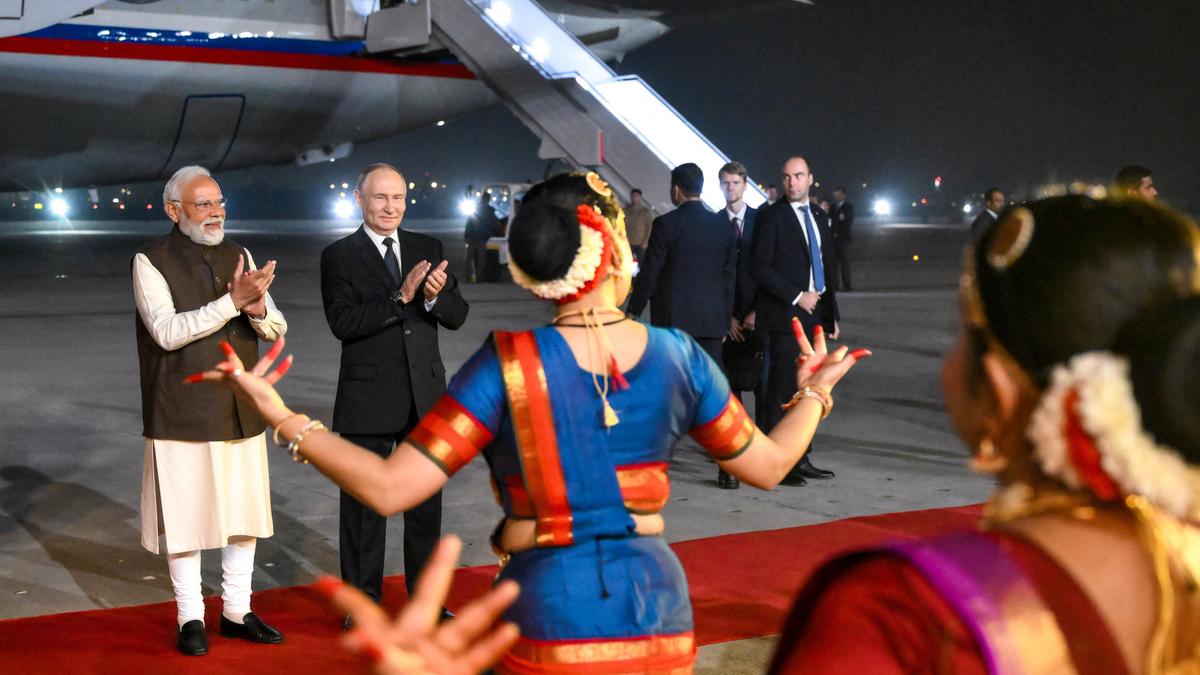
Ties with China and Russia remained tenuous despite the iconic photo-moment of Mr. Modi-President Xi-President Putin holding hands at the Shanghai Cooperation Organisation Summit (September 2025) and the Modi-Putin bear hug on the tarmac of New Delhi airport earlier this month. While India-China flight-visa-pilgrimage links were restored, more fundamental security guarantees for the LAC were not. Neither have economic investment regulations been removed. The hours-long detention of an Indian air passenger from Arunachal Pradesh at Shanghai (November 2025) has raised new concerns.
After three years of resisting western pressure over Russian Ural energy imports, New Delhi appeared to bend, after a new wave of U.S. sanctions. Whether India will be compelled to zero out its Ural imports — similar to how it halted Iranian and Venezuelan oil imports under U.S. pressure in the past — remains uncertain, but the choice carries economic and reputational costs. The India-Russia summit, that ended without any major agreements in strategic spheres such as defence, energy, nuclear and space cooperation, disappointed all the hype preceding it.
Global and regional security
A central challenge for Indian strategists in 2025 has been the rise in global unpredictability. In its 2017 National Security Strategy (NSS), Washington identified China and Russia as “revisionist powers” seeking to undermine U.S. influence and global stability. In contrast, the 2025 NSS presents a softened, more ambiguous stance — avoiding direct mentions of China’s aggression in the South China Sea and toward Taiwan, and treating Russia with more caution than criticism. The 2017 NSS hailed India’s rise as a “leading global power” and “major defense partner”, but the 2025 version offers only a limited articulation of India’s role, primarily in the context of Indo-Pacific security and critical minerals. Given the short shrift to traditional U.S. allies in Europe and Asia, any deeper alignment with Washington, as had earlier been envisaged, seems risky now. Mr. Trump’s references to his meeting with Xi Jinping as a potential “G-2” only intensify concerns about India’s position in the Asian power balance.
At the same time, global acceptance of the Gaza and Ukraine peace proposals — both of which critics argue favour the aggressors — signals a weakening of the international rules-based order. China’s rollout of a framework for “Global Governance” reflects its ambition to shape an alternative international architecture. For India, this requires serious thought about its own vision for a future global order, especially as the UN’s failures at controlling conflict grow.
India’s immediate neighbourhood, which initially appeared stable in early 2025, became more volatile as the year progressed. The terror attack in Pahalgam (April) was a grim reminder that even with the security crackdown in Jammu and Kashmir and past cross-border operations in 2016 and 2019, threats remain embedded. That terrorists came hundreds of kilometres inside the Valley to carry out the killings and escaped should merit serious introspection. India’s retaliatory Operation Sindoor was militarily effective, but New Delhi’s diplomatic campaign following the strike encountered setbacks. While countries condemned the terror attack, few openly supported India’s cross-border response. Persistent questions — particularly regarding speculation about the loss of Indian jets — damaged India’s credibility, as the government neither confirmed nor denied the reports.
Complicating matters were claims that other countries supported Pakistan’s military actions. While India set aside concerns over China’s role in Pakistan Air Force strikes, ties with Türkiye and Azerbaijan have nose-dived. The announcement of a Saudi-Pakistan mutual defence pact was an additional blow to India’s regional calculus.
Mr. Modi’s declaration of a “new normal” after the Pahalgam attack led to international worries over rapid escalation of the next conflict in South Asia. India’s restrained handling of the Delhi blasts conspiracy (November 2025) eased some of those worries, but the broader issue remains: how will New Delhi respond to the next major attack, especially with Pakistan’s political landscape increasingly shaped by the ultra-hawkish Field Marshal Asim Munir?
The 2024 regime-change protests in Bangladesh and the 2025 Gen-Z demonstrations in Nepal have created fragile transitional governments, reducing predictability in India’s periphery. With elections in both countries scheduled for early 2026, New Delhi must prepare to engage with new leadership that is not necessarily positively disposed to it. With Bangladesh in particular, the end of the year has seen relations at their lowest ebb yet. The elections in Myanmar, on December 28, will be held on the Junta’s terms, despite New Delhi’s best attempts at fostering talks with the deposed NUG members and to ask for the more humane treatment of Aung San Suu Kyi.
Lessons for 2026
Several lessons from 2025 stand out clearly. India must recognise the limits of performative diplomacy — warm embraces, highly publicised summits and symbolic gestures such as awards and leaders driving together in the same car do not necessarily translate into tangible gains. Performative aggression — threats to isolate or boycott countries only mean something if other countries join in. The government was sensible in shifting its projection of India as “Vishwaguru” (global teacher) during the G-20 year in 2023 to “Vishwamitra” (global friend). But it must now avoid slipping into the narrative of a “Vishwa-victim”, blaming all others — American sanctions, Chinese manoeuvring, Pakistan’s machinations, or the “ingratitude” of neighbouring states — for its disappointments.
New Delhi must stop being blind to its own double standards too — concerns over the lynching of a minority member in Bangladesh can only ring true only if the Modi government is prepared to condemn and stop similar attacks on minorities in India. The same is true for concerns about democracy and inclusive elections in the neighbourhood. If rising Islamism in the region is an issue, then how does the government sanguinely sup with the Taliban? In 2026, with a world turning increasingly transactional, India can only bring up principles if it follows them consistently, regardless of whether they pertain to ties with geopolitical powers, or its own neighbours.
suhasini.h@thehindu.co.in
Published – December 26, 2025 12:16 am IST

