

Unions and workers’ organisations have been raising objections against the new labour codes of 2019 and 2020. The four codes — they concern industrial relations, wages, social security and occupational health and safety of workers — were passed without a tripartite consultation between workers, employers and government representatives at the Indian Labour Conference (ILC). As implementation of the codes begins, the hard-won labour rights of workers across sectors are either threatened or destroyed.
While the impact on workers in the organised sector is rightfully being discussed, debated and documented, the codes also significantly endanger unorganised sector workers, who are estimated to constitute over 90% of India’s workforce and producing 65% of its GDP. As Tamil Nadu deliberates on issuing rules for the Social Security Code, the serious dangers posed by the Codes to unorganised workers in particular must be highlighted.
On the Codes
The Union Government claims that the codes are an attempt to “consolidate” and codify existing labour laws and “universalise” social security for workers. However, the claims of universalisation and consolidation are myths. Unorganised workers have been mostly left out of consideration in all codes except the one concerning social security. Alongside, in the name of consolidation, existing protections for them under other laws such as the Building and Other Construction Workers (BOCW) Act, 1996, have been threatened or entirely repealed.
Editorial | Labour and honour: On the four Labour Codes, the path ahead
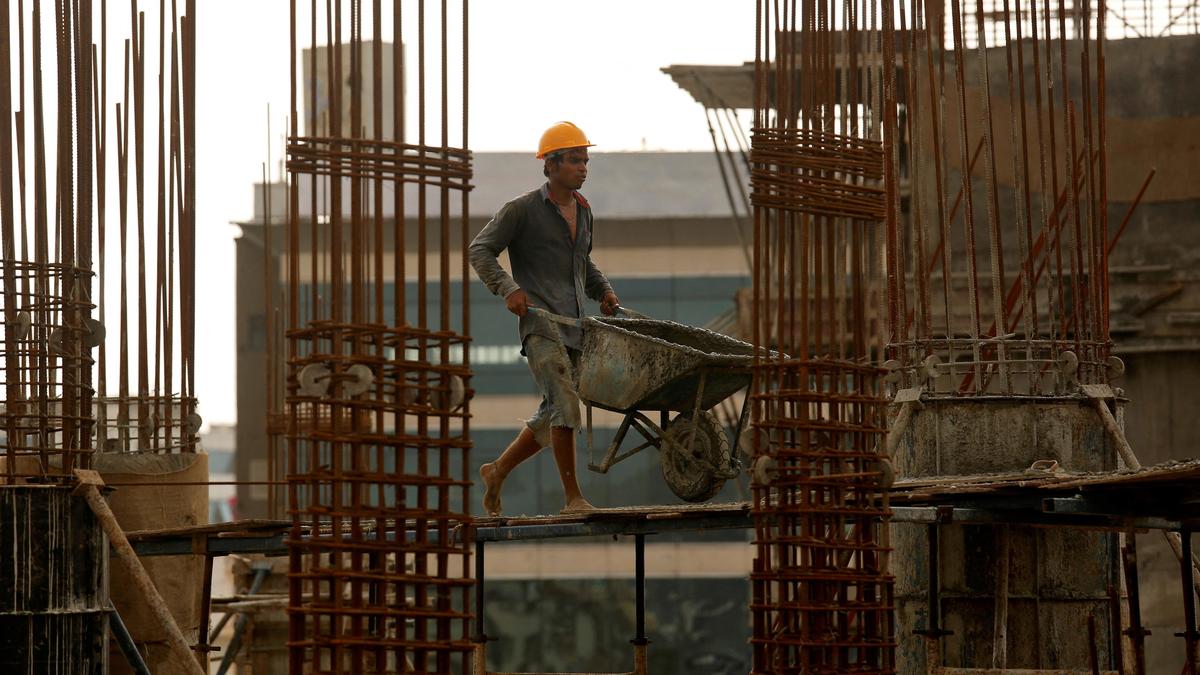
For instance, about 180 rules have been laid out under the BOCW Act to ensure worker safety at construction sites. These are now entirely missing in the central rules issued for the new Occupational Safety, Health and Working Conditions (OSHWC) Code. This is a dangerous sign given the hazardous nature of labour and the high number of deaths in the construction sector. The OSHWC code has also replaced an existing system of inspection with a process that is web-based, which cannot be an effective means of ensuring the safety of the workplace or minimum wage implementation. This is in violation of ILO Convention 81 which is ratified by India.
Unorganised workers can also contract diseases from prolonged manual work and exposure across several sectors. Silicosis is very prevalent in the construction sector, while agricultural workers have a high incidence of cancer from pesticide use, while salt workers face chronic eye, skin and kidney problems. There is no concern for these realities of informal workers and their working conditions in the OSHWC. This negligence stands in violation of ILO Convention 161, which calls for a national policy on occupational health services for all workers and mandates identification, treatment and rehabilitation in the event of an occupational disease.
In threatening and repealing sector-specific laws for workers such as the BOCW Act, the codes foreclose a serious consideration of the occupational health of informal workers. Given that the Employees’ State Insurance (ESI) is not available to them, informal workers will have no state recognition or measures to address their occupational health and safety concerns.
Threats to welfare boards and funds
In the Social Security (SS) Code, organised workers seem to be given some social security benefits, while informal workers are to receive vaguely defined “welfare schemes”. Also notable is the abolition of various cesses as part of the Goods and Services Tax reforms, with no replacement of the cesses collected to provide for the welfare of workers in the beedi, salt, mining and other sectors.
This implies that there are no guaranteed funds, raised either from employers in particular sectors or offered by the Union government, to provide for the welfare of informal sector workers.
In fact, the SS Code sets up one welfare board for all unorganised workers, with no imagination of the various sectors that informal workers can and do work in, except for construction and gig work. Even in the construction sector, the implementation of the now-centralised e-Shram registration system creates a possibility for the central government to take over accrued funds raised for workers’ welfare — estimated to be of the order of ₹1 lakh crore.
As is, in Tamil Nadu, the SS Code stands to threaten the dissolution of all existing 39 sector-specific boards established in Tamil Nadu. There are no saving clauses for these State-level welfare boards and the protections they offer, including old age pensions, maternity assistance and educational assistance for workers’ children. This reality, highlighted consistently by unions and worker movements, is perhaps the main reason why Tamil Nadu continues to deliberate on issuing rules for the SS Code.
What needs to be done
Some States including Andhra Pradesh have closed down their welfare boards in response to the Codes. Tamil Nadu has a strong architecture for workers welfare under the Tamil Nadu Manual Workers Act, 1982, painstakingly built through worker and union demands and advocacy. It is estimated that there are three crore informal workers in the State, and about two crore workers registered across the various welfare boards.
Watch: New Indian Labour Codes: wages, rights & benefits explained
To ensure the welfare of these workers, the State government must protect its welfare boards and State-level labour legislation at all costs. Like Kerala, Tamil Nadu must refuse to implement the codes and notify rules, and, instead, push for saving clauses of existing State-level welfare infrastructure.
R. Geetha is Adviser to the Unorganized Workers Federation (UWF). Priti Narayan is Assistant Professor in the Department of Geography at the University of British Columbia
Published – December 25, 2025 12:08 am IST

