

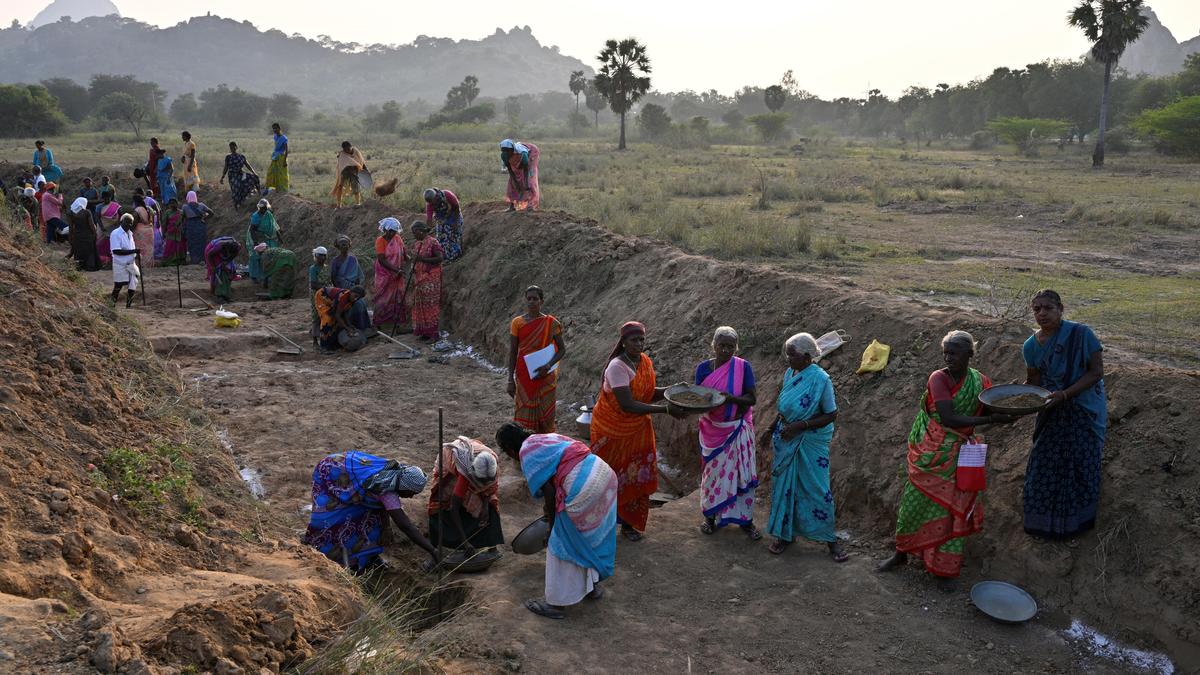
One of the world’s largest rights-based public employment programme has been dismantled and superseded by the Viksit Bharat-Guarantee for Rozgar and Ajeevika Mission (Gramin) (VB-G RAM G) Act, 2025. Enacted in 2005 as the National Rural Employment Guarantee Act (NREGA) and renamed in October 2009 as the Mahatma Gandhi National Rural Employment Guarantee Act (MGNREGA), the law established a legally enforceable, demand-driven right to employment for rural citizens across the country.
The 2025 law inverts this core principle, replacing it with a supply-driven framework that gives the Centre the sweeping authority to determine allocations to States and to decide where and to what extent the programme will operate.
A turn that is political and ideological
This shift is not a technical adjustment but a deliberate ideological rupture. The removal of Mahatma Gandhi’s name and the rebranding of the scheme as VB-G RAM G offer the clearest indication of this unmistakable political and ideological turn. Gandhi’s name anchored the right to work in a moral vision of justice for the poorest, lending the law both an ethical as well as historical legitimacy. The current law severs that association. The policy changes cap employment, centralise control and erode state autonomy. As Jean Drèze, one of the programme’s principal architects, has observed, these changes amount to an effective end rather than reform, hollowing out both the legal force and the moral foundations of the original law.
The new law transfers significantly greater financing obligations to the States. Earlier, State governments had strong incentives to implement MGNREGA, since the Centre bore the full wage cost and over 90% of the total expenditure. Under the revised framework, the funding ratio between the Centre and the States has changed from 90:10 to 60:40, which, by some estimates, could place an additional financial burden on States, one that many may struggle to meet. This is likely to compel poorer States to curtail project approvals, directly suppressing demand for work. Devolving the scheme to States without corresponding fiscal support thus poses a serious threat to its continued viability.
This marks a critical break from one of the most consequential pieces of social legislation in independent India. To grasp the significance of this change, it is essential to understand the context in which the programme was introduced. It arose in response to the contradictions of post-liberalisation India, where rapid economic growth often coexisted with agrarian distress, jobless growth and widespread livelihood insecurity. These conditions exposed the limits of market-led development in generating employment or providing social protection. By the time the United Progressive Alliance (UPA) assumed office in 2004, rural distress had intensified, employment creation lagged behind growth, and inequalities widened, revealing the inadequacy of growth in the absence of inclusive social safeguards.
Editorial | Change for the worse: On MGNREGA to VB-G RAM G
NREGA, along with the Right to Information Act and the Forest Rights Act, represented a rights-based response to these structural failures. Rather than rejecting economic liberalisation, these laws sought to temper its social consequences by embedding enforceable entitlements within an inclusive framework. They asserted that political equality requires both material security and institutional guarantees, and that the state should bear responsibility for ensuring basic livelihood security where economic growth alone falls short.
A gradual retreat
Unlike targeted welfare schemes aimed at specific deprivations, MGNREGA addressed the foundational issue of livelihoods. It recognised employment as the most effective and dignified form of social protection in a country where the vast majority of workers remain outside formal labour markets and social security systems. This rights-based welfare architecture, however, provoked massive opposition from neoliberal interests, corporate capital and mainstream media, who framed such measures as fiscally reckless and economically distortive. Over the past 11 years, the consolidation of a far-right dispensation under the Bharatiya Janata Party (BJP) has decisively shifted the political balance in favour of these interests, paving the way for this process and, more broadly, for the erosion of the rights-based framework itself.
This retreat comes despite empirical evidence of the programme’s positive impact on economic output, efficiency and rural wages, undermining claims of unproductivity. Operating at an unprecedented scale across every rural district, it employed tens of millions of households annually. Crucially, its universality and demand-driven strategy represented a democratic innovation: employment was a legal entitlement, delays attracted compensation, and social audits and grievance mechanisms strengthened grassroots accountability. It, thus, functioned not merely as a welfare scheme but as an institutional mechanism that enabled citizens to assert enforceable claims on the state.
For the BJP government, scrapping MGNREGA constitutes a pivotal repudiation of the UPA’s social policy legacy, signalling the end of an era. That approach had sought, however imperfectly, to reconcile economic growth with redistribution and enforceable rights. It also gave political expression to the brief social-democratic experiment under the first term of the UPA, and was supported by Left parties, social movements and civil society groups.
The repeal signals an ideological realignment in which market imperatives and corporate interests are privileged over the state’s obligation to secure livelihoods for its most vulnerable citizens. Rights-based entitlements that empower workers, decentralise authority and institutionalise claims on the state sit uneasily with a political economy paradigm that concentrates wealth in corporate hands while relying on cultural and religious majoritarianism to manufacture consent. In their place, discretionary state benevolence and executive largesse are preferred, as they depoliticise structural economic injustice and transform welfare into a tool of political loyalty that delivers dividends to the ruling party, thereby compromising the integrity of rights-based policies.
A divergence in legislative trajectories
When enacted, MGNREGA commanded unanimous parliamentary support, reflecting a rare moment of cross-party consensus. By contrast, the VB-G RAM G Bill was rushed through amid Opposition walkouts, without referral to a Parliamentary Standing Committee, and with no attempt to build consensus or accommodate dissent. It was introduced abruptly, leaving minimal time to mount a coordinated opposition. That the Cabinet approved, introduced, and passed such a far-reaching reversal in just a few days magnifies both its political and societal repercussions. The sharp divergence in the legislative trajectories of the two Bills underscores the political rupture now underway. The contrast extends beyond Parliament. The Bill was pushed through so hastily that those whose lives it directly affects were neither informed nor consulted. Recently, the NREGA Sangharsh Morcha was denied permission by the Delhi Police to protest the decision at Jantar Mantar on the grounds that it had failed to provide the 10-day notice requirement. An Act that has stood for over two decades can be overturned in two days, yet citizens must wait 10 days to oppose it. Rights can be undone overnight, while dissent is delayed by procedure.
Over the years, this landmark programme has attracted global attention for both its scale and its innovative, rights-based design. Its repeal, after it had demonstrably strengthened rural livelihoods, particularly during the COVID-19 pandemic, and advanced social and economic justice more broadly, constitutes a historic error, enacting a systematic rollback — legal, fiscal, and institutional — of rights, constitutional guarantees, federal balance, and democratic accountability. More than the future of a single employment programme, what is at stake is the erosion of a foundational principle of India’s democracy: that the state is obligated to secure dignity through work as a matter of right, rather than making livelihoods contingent on fiscal discretion or dispensing relief as an act of benevolence.
Zoya Hasan is Professor Emerita, Centre for Political Studies, Jawaharlal Nehru University
Published – December 25, 2025 12:16 am IST

