

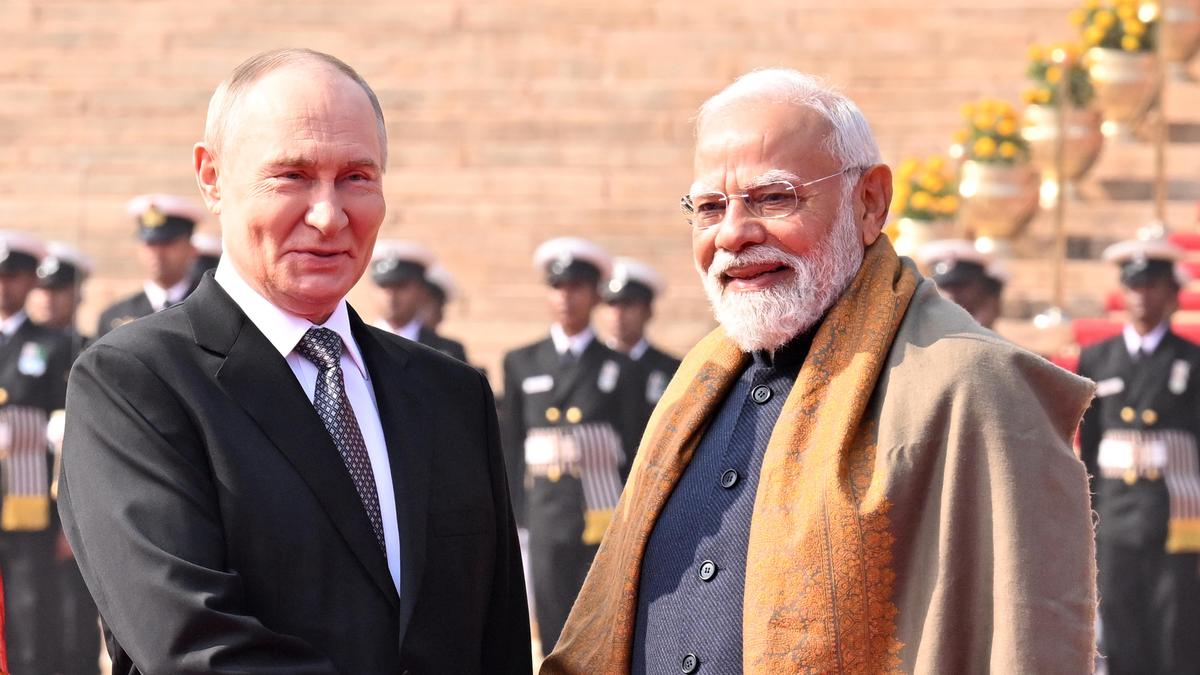
Russian President Vladimir Putin being welcomed by Prime Minister Narendra Modi during the ceremonial reception at the Rashtrapati Bhavan in New Delhi on December 05, 2025.
| Photo Credit: R V Moorthy
Appreciating Russian President Vladimir Putin for taking the India-Russia relationship to “new heights” over the past quarter of a century, Prime Minister Narendra Modi laid out an expansive canvas of energy and trade collaborations between the two countries, stretching to 2030. Addressing the media after bilateral talks at Hyderabad House on Friday (December 5, 2025), Mr. Modi described the India-Russia friendship as a “guiding star” and called for a peaceful solution to Russia’s war with Ukraine.

“Over the past eight decades, the world has witnessed many ups and downs. Humanity has faced numerous challenges and crises. Yet, through all of this, the India-Russia friendship has remained steady like a dhruva tara (guiding star),” the Prime Minister said.

Foreign Secretary Vikram Misri expanded on the PM’s use of the Hindi term ‘dhruva tara’ during a later briefing, saying it referred to the “sustained and long term significance of this relation.” Highlighting the “sustainability and certainty” of India-Russia ties, Mr. Misri added, “This relationship is a constant. There have been several crises along the way but they have not altered the fundamentals of this relationship.”

‘Pushing for peace in Ukraine’
Mr. Putin’s visit has attracted global attention as it comes months after U.S. President Donald Trump imposed punitive tariffs on India for purchasing Russian energy. Mr. Trump described his move as a tactic to push Russia to the negotiating table on Ukraine.
In his remarks, the Prime Minister referred to “energy security” as a “strong and vital pillar of the India-Russia partnership”. Since the beginning of the conflict in Ukraine, “India has consistently advocated for peace, with regards to the situation in Ukraine,” he added.
Ahead of the press statements by Mr. Modi and Mr. Putin at Hyderabad House, the Russian President’s special envoy Kirill Dmitriev told the Russian and Indian media that “British and European press is going hysterical trying to disrupt the U.S.-Russia negotiation”. In an oblique reference to an article recently published in an Indian newspaper that was jointly authored by the French, British, and German envoys to India, Mr. Dmitriev said, “We know the British empire does not exist any more but attempts to disrupt [the Russia-U.S.] peace negotiation through the use of the media is still continuing.”
Mr. Modi, who has called for peace on multiple occasions since the beginning of the Ukraine conflict in February 2022, reiterated the Indian position. “We welcome all efforts being made for a peaceful and lasting resolution in this matter. India has always been, and will always be ready to contribute,” he said.
Nuclear energy cooperation
Referring to the Kudankulam power plant as the “largest nuclear reactor of India”, Mr. Putin announced that Russia is also willing to collaborate with India for small modular nuclear reactors.

“Our decades-old cooperation in the field of civil nuclear energy has played an important role in advancing our shared clean energy priorities. We will continue to take this win-win cooperation forward,” the Prime Minister said, mentioning the Chennai-Vladivostok transport corridor as a project that is being nurtured jointly.
The India-Russia joint statement also made an extensive reference to energy security, noting “the current and potential cooperation between Indian and Russian companies in fields such as oil and oil products, oil refining and petrochemical technologies, oilfield services and upstream technologies and related infrastructure.” Both sides have also agreed to resolve the challenges faced by their “investors in the energy sector”.
Rising trade, free visas
Mr. Putin emphasised the commercial aspect of India-Russia relations. During 2024-25, India-Russia trade has touched $64 billion, he said. “We are on track to touch $100 billion by 2030. We are currently in discussion for a Free Trade Agreement between India and the Eurasian Economic Union and new effective international transport corridor that will connect Belarus and Russia with the Indian Ocean coast,” he said.
The Russian President described India and Russia as countries that both follow an “independent foreign policy” that calls for a “more just, democratic multipolar world order and respect for sovereignty”.
The two sides also announced a programme for the development of strategic areas of India-Russia economic cooperation till 2030. To enhance people-to-people and commercial contacts, the Prime Minister announced the grant of 30 days e-tourist visas “on gratis basis” to Russian nationals on reciprocal basis, and the grant of group tourist visa on gratis basis to Russian nationals as well.
The two sides signed sixteen MoUs covering areas such as the mobility of semi-skilled workers, fertilizers, media, and academic collaboration. Marking a new turn in media collaboration, Mr. Putin attended a special event here to launch the Indian edition of the Russian state-owned English broadcaster, Russia Today. The channel’s Indian version will be its second international foray after an earlier Arabic edition.
Published – December 05, 2025 11:06 pm IST

