

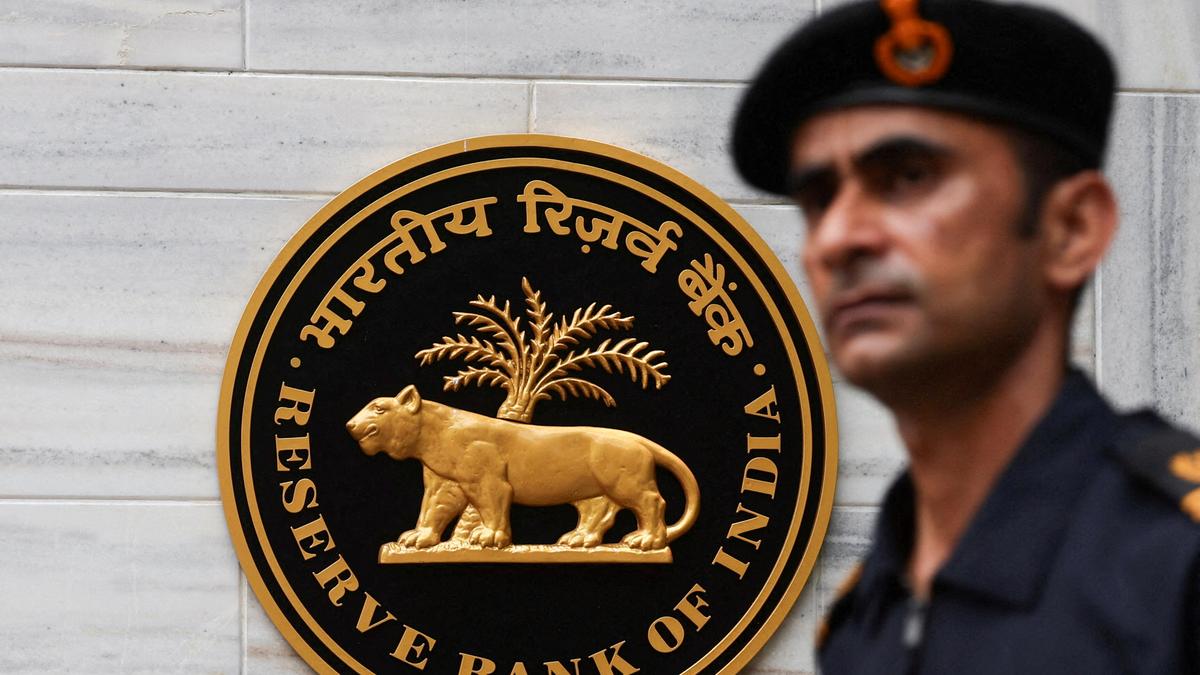
A man walks past the Reserve Bank of India (RBI) logo outside its headquarters in Mumbai. File
| Photo Credit: Reuters
The Reserve Bank Of India (RBI) on Friday (December 5, 2025) decided to conduct Open Market Operations (OMO) purchases of government securities of ₹1 lakh crore in December in a bid to maintain sufficient liquidity in the system.

Besides, the RBI will do a 3-year USD/INR buy-sell swap of $5 billion this month to inject durable liquidity.
These measures would help mitigate the liquidity crunch in view of the outgo from the banking system towards the third instalment advance tax payments due on December 15.
“In view of the evolving liquidity conditions and the outlook, the Reserve Bank has decided to conduct OMO purchases of government securities of ₹1,00,000 crore and a 3-year USD/INR Buy Sell swap of $5 billion this month to inject durable liquidity into the system,” RBI Governor Sanjay Malhotra said while announcing the outcome of the Monetary Policy Committee meeting.
System liquidity, as measured by the net position under the Liquidity Adjustment Facility (LAF), he said, stood at an average surplus of ₹1.5 lakh crore for the period since the MPC last met in October 2025.
The average daily net absorption under the LAF stood at ₹2.9 lakh crore in August and ₹1.6 lakh crore in September, respectively.
Also Read | RBI raises FY26 GDP growth projection to 7.3%
The average daily net absorption under the LAF declined to ₹0.9 lakh crore in October 2025 but improved to ₹1.9 lakh crore in November 2025. As of December 3, net absorption under the LAF stood at ₹2.6 lakh crore.
RBI signals commitment to maintaining durable liquidity
Providing assurance to the market, Mr. Malhotra said, “We are committed to providing sufficient durable liquidity to the banking system. We continuously assess the durable liquidity requirements of the banking system due to changes in currency in circulation, forex operations, and reserve maintenance.” He clarified that the injection (absorption) of liquidity through purchase (sale) of government securities under OMOs and that through operations under the LAF (VRR or VRRR) of short-term duration serve very different purposes.
“While the objective of purchase (sale) under OMO is to provide (absorb) durable liquidity, the purpose of repo operations is to manage transient liquidity so as to align the operating target – the Weighted Average Call Rate (WACR)– to the policy repo rate,” he said.
So, it is quite possible that the RBI injects durable liquidity through the purchase of government securities under OMO on the one hand, while simultaneously withdrawing transient liquidity through a VRRR operation on the other hand, he said.
“I would further like to reiterate that the primary instrument of monetary policy is the policy repo rate. It is expected that changes in the short-term interest rates will transmit to various long-term rates. At the same time, the primary purpose of OMOs is to provide sufficient liquidity and not to directly influence G-Sec yields,” Mr. Malhotra said.
Published – December 05, 2025 01:07 pm IST

