

(This is the latest edition of the Political Line newsletter curated by Varghese K. George. The Political Line newsletter is India’s political landscape explained every week. You can subscribe here to get the newsletter in your inbox every Friday.)
A dominant national party determined to win all elections at all costs. Its principal opposition party which thinks that elections do not matter. And an increasingly depoliticised electorate. That is a summary of the state of Indian democracy.
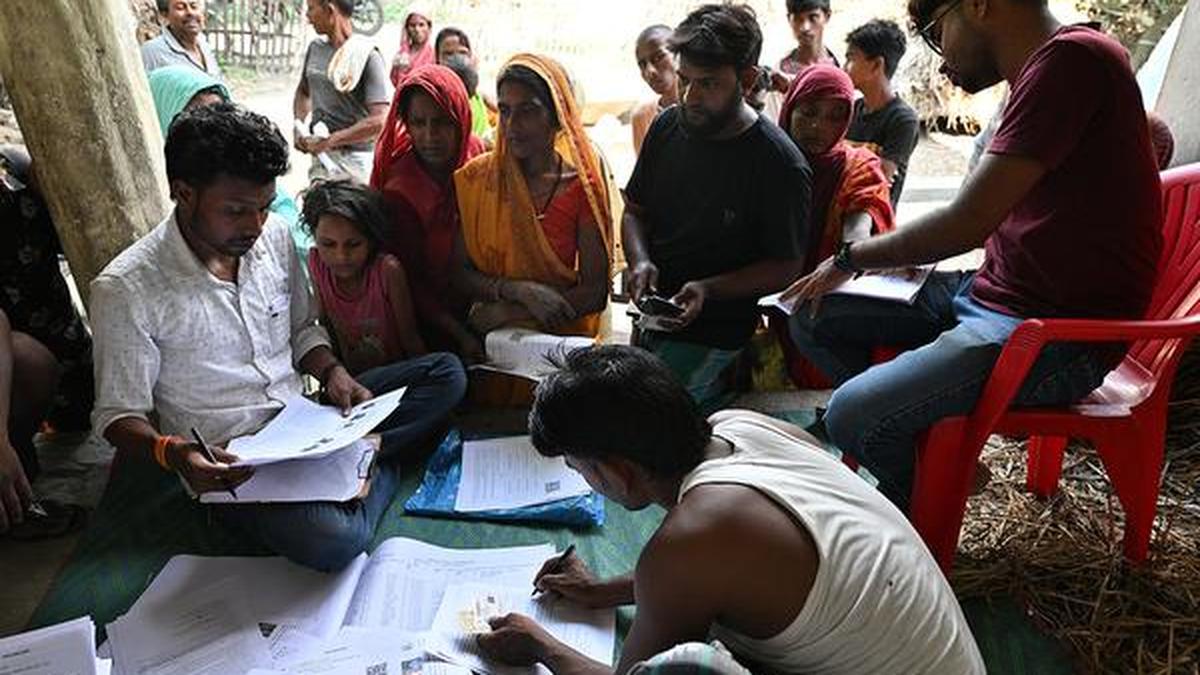
Bihar is India in its extreme, and the recent Assembly election in the State proved these points in a stark manner. You may have already read a ton on the Bihar elections. Two questions are worth revisiting.
Would the NDA have won Bihar
- had there been no SIR,
- had there been no cash-transfer scheme (₹10,000 each distributed to around 1.25 crore women under the Mukhyamantri Mahila Rojgar Yojana, launched just before the Model Code of Conduct came into force)?
The answer is clear for me — yes.
A brilliant analysis by Srinivasan Ramani in The Hindu establishes that there is no discernible link between the Special Intensive Revision (SIR) of electoral rolls and the victory of the NDA.
The election was framed in favour of the NDA by its principal opponent, the alliance of the RJD and the Indian National Congress, the moment it named Tejashwi Yadav as the Chief Ministerial face. Bihar’s electors had to make only one choice — who should be the Chief Minister of Bihar: Nitish Kumar or Tejashwi Yadav. There was no confusion, no wavering for a considerable plurality of them that it was Nitish, and not Tejashwi. The BJP–JDU milked the opportunity to its fullest by invoking memories of the RJD rule that ended two decades ago.
Though the BJP was already ahead in the race, it did not leave anything to chance. That was its maximalist approach towards elections in general.
To illustrate, let me cite one story: weeks before the election, a migrant from Bihar working as a cook in Delhi got a call from her uncle in Purnea, asking her to go and vote. She was a BJP supporter belonging to an EBC group; she wasn’t keen. “Will come for the parliamentary election, to vote for Modi,” she told her uncle. Then a BJP functionary from her locality in Delhi called, encouraging her to travel to Bihar — she resisted. Her uncle called again, telling her that if Nitish Kumar did not win the election, her aunt would not get the next instalment of the cash dole. She was burdened and could not forgo wages or afford travel. Eventually, she was persuaded enough that she travelled all the way to Bihar to vote for the BJP–JDU alliance. The NDA would likely have won even without her vote, but the maximalist approach of the BJP leaves no trick unused — saam, daam, dand, bhed. Election rules, standards and norms be damned. Numerous such examples of intense, targeted, centrally monitored mobilisation and outreach have been observed, and others too have reported similar tales.
The Congress has various strands of “elections don’t matter” thinking. One set — mind-managers of its supremo Rahul Gandhi — sees politics as an abstract, unbounded pursuit of undefined goals. Elections, they argue, are a distraction from the “real” purpose of politics, such as social transformation and the awakening of the people. They live off the resources mobilised by old-style politicians, endlessly theorise and present themselves as puritans unblemished by the schemes and propaganda of electioneering. A second set of election agnostics thinks the party will win when it has to, regardless of what it does. People will get tired of the BJP and vote for the Congress at some point, they believe. So why sweat or strategise? A new strand is the complete desecration of the election process itself — that the party does not lose a fair election. If it has lost, it only means that it has been stolen from it by the BJP in collusion with the Election Commission of India (ECI). All these strands are united by the thread that nobody needs to do anything really consequential to win any election. In fact, the hallucinating club of self-righteous people surrounding Mr Gandhi treat those who fight and win elections with contempt and hostility.
Sandwiched between these two extremes of election-mania (BJP) and election-indifference (Congress), the ECI’s reputation and credibility are in tatters. The ECI bends to the pressure of the BJP; and the Congress wrecks it further. To cite just one crystal-clear example: the ECI allowed the distribution of money under the women’s scheme cited above in the midst of polling in Bihar, while it froze ongoing schemes in Rajasthan when the government there (of the Congress) was contesting the 2023 election.
Not to be outdone, the Indian electorate has become increasingly apolitical. It is not a question of electors being uninformed or ignorant — quite the contrary. This is not to dismiss the electorate as fools, but to acknowledge its cynical calculus. It is a case of people getting what they want and deserving what they get. According to a 2023 survey by Pew Research Center, 85 per cent of Indians support autocracy or authoritarian rule. That is the highest among the 24 countries covered in the survey.
I do not make this argument in a strictly partisan manner. Incumbent governments at the Centre and nearly in all States are run by the chief executive — the Prime Minister or Chief Ministers — assisted by a small coterie of advisers. Of all parties. People see this as efficiency, and vote back incumbents. Apolitical voters view their interests narrowly through material, religious, caste or tribal interests. How we got here — or whether it has always been like this — are questions to be explored. But the transactionalism and tribalism of the electorate, which erode any notion of a shared political identity and ideal, are unmistakably in our face today.
Being Hindu, Indian, Secular: Sonia Gandhi’s political life
Last week, PL discussed faith and politics in the context of the divergent reactions to the religious assertions of two figures in US politics — Zohran Mamdani and J. D. Vance — and recalled the lesser-known episode of a Christian First Lady of India who too was Usha. Mr Vance expressed hope that his wife Usha would one day convert to Christianity. One reader, perhaps half in jest, responded that Sonia Gandhi was the first Christian First Lady of India. I do not know whether he was alluding to the fact that Mrs Gandhi was the most powerful political figure in India for at least a decade, or that her husband Rajiv Gandhi was the Prime Minister of India.
Regardless, that reminded me of how she came to be considered Hindu in Indian common sense; and how she herself projected her Hindu identity as a source of political legitimacy even as she championed secularism and pluralism. This is different from Mr Mamdani’s politics of asserting his Muslim identity in order to affirm the diversity of America. In Mrs Gandhi’s case, the main argument in her defence was that, as per Indian tradition, the wife joins the husband’s family, its traditions and faith. Born Italian and Catholic, she married Rajiv Gandhi in 1968 according to Hindu rituals. There is no defined method of converting to Hinduism, so one cannot really say whether anyone has “converted” in a formal sense.
In 2001, she went to the Kumbh Mela and took the holy dip; she routinely attended the annual Dussehra event in Delhi and made visible visits to temples and shrines. She has never been seen practising Christianity in public.
Sushma Swaraj, the BJP leader who was at the forefront of confronting the Congress on Mrs Gandhi’s foreign origins, never raised the question of her religion. Not only that, in May 1999, of the three senior Congress leaders who expressed concern that Mrs Gandhi’s foreign origin might adversely affect the party’s electoral prospects, one was a Muslim from Bihar (Tariq Anwar) and another was a self-declared “devout Christian” from Meghalaya (P. A. Sangma). Secular doubts about her Indian-ness, perhaps.
So here is the paradox. Mrs Gandhi demonstrated her affinity with Hindu rituals as proof of her Indian-ness, even while strongly championing secularism. Her opponents who questioned her Indian-ness did so by recalling her birth as an Italian, not as a Catholic. Hinduism and patriarchy thus became the source of her legitimacy to lead the party and the broader opposition front confronting the BJP.
Federalism Tract
After mooting the idea of bringing Chandigarh more directly under its control, the Centre has now postponed the plan. The status of Chandigarh is a highly emotive issue in Punjab, and the proposal to reduce its autonomy triggered strong reactions from parties in the State and other national opposition parties.
Published – November 30, 2025 12:42 pm IST

