

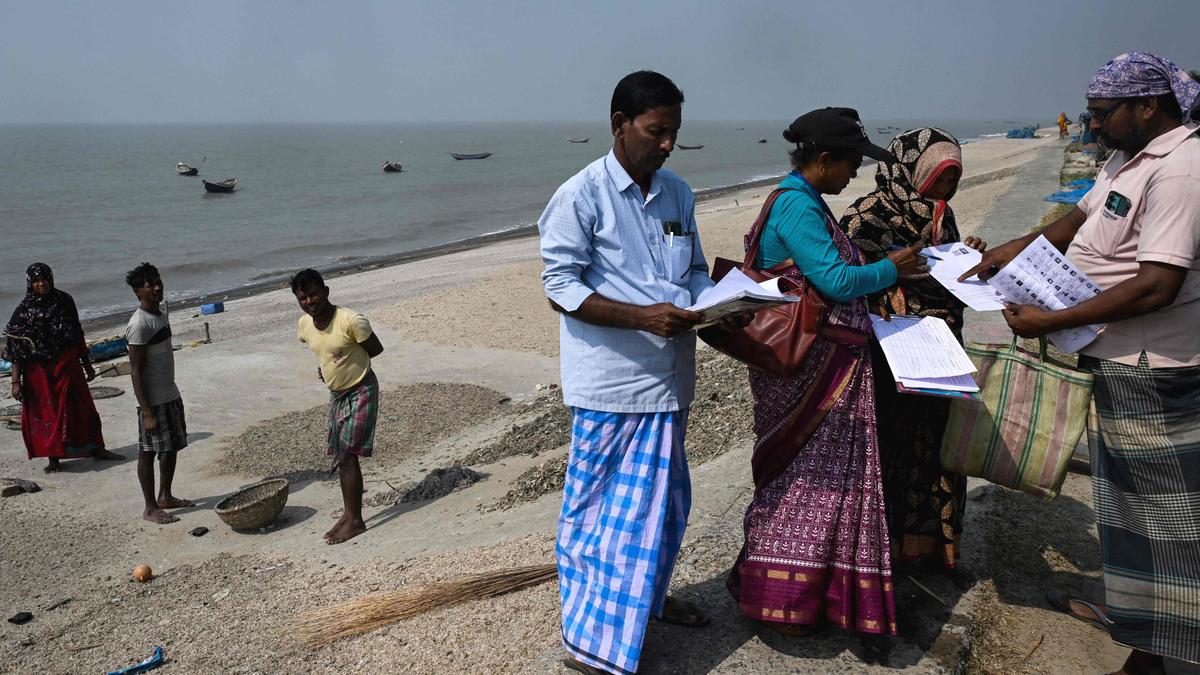
“I want to live. My family lacks nothing. But for this minor job, they have forced me, through humiliation, to die… I have completed almost 95% of the offline work, but I cannot manage anything online.”
These words, from a note by a Booth Level Officer (BLO), should shake the conscience of any democratic society. Before her life faded away, she wrote a line — that none of her family members was responsible for her death. Yet, no proceedings have been initiated, suo motu, to examine the role of the Election Commission of India (ECI) in the circumstances that allegedly led to her despair. This silence is deeply troubling.
The need for an SIR, the crisis around it
There is no doubt that West Bengal required a Special Intensive Revision (SIR) of its electoral rolls as there are fake entries, names of deceased individuals, and — according to multiple reports— the names of infiltrators. Once the SIR process began, many infiltrators were said to have tried to cross the border to exit. The fault of allowing such infiltration lies principally with the Border Security Force, followed by the State police, and by political networks that helped irregular applicants acquire voter cards.
But the validity of the SIR does not justify the manner in which it is being executed. An exercise that took two full years, in 2002, is now expected to be completed in less than two months, despite the manifold increase in the number of voters. This compression of time has resulted in BLOs facing immense pressure, many of whom are schoolteachers or para-teachers engaged in modestly paid contractual work.
From the day the SIR began, signs of the ECI’s unpreparedness became evident. Voters have faced inconvenience, but the brunt of the crisis has been borne by BLOs. Apart from rigid deadlines, they face political pressure, particularly from Booth Level Agents of the ruling party. Several BLOs have fallen ill; some have died. A large demonstration of BLOs has already taken place in Kolkata, with some threatening to lock the ECI’s office.
Challenges on the ground
Consider the operational challenges alone. BLOs were told that all voter forms would be distributed on November 4. They were not. Forms arrived in phases, forcing BLOs to visit households a number of times because members of the same family were listed under scattered serial numbers. Reports indicate that some BLOs have had to be on their feet for 16 hours a day to complete these visits.
There were also contradictions in the instructions given during training and the ECI’s social media announcements. Something as basic as attaching a voter’s photograph to the form was described as mandatory and then optional. The enumeration form should have had clear instructions on what to do. Even the Bengali used in parts of the form is confusing — something this writer experienced and had to call the BLO to clarify.
The most serious grievance is the unplanned digital component. BLOs say they were never informed during training that they would have to enter all data online. No meaningful digital training was given. Many senior teachers are not comfortable using smartphones or computers, yet the ECI expects them to complete large-scale data entry using the threat of disciplinary action.
The data-entry app malfunctions. BLOs across districts report that it works reasonably only during limited windows — 6 a.m. to 11 a.m. and then 8 p.m. to 11 p.m. Even so, it is still not reliable. It frequently logs out, does not display how many forms have been uploaded, and offers no option to correct errors. The ECI has promised a window for editing later, but how can such a crucial democratic exercise depend on a flawed digital tool? This cannot be the face of “Digital India”.
Compounding these issues is a mapping problem: the app often displays “no record found” for names that are listed in the 2002 electoral rolls.
Lack of a support system
The ECI initially indicated that additional BLOs would be appointed to help complete the SIR. This did not materialise to a large extent until BLOs submitted deputations. Even then, the assistance was limited to booths with more than 1,200 voters. The State government has not provided data-entry operators, though it is best positioned to do so. As a result, BLOs are overworked, under-trained, digitally unsupported, yet held to be fully accountable.
Nobody argues that the SIR should be halted. Electoral transparency is indispensable. But the ECI must recognise that a democratic exercise cannot be sustained through coercion, fear or administrative opacity. It must extend the SIR deadline, ensure a fully functional digital platform, and deploy trained data-entry operators to assist BLOs.
The speed at which the SIR is being pushed through raises questions. Why the haste? Is the ECI, intentionally or by omission, enabling the interests of a certain political party ahead of the Assembly elections?
The ECI occupies a sacrosanct constitutional space in India. If it fails to act swiftly and sensitively, not only will more BLOs suffer, but also public trust in the impartiality of India’s election machinery may erode further. A democracy cannot afford that cost.
Angshuman Kar is Professor, Department of English and Culture Studies, Director, Centre for Australian Studies, Associate-in-Charge, Alumni Affairs and International Relations Centre, The University of Burdwan, and former Secretary, Eastern Region, Sahitya Akademi, India’s Official Academy of Letters
Published – November 26, 2025 03:46 pm IST

