

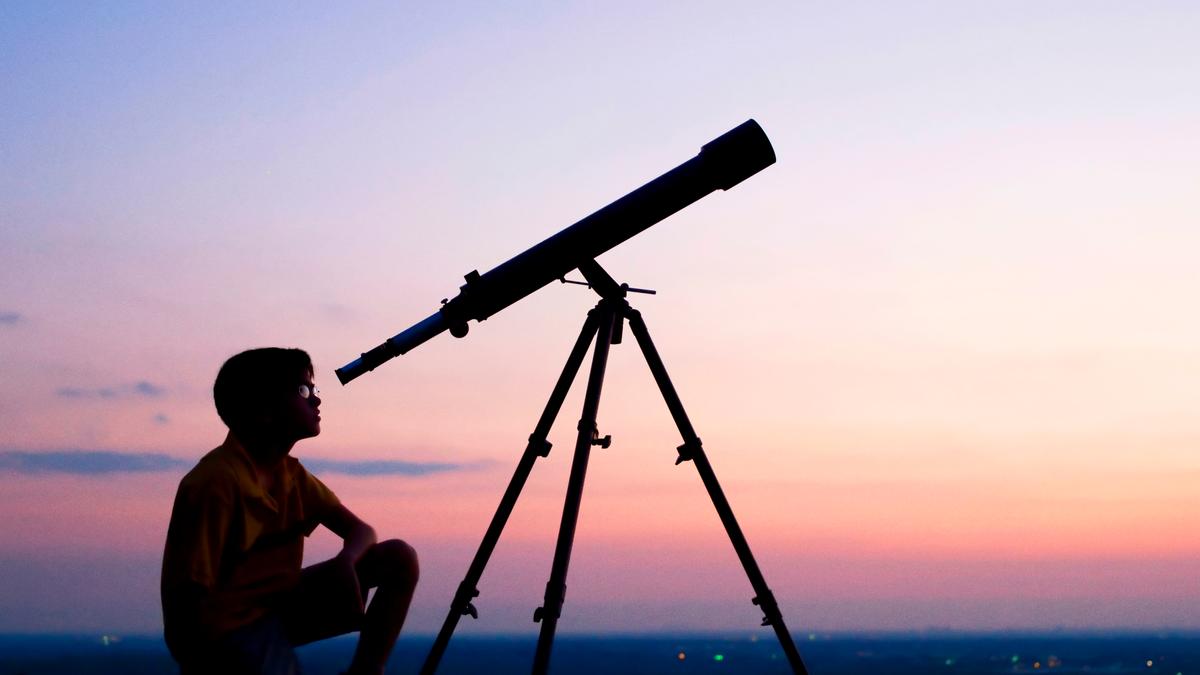
Astronomy is a powerful gateway to interdisciplinary learning.
| Photo Credit: Getty Images
In an age when our attention is increasingly drawn toward screens and social media, the night sky still holds a timeless, universal appeal — a quiet invitation to wonder. Astronomy, one of the oldest sciences, has inspired poets, philosophers, and physicists alike. Yet, in many schools today, it remains on the periphery of the curriculum, treated as an optional topic rather than a vital field of learning. Encouraging interest in astronomy among school-going children is not just about teaching them to identify stars or constellations; it is about nurturing curiosity, imagination, and a deeper understanding of our place in the universe.
To begin with, astronomy uniquely combines wonder with scientific inquiry. When children gaze at the moon or watch a solar eclipse, they are not merely observing natural phenomena — they are engaging with questions about existence, creation, and the nature of reality itself. Astronomy invites young learners to think beyond the boundaries of earth, to question how things work in space, and to seek answers through observation, experimentation, and reasoning. This curiosity-driven learning is the foundation of scientific temperament, something every society needs to cultivate from an early age.
Moreover, astronomy is a powerful gateway to interdisciplinary learning. It connects physics, mathematics, chemistry, computer science, and even history and literature. For example, understanding how stars form involves physics and chemistry; calculating planetary distances uses mathematics; exploring space missions requires computer programming; and studying the history of astronomy brings in art and culture. When students study astronomy, they begin to see how knowledge is interconnected rather than compartmentalised — a realisation that makes learning richer and more meaningful.
Astronomy also teaches humility and perspective. At a time when competition and material success dominate the lives of young people, the study of the cosmos offers a rare and profound sense of proportion. To realise that earth is but a small planet orbiting an ordinary star in one of billions of galaxies can be a deeply transformative experience. It reminds children of both the fragility and the beauty of our world, instilling in them respect for nature and a sense of responsibility toward preserving it. This cosmic awareness is essential in nurturing global citizens who care not only about human progress but also about planetary well-being.
Additionally, astronomy has the potential to foster inclusivity and equality. The night sky belongs to everyone — regardless of nationality, language, or background. In fact, many ancient civilisations, from India to Egypt and Greece, made their own astronomical observations and discoveries. Introducing children to astronomy can therefore help them appreciate the shared human heritage of knowledge and curiosity. It transcends barriers and reminds them that the pursuit of understanding is a universal human endeavour.
Astronomy can also inspire future careers and innovations. The skills developed through astronomy — critical thinking, problem-solving, data analysis, and creativity — are invaluable in today’s technology-driven world. As India and other nations expand their space programmes, opportunities in fields related to astrophysics, aerospace engineering, satellite communication, and data science are growing rapidly. By igniting interest in astronomy early, schools can help students envision themselves as part of these exciting frontiers of discovery.
However, to make this possible, educational institutions need to move beyond textbook-based learning. Setting up school astronomy clubs, organising sky-watching sessions, planetarium visits, and telescope-making workshops can make the subject come alive. Simple activities — like observing the moon’s phases or tracking constellations — can spark lifelong fascination. Teachers, too, must be equipped with training and resources to guide students effectively.
In the end, increasing children’s interest in astronomy is about far more than producing future scientists. It is about cultivating wonder, curiosity, and a sense of belonging in the vast cosmic story. The stars remind us that every child’s imagination, like the universe itself, is limitless. By encouraging young learners to look up and question what they see, we are not only nurturing scientific minds but also inspiring dreamers — the kind the world will always need to move forward.
rudrashisdatta@gmail.com
Published – November 16, 2025 04:40 am IST

