

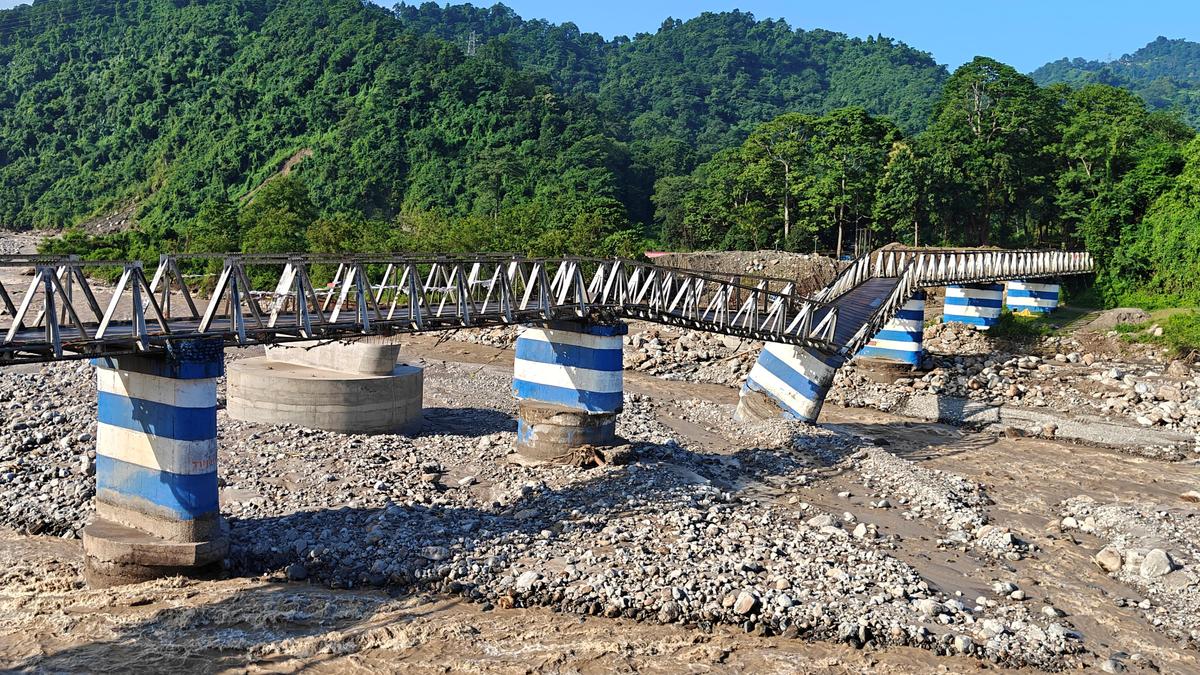
The bridge at Dudhia in Darjeeling district that collapsed after a flash flood.
| Photo Credit: Shrabana Chatterjee
No journalism school or newsroom experience can truly prepare a journalist to report on a natural disaster. Earlier this month, when I set out from Kolkata to report on the devastating north Bengal floods, which killed over 30 people and caused more than 110 major landslides, I had little idea about the harrowing stories I would come across: a woman had lost her only child and another woman, who was buried under debris for over a day, survived to tell the tale even through the crushing pain of losing her daughter.
Articulating these stories is just one of the many challenges. First, there was the issue of navigating unknown terrain and trekking through crumbling landslide-affected areas just to get to the families. Then there was the trauma of seeing the extent of destruction and despair. It took me a while to simply fathom the gravity of the disaster.
When I set foot in north Bengal, a day after the floods, no driver was ready to take me through these high-risk zones. Most of the roads had caved in, bridges were broken, and hills had crumbled. It took frantic calls, plenty of convincing, and promises of more money before a young driver from Siliguri stepped up for the dangerous journey. Throughout the three days of the trip, he and I looked in horror at the scenes of destruction. He became my translator, trekking guide, and the friend with whom I discussed stories at the end of each day. He could not understand why I insisted on going to places from where people were fleeing.
With a list of deceased persons, every morning, at 6 a.m., I went around the villages of north Bengal to find families. I met them at their most vulnerable state, so asking intrusive and pointed questions was not easy. This is a fine balancing act, which can quickly turn into a harrowing experience for the people on the ground if reporters forget to be empathetic in their hunger for stories. I realised that visual cues are important: body language, for instance, is one indicator of when to stop asking questions. No family owes a reporter their story or a “scoop”; they are real people reliving their trauma just for our sake. Yet, many of them were ready to share their stories and their grief.
Some of the families were left with nothing other than the clothes on their bodies, yet they never lacked compassion. As a native of West Bengal, I have taken many trips to these mountains before, but this time around, the experience was different. The mountains were calm, but a sense of gloom hung in the sky. The once-crowded lanes of popular tourist spots were deserted. It seemed like they were mourning the passing of the 30 community members from different parts of the mountains.
In Manebhanjan, a town of 2,300 people at the India-Nepal border, five people had died. Seeing me get down from a car that said ‘press’, the locals were surprised. It had been three days since the tragedy and no journalist had visited them yet. “Are you really from the media,” a man asked me with a hint of disbelief. The whole town then gathered around to tell me how five neighbours had died in their sleep as boulders came tumbling down the mountain and crushed their house. Clothes remained piled on the mud and children’s toys were scattered on the ground.
As this was a border town, the citizenship of some people remained in doubt. No media from either side of the border wanted to take the risk of reporting from a high-altitude mountain and get caught in the bureaucracy of talking about cross-border citizens. So, no one showed up.
Before I left, a tea shop owner offered me a cup of tea. When I tried to pay, he said, “Come back when you visit as a tourist. Then you can pay me. Not today.” Even amid all the grief, humanity ran deep. Every single person went out of their way to make space for me.
Published – October 31, 2025 12:57 am IST

