

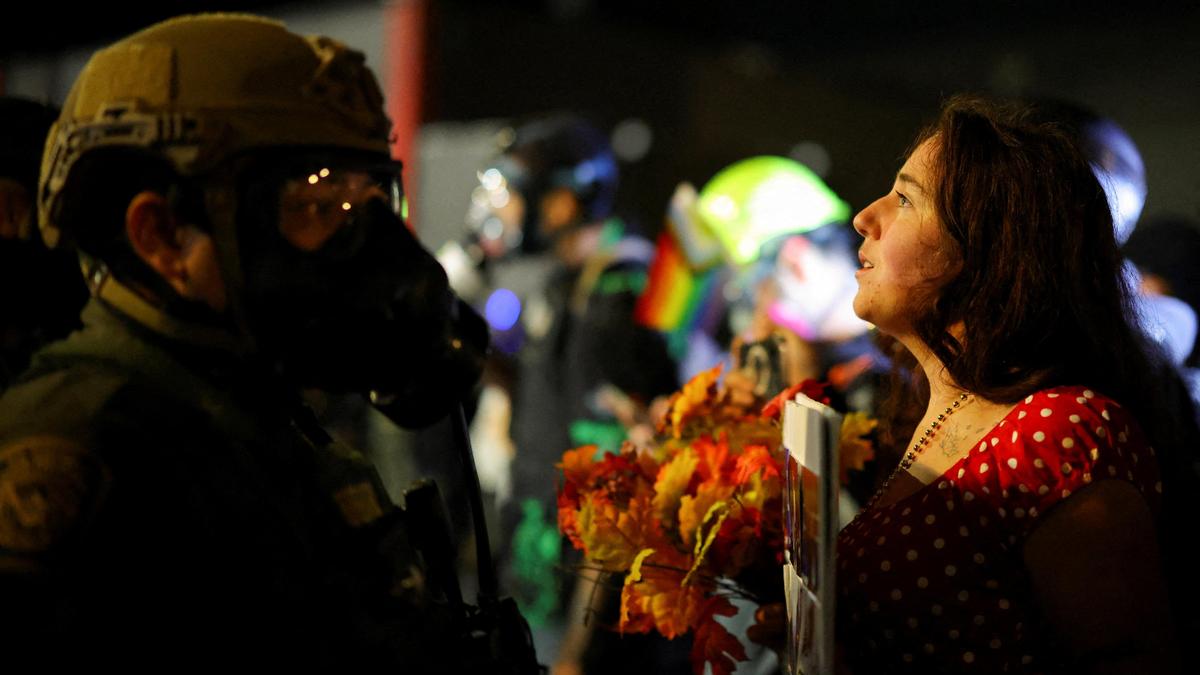
A divided U.S. appeals court ruled on Monday (October 20, 2025) that Donald Trump can send National Guard troops into Portland, Oregon, despite objections by the leaders of the city and state, giving the Republican president an important legal victory as he dispatches military forces to a growing number of Democratic-led locales.
A three-judge panel of the 9th U.S. Circuit Court of Appeals granted the Justice Department’s request to put on hold a Judge’s order that had blocked the deployment while a legal challenge to Mr. Trump’s action plays out.
The court said that sending in the National Guard was an appropriate response to protesters, who had damaged a federal building and threatened U.S. Immigration and Customs Enforcement officers.
The unsigned majority opinion was joined by Circuit Judge Bridget Bade and Circuit Judge Ryan Nelson, who were both appointed by Trump in his first term. Nelson also wrote a concurring opinion saying courts have no ability to even review the president’s decision to send troops.
Circuit Judge Susan Graber, an appointee of Democratic President Bill Clinton, dissented. She said allowing troops to be called in response to “merely inconvenient” protests was “not merely absurd” but dangerous, and she said the full 9th Circuit should overturn the ruling before Trump has a chance to send troops.
Oregon Attorney General Dan Rayfield also called for a reconsideration by the 9th Circuit, saying the ruling puts America on a “dangerous path.”
“Today’s ruling, if allowed to stand, would give the president unilateral power to put Oregon soldiers on our streets with almost no justification,” Rayfield said.
White House spokeswoman Abigail Jackson welcomed the ruling, saying Mr. Trump had exercised his lawful authority to protect federal assets and personnel from protesters.
Mr. Trump has asked the U.S. Supreme Court to weigh his authority to send troops to Democratic-led cities, after another U.S. appeals court ruled against his decision to send troops to Chicago.
Judges divided on whether deployment is required
On October 4, Portland-based U.S. District Judge Karin Immergut, who is also a Trump appointee, ruled that Trump likely acted unlawfully when he ordered troops to Portland. She had blocked Mr. Trump from sending any National Guard troops to Portland at least until the end of October, and has scheduled a non-jury trial set to begin on October 29 to determine whether to impose a longer-term block.
Mr. Trump on September 27 had ordered 200 National Guard troops to Portland, continuing his administration’s unprecedented use of military personnel in U.S. cities to suppress protests and bolster domestic immigration enforcement. Mr. Trump called the city “War ravaged” and said, “I am also authorizing Full Force, if necessary.”
City and state officials sued the administration in a bid to stop the Portland deployment, arguing Mr. Trump’s action violates several federal laws that govern the use of military forces as well as the state’s rights under the U.S. Constitution’s 10th Amendment.
The lawsuit accused Mr. Trump of exaggerating the severity of protests against his immigration policies to justify illegally seizing control of state National Guard units.
Police records provided by the state showed that protests in Portland were “small and sedate,” resulting in only 25 arrests in mid-June and no arrests in the 3-1/2 months since June 19.
The National Guard serves as state-based militia forces that answer to state governors except when called into federal service by the president. In ordering troops to California, Oregon and Illinois, Mr. Trump has relied on a law – Section 12406 of Title 10 of the U.S. Code – that allows a president to deploy state National Guard to repel an invasion, suppress a rebellion or allow the President to execute the law.
In assessing Mr. Trump’s determination in September that the protests had created an “inability” to enforce federal law in Portland, the 9th Circuit judges split on what evidence should be considered.
The majority looked at evidence from June, when more active protests caused the ICE headquarters in Portland to shut down for three weeks, as well as unrelated events including a shooting at an ICE facility in Dallas.
Graber said there was no emergency in the city, because protests had been calm for several weeks before Trump sent in the troops, mostly involving people “wearing chicken suits or inflatable frog costumes” rather than the dangerous rioters described by Trump administration officials.
Immergut issued decisions against the administration on October 4 and October 5, first ruling that Mr. Trump could not take over Oregon’s National Guard and then ruling that he could not circumvent that decision by calling in National Guard troops from other states.
She said there was no evidence that recent protests in Portland rose to the level of a rebellion or seriously interfered with law enforcement, and she said Trump’s description of the city as war-ravaged was “simply untethered to the facts.”
Immergut is one of three district court judges who have ruled against Mr. Trump’s use of the National Guard, and no district court judge has yet ruled for Trump in the National Guard cases.
Published – October 21, 2025 05:47 am IST

