

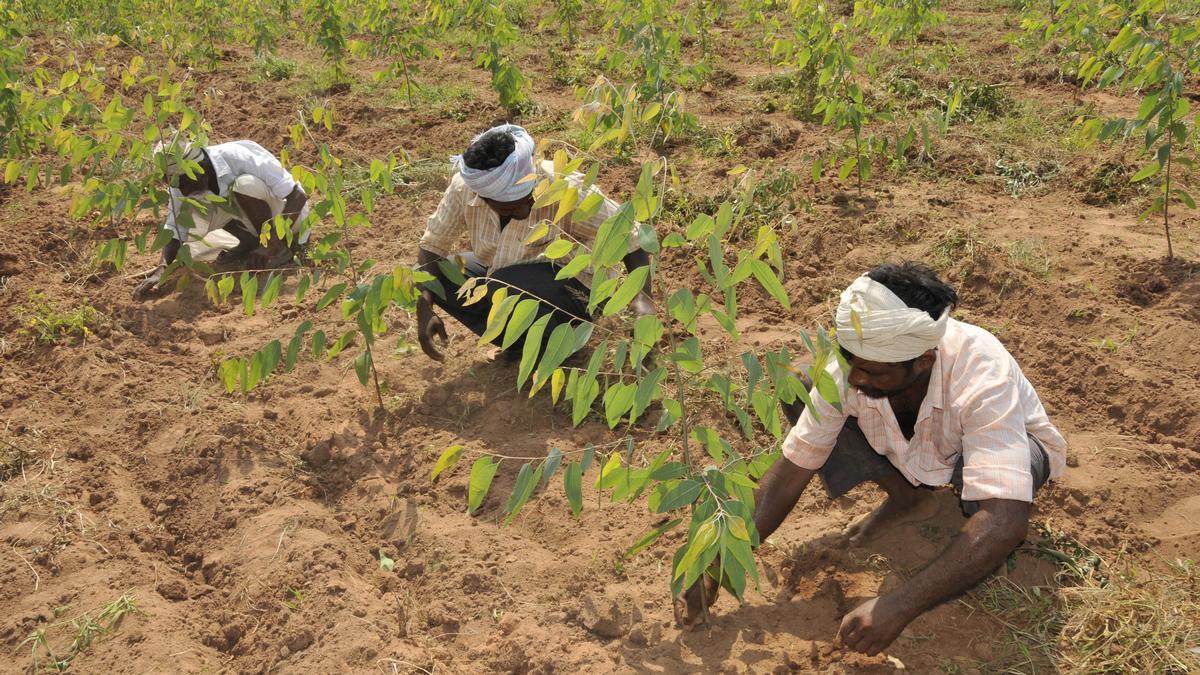
The growth-driven model of development, rooted in the Industrial Revolution, has already pushed planetary boundaries beyond safe limits. Some call for “degrowth” to address environmental damage, but this is neither just nor feasible for developing countries that are still grappling with poverty and hunger. A more equitable path lies in decoupling growth from environmental harm. In other words, countries must find ways to reduce poverty and expand their economies without repeating the high-pollution, high-emission model of the past.
This can be done by relying on cleaner technologies, renewable energy and sustainable farming practices. In India, for instance, the rapid expansion of solar energy and micro-irrigation illustrate how growth and sustainability can go hand in hand.
On carbon credit
Carbon crediting is one such tool. A carbon credit represents a certified reduction or removal of greenhouse gases, expressed in carbon dioxide (CO2) -equivalents. These can be generated through mitigation activities such as renewable energy or sequestration efforts such as reforestation, agroforestry and biochar. Firms buy them to offset emissions while transitioning to cleaner processes, ideally rewarding developing countries for adopting low-carbon practices.
Carbon credits are booming, with 175 million–180 million retired annually, primarily from renewable energy and nature-based projects such as REDD+ and afforestation. India is also building its own carbon market through the Carbon Credit Trading Scheme (CCTS). The scheme will set emission-intensity benchmarks for energy-intensive sectors and include voluntary offsets. A national registry and trading platform will manage transactions, with draft methods for biomass, compressed biogas, and low-emission rice cultivation already released.
Globally, agriculture-based projects lag despite high potential. Of 64 Indian agricultural projects listed under Verra, only four are registered and none has issued credits. CIMMYT’s research links this to weak farmer engagement, training and follow-up, especially among smallholders and marginalised caste groups.
Carbon markets and the risk of exploitation
Carbon projects are meant to reward communities at the frontlines of climate action. But without safeguards, they risk replicating extractive power structures, echoing the logic of colonial plantations. Rising carbon prices only heighten this risk. The Northern Kenya Rangelands Carbon Project offers a cautionary tale. Launched in 2012, it spanned 1.9 million hectares and sought to remove 50 million tonnes of CO2 over 30 years. Though framed as community-led, the project has drawn scrutiny for bypassing consent and weakening local land rights, raising critical questions about who truly controls and benefits from carbon projects. The project introduced rotational grazing and rangeland restoration, but cracks soon appeared.
In 2023, Verra suspended credit issuance after advocacy groups highlighted flaws in soil carbon measurement and a lack of free, prior, and informed consent (FPIC) from indigenous communities. Petitioners alleged that the conservancies were created without public consultation, on unregistered community land, and enforced through armed rangers. In 2025, a Kenyan court confirmed that key conservancies had bypassed public participation, prompting a second suspension by Verra. Community conservancies, common across Kenya, are locally managed bodies meant to promote sustainability and protect livelihoods through elected governance. In principle, they embody decentralised, community-driven resource management. Critics argue that the project’s top-down grazing restrictions and opaque governance structures mirror colonial-era resource control, infringing on pastoralist land rights and underscoring the urgent need for community-led, decolonised carbon initiatives.
Similarly, the Lake Turkana Wind Power project (Kenya) fenced 1,50,000 acres of community rangeland, cutting off herders from grazing routes and water; it raised the question of whether sustainability is advancing at the expense of the vulnerable.

India could face similar risks. Carbon projects in afforestation, reforestation and agriculture often extend into areas with customary land use. Plantations on village commons or forest fringes could disrupt access to grazing, fuelwood and forest produce without community consent. Agricultural projects have already shown signs of bypassing marginalised caste farmers while delivering few benefits. The Kenyan judgment is a timely warning: unless land rights, consent and fair benefit-sharing are secured, India’s carbon market risks reproducing extractive models under the guise of climate action.
Why carbon projects are vulnerable
Carbon projects can slip into “modern plantations” when powerful companies dominate and local communities are sidelined. In India, farmers and tribal communities often face information and power asymmetries that enable opaque deals and unfair benefit-sharing. Developers are not required to disclose benefit-sharing arrangements, and practices are often imposed top-down, with little regard for local contexts or consent.
India’s Carbon Credit Trading Scheme, while ambitious, focuses mainly on procedures and compliance, with scant attention to land rights, FPIC, and equitable revenue distribution. These blind spots may expose vulnerable groups to exclusion and exploitation as the market expands.
Overregulation is not the solution, as burdensome legal frameworks could discourage even well-intentioned actors. What India needs is a balanced, lightweight regulatory architecture that guarantees transparency, formalises benefit-sharing, and protects community rights, without creating bureaucratic choke points.
Achieving this will require stakeholder consultation, adaptive regulation and a clear-eyed recognition of risks. Only then can India build trust and integrity in its carbon market while ensuring that climate action does not come at the cost of justice.
K.S. Aditya is a Scientist at the Indian Council of Agricultural Research-Indian Agricultural Research Institute (ICAR-IARI), New Delhi. Adeeth A.G. Cariappa is an Environmental and Resource Economist at the International Maize and Wheat Improvement Center (CIMMYT)-India
Published – October 17, 2025 12:08 am IST

