

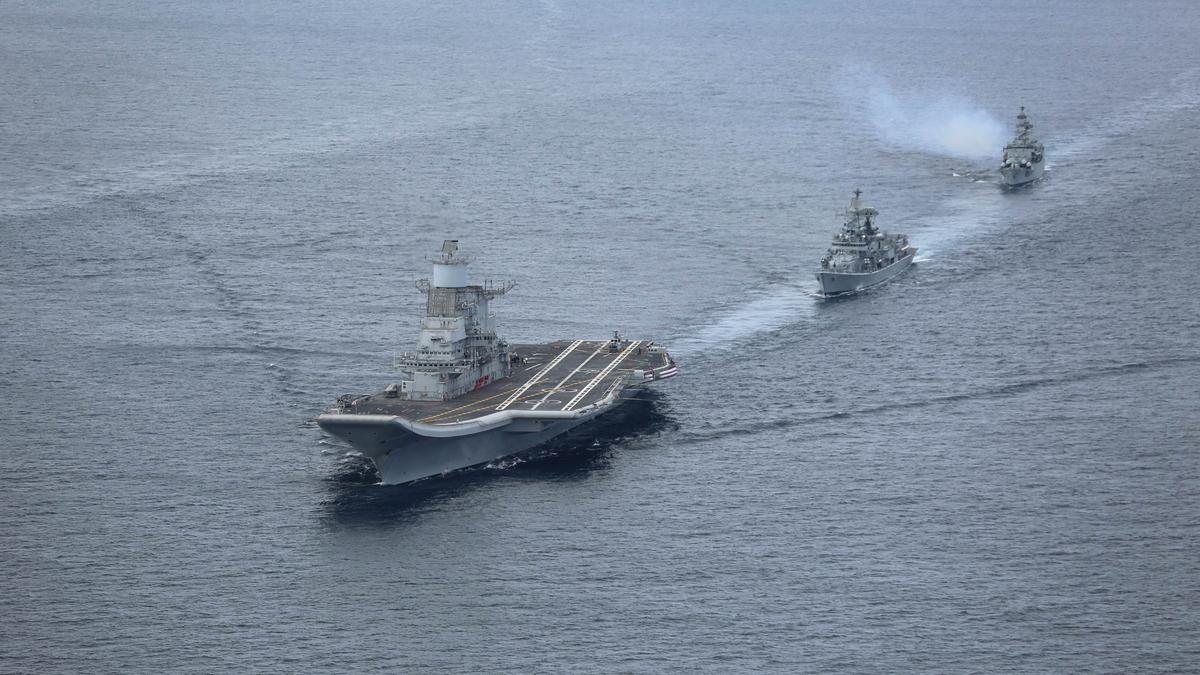
While the standoff with Pakistan in May 2025 culminated in engagement in the air domain, subsequent developments have shifted attention to the maritime theatre, as seen in key naval movements, capability demonstrations and official statements from both India and Pakistan, with their navies recalibrating posture and signalling readiness for potential escalation.
On October 2, Defence Minister Rajnath Singh, citing the 1965 war, warned Pakistan of a “resounding response” that could alter its “history and geography” should any misadventure occur in the Sir Creek area — Pakistan is expanding military infrastructure in the region, a development that has been ongoing since 2023. Historically, Pakistan has had a perceived military edge in the area. This follows the statement in August by the Chief of Naval Staff, Admiral Dinesh Tripathi, that the service would be the first to take action against Pakistan in any future conflict. Operation Sindoor itself was described as designed for a naval forward deterrent posture, highlighting a readiness for a ‘more active role’ than during the standoff in May. Induction of the first indigenously designed diving support vessel, INS Nistar, and India’s first joint patrols with the Philippines in the South China Sea reflect both capacity-building and alignment with a wider Indo-Pacific strategy, where a Chinese presence at Karachi and Gwadar remains a key factor.
Pakistan has also reinforced its maritime signalling. In May, it dispersed assets from Karachi to Gwadar to mitigate vulnerability. Since then, it has launched the Chinese-built Hangor-class submarine, PNS Mangro, and showcased the domestically developed P282 ship-launched ballistic missile. In the months after, there have also been overlapping NOTAMs, missile tests and live-fire drills — at times just 60 nautical miles apart — sustaining a cycle of alerts and operational friction in the Arabian Sea.
Strategic weight of naval signalling
The surge of naval activity following Operation Sindoor raises a fundamental question of whether these parallel exercises are mere routine activities or a calculated show of force implying a shift in the India-Pakistan deterrence equation in the naval domain. The answer matters because the current crisis, while resolved in the air domain, has left behind a residue of strategic uncertainty at sea. India and Pakistan appear to be recalibrating their naval postures, preparing not just for deterrence but also for the possibility that the next phase of confrontation could unfold in the maritime theatre.
This shift must also be understood against the broader balance of capabilities. Much like the air domain, the maritime balance can no longer be assumed to mirror the asymmetries of Kargil in 1999, or India’s decisive superiority of 1971. India retains numerical and geographical advantages, but its naval fleet is aging, raising modernisation concerns. Pakistan is steadily expanding capabilities, inducting Chinese-designed submarines and Babur-class corvettes from Türkiye. With advanced radar, electronic warfare suites, and versatile anti-air and anti-surface weaponry, these assets are significant.
Acknowledging this shift, India’s Navy Chief had also pointed to the “surprising growth” of Pakistan’s naval fleet. While India’s edge may still endure, the gap is narrowing, complicating assumptions of uncontested dominance in the Indian Ocean. Taken together, these developments are important for three reasons: escalation control, external involvement and shifting doctrines on both sides.
First, escalation control is far harder at sea. Unlike aerial skirmishes that may be calibrated and walked back, any naval engagement (ship-on-ship or ship-on-land) would carry a higher risk of crossing the war threshold. Memories of 1971, when Indian naval operations decisively tilted the conflict, add extra sensitivity — even limited maritime action is associated with existential risk in Pakistan’s strategic imagination. Since then, Pakistan’s core maritime concern has been to avert a recurrence of its vulnerability to Indian naval operations, seen in its pursuit of anti-access/area-denial (A2/AD) capabilities and gradual articulation of a doctrine oriented toward deterrence-by-denial.
The development of Gwadar under the China-Pakistan Economic Corridor framework must also be understood within this deterrence logic. Pakistan’s decision-makers have for long said that Gwadar’s origins lay in Islamabad’s own strategic calculations than in Beijing’s. Thus, Gwadar and Karachi seem more than operational or economic hubs — they are also psychological pressure points. Against this backdrop, should the Indian Navy be drawn into direct operations in future, space for coercion short of war would shrink drastically, with India also having to consider the presence and stakes of the People’s Liberation Army Navy (PLAN).
External dimension
Second, parallel exercises and missile tests by both sides may reflect more than isolated drills, pointing to deliberate efforts to demonstrate readiness and complicate the adversary’s planning cycle. For India, the pattern may suggest an effort to maintain pressure and shape the post-crisis narrative, reflecting unease with how the post-Sindoor outcome has been perceived. Pakistan has sought to underscore the point that its Navy is no longer the vulnerable force of 1971 and is signalling preparedness to deter coercion and complicate Indian operational planning in the maritime domain. India appears intent on retaining the initiative through visible demonstrations of capability and risk acceptance. This parallelism suggests that both sides may signal preparedness and also be actively invested in shaping a future “conflict-template” at sea.
Third, the external dimension is sharpening. Chinese involvement in the Karachi and Gwadar ports erodes India’s assumed dominance by raising the spectre of PLAN support to Pakistan in crisis. Türkiye’s emerging role, even if limited to supply or training, adds another layer of uncertainty.
These shifts matter because they change how coercion and deterrence work. It has been reported that Indian deployments had forced Pakistan to disperse its fleet from Karachi, demonstrating dominance and imposing psychological costs without triggering escalation, but that playbook may no longer work. At the same time, projections of recent procurements and high-profile inductions may have fuelled expectations of a more prominent naval role in the future, creating a dilemma — the coercive option may be narrowing, but the pressure to use it is increasing.
Finally, there may also be the problem of strategic drift. Both militaries appear to be operating on precedents from past crises, even as new capabilities from hypersonic missiles to drones are altering the escalatory ladder. If crisis decision-making remains anchored in outdated assumptions, the risk of miscalculation grows. In effect, the maritime theatre is becoming the space where this cognitive gap will be tested.
The broad view
The naval element of the next India-Pakistan crisis is unlikely to remain peripheral. Both sides may not just be testing platforms but also signalling thresholds at sea, where risks of miscalculation are qualitatively different from the air domain. Unlike air skirmishes, naval deployments linger, continuously, shaping perceptions of intent and resolve.
Yet, paradoxically, this very pattern may also carry stabilising effects. By testing and observing each other’s tactics, manoeuvres, and novel applications of capability, both navies are building mutual awareness that may, over time, reduce the fog of war. In this sense, the Indian Navy may be acquiring insights into its Pakistani counterpart in a way the Air Force arguably could not prior to Operation Sindoor.
For India, the challenge will be to decide whether to treat the maritime theatre as an arena for early signalling or hold it back as a reserve domain of escalation. The commissioning of stealth frigates, emphasis on joint patrols in the wider Indo-Pacific, and drive for indigenous capacity suggest that New Delhi is preparing for both possibilities: an expanded regional role and a crisis-specific coercive lever. The question then remains whether the Navy will be drawn into frontline operations earlier than in the past.
Hely Desai is a Research Associate at the Council for Strategic and Defense Research, New Delhi
Published – October 04, 2025 12:16 am IST

