

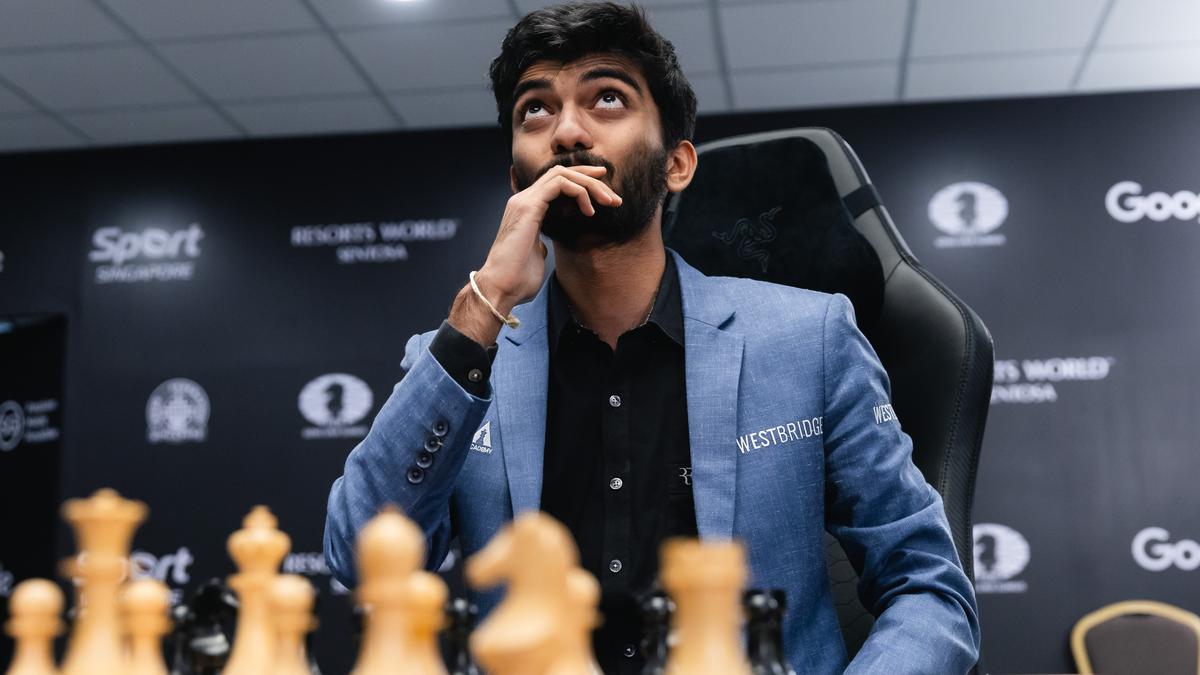
Gukesh celebrates after defeating Ding Liren in the 2024 World Chess Championship in Singapore on December 12, 2024
| Photo Credit: Eng Chin An
At certain points in sporting history, some remarkable events take place. So remarkable, they defy belief.
Such an event took place on a humid Thursday (December 13, 2024) evening at Equarius Hotel here in the island called Sentosa. D. Gukesh, at the age of 18, won the World chess championship.
That is, of course, a World record, which stayed with Garry Kasparov since 1985. He was 22 when he won the World championship after beating fellow Soviet Union player Anatoly Karpov in an epic, bitter battle that lasted over a year.

Now, the World chess championship is one of the hardest things to win in international sport.
It is played over a long series of matches that test the mental endurance to the maximum, not to mention the physical exertion.
EDITORIAL | A legend, made: On D. Gukesh, the world’s youngest chess champion
The defending champion is seeded directly to the title match, while the challenger has to win the qualifying tournament called the Candidates. And to make it to the Candidates, a player has to come through a long, tough process.
When Gukesh won the Candidates, he became the youngest challenger. Now the question was if he could become the youngest champion.
The answer came this unforgettable evening for Indian sport.
After Gukesh made his 58th move with his king, Ding, the 17th World champion and the first from China, resigned in a hopeless position, conceding defeat.

Gukesh wept. He wept in joy. Much in contrast to what happened a day earlier, when he had to agree to draw, after squandering a winning chance.
It was indeed a great escape for Ding. And that wasn’t the first time he was doing it here.
Somehow, when he seemed on the brink, on the board, and on the clock, he would find the right move – even if it was the only move and any other would have doomed him. Like he did with his rook in Game 13.
But in Game 14, after he blundered with his rook – yes, the very piece – he had no chance. There was no scope for yet another Houdini act.
Heading for a draw
The game was heading towards a draw – and that meant the match could go to the tie-breaks on Friday – in an ending featuring rook-and-same-coloured bishops.
Gukesh had an extra pawn, but that wasn’t going to be enough.
The only possibility of a decisive result was a big blunder.
That was what happened when Ding took his rook to the ‘f2’ square on the 55th move. He could have taken the rook to another square, or he could have played with his bishop, and he would have been safe.
Gukesh exchanged the rooks straight away and then the bishops too left the board. Now he had the clearly winning position.
Ding’s king and lonely pawn were no match to Gukesh’s king and two connected pawns. A visibly shaken Ding realised that the crown was slipping away. He was crowned last year after beating Ian Nepomniachtchi in a tie-breaker, and he must have been hoping that history would repeat itself.
He had not only more experience than his younger opponent, he also has a distinctly better record in speed chess.
So it wasn’t surprising to see him play for a position that could have given him a draw. But Gukesh has been playing uncompromising chess here.
He has refused virtual offers of draw, and has chosen to play on from drawish positions. And yes, he was lucky on this day.
But he has earned his luck. Surely.
The Moves: Game 14
Ding vs Gukesh
1. Nf3 d5 2. g3 c5 3. Bg2 Nc6 4. d4 e6 5. 0–0 cxd4 6. Nxd4 Nge7 7. c4 Nxd4 8. Qxd4 Nc6 9. Qd1 d4 10. e3 Bc5 11. exd4 Bxd4 12. Nc3 0–0 13. Nb5 Bb6 14. b3 a6 15. Nc3 Bd4 16. Bb2 e5 17. Qd2 Be6 18. Nd5 b5 19. cxb5 axb5 20. Nf4 exf4 21. Bxc6 Bxb2 22. Qxb2 Rb8 23. Rfd1 Qb6 24. Bf3 fxg3 25. hxg3 b4 26. a4 bxa3 27. Rxa3 g6 28. Qd4 Qb5 29. b4 Qxb4 30. Qxb4 Rxb4 31. Ra8 Rxa8 32. Bxa8 g5 33. Bd5 Bf5 34. Rc1 Kg7 35. Rc7 Bg6 36. Rc4 Rb1+ 37. Kg2 Re1 38. Rb4 h5 39. Ra4 Re5 40. Bf3 Kh6 41. Kg1 Re6 42. Rc4 g4 43. Bd5 Rd6 44. Bb7 Kg5 45. f3 f5 46. fxg4 hxg4 47. Rb4 Bf7 48. Kf2 Rd2+ 49. Kg1 Kf6 50. Rb6+ Kg5 51. Rb4 Be6 52. Ra4 Rb2 53. Ba8 Kf6 54. Rf4 Ke5 55. Rf2 55…Rxf2 56. Kxf2 Bd5 57. Bxd5 Kxd5 58. Ke3 Ke5
White resigned
Published – December 13, 2024 10:59 am IST

